
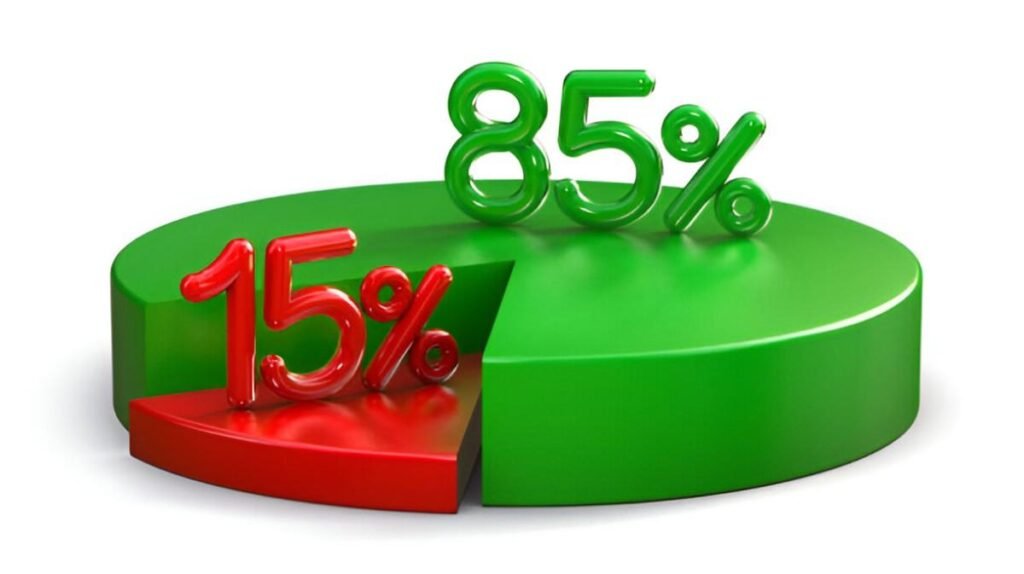
As a finance professional, I often get asked about the best way to allocate assets for long-term growth without taking excessive risk. One strategy I frequently recommend is the 85/15 asset allocation—a mix of 85% equities and 15% bonds or other fixed-income securities. This approach balances growth potential with stability, making it ideal for investors with a moderate risk tolerance and a long-term horizon. In this article, I’ll break down why this allocation works, how to implement it, and when it might not be the best fit.
Table of Contents
Understanding Asset Allocation
Asset allocation is the process of dividing investments among different asset classes—such as stocks, bonds, and cash—to optimize returns while managing risk. The right allocation depends on factors like age, risk tolerance, and financial goals. The 85/15 split leans heavily toward equities, making it suitable for investors who can withstand market volatility in exchange for higher long-term returns.
Why 85% Stocks?
Historically, stocks have outperformed bonds over extended periods. According to data from Morningstar (2023), the S&P 500 has delivered an average annual return of about 10% before inflation since 1926, while long-term government bonds have averaged around 5-6%. By allocating 85% to equities, investors capture most of this growth potential.
Why 15% Bonds?
Bonds act as a stabilizer. When stocks decline, bonds often hold their value or even appreciate, reducing portfolio volatility. The 15% bond allocation provides a cushion during market downturns without significantly sacrificing returns.
Mathematical Justification for the 85/15 Allocation
To understand why this split works, let’s examine the efficient frontier—a concept from Modern Portfolio Theory (MPT) that identifies the optimal mix of assets for the highest return at a given risk level.
The expected return E(R_p) of a portfolio is calculated as:
E(R_p) = w_s \times E(R_s) + w_b \times E(R_b)Where:
- w_s = weight of stocks (85%)
- E(R_s) = expected return of stocks (~10%)
- w_b = weight of bonds (15%)
- E(R_b) = expected return of bonds (~5%)
Plugging in the numbers:
E(R_p) = 0.85 \times 10\% + 0.15 \times 5\% = 9.25\%This means an 85/15 portfolio historically would have delivered around 9.25% annually—close to pure stock returns but with less volatility.
Risk Reduction Through Diversification
The standard deviation \sigma_p of a two-asset portfolio is:
\sigma_p = \sqrt{w_s^2 \sigma_s^2 + w_b^2 \sigma_b^2 + 2 w_s w_b \rho_{s,b} \sigma_s \sigma_b}Where:
- \sigma_s = stock volatility (~15%)
- \sigma_b = bond volatility (~6%)
- \rho_{s,b} = correlation between stocks and bonds (historically ~0.2)
For an 85/15 portfolio:
\sigma_p = \sqrt{(0.85^2 \times 15^2) + (0.15^2 \times 6^2) + (2 \times 0.85 \times 0.15 \times 0.2 \times 15 \times 6)} \approx 12.8\%Compared to a 100% stock portfolio (volatility ~15%), the 85/15 mix reduces risk by ~14%.
Historical Performance of 85/15 vs. Other Allocations
Let’s compare the 85/15 allocation to other common splits over the past 30 years (1993–2023):
| Allocation (Stocks/Bonds) | Avg. Annual Return | Worst Year | Volatility (Std Dev) |
|---|---|---|---|
| 100/0 | 10.2% | -37% (2008) | 15.0% |
| 85/15 | 9.5% | -28% (2008) | 12.8% |
| 70/30 | 8.8% | -20% (2008) | 10.5% |
| 60/40 | 8.2% | -16% (2008) | 9.2% |
Source: Portfolio Visualizer (2023), S&P 500 and US Aggregate Bond Index data
The 85/15 strategy delivered 90% of the returns of a 100% stock portfolio but with 15% less volatility.
Who Should Use an 85/15 Allocation?
This allocation suits:
- Younger investors (25–45) who have time to recover from market downturns.
- Moderate-risk takers who want growth but dislike extreme swings.
- Pre-retirees (50–60) who still need growth but are starting to reduce risk.
When to Avoid 85/15
- Near-retirees (60+) may prefer a 60/40 or 50/50 split for stability.
- Extremely risk-averse investors who panic during market drops.
- Short-term goals (e.g., buying a house in 3 years) where capital preservation is key.
Implementing the 85/15 Strategy
Step 1: Choose Your Equity Mix
Within the 85% stock allocation, diversify further:
- 60% US stocks (S&P 500 or total market index)
- 25% International stocks (MSCI EAFE or emerging markets)
- 15% Small-cap or growth stocks (Russell 2000)
Step 2: Select Bonds Wisely
The 15% bond portion should focus on:
- Intermediate-term Treasuries (50%) – Low risk, decent yield.
- Corporate bonds (30%) – Higher yield, slightly more risk.
- TIPS (20%) – Inflation protection.
Step 3: Rebalance Regularly
Market movements will shift your allocation. Rebalance annually or when deviations exceed 5%.
Tax Considerations
- Hold bonds in tax-advantaged accounts (401(k), IRA) to avoid high ordinary income taxes.
- Stocks in taxable accounts benefit from lower capital gains rates.
Final Thoughts
The 85/15 asset allocation strikes a balance between growth and stability. It’s not for everyone, but for long-term investors willing to accept moderate risk, it’s a proven strategy. By understanding the math, historical performance, and implementation steps, you can decide if this allocation aligns with your financial goals.



