
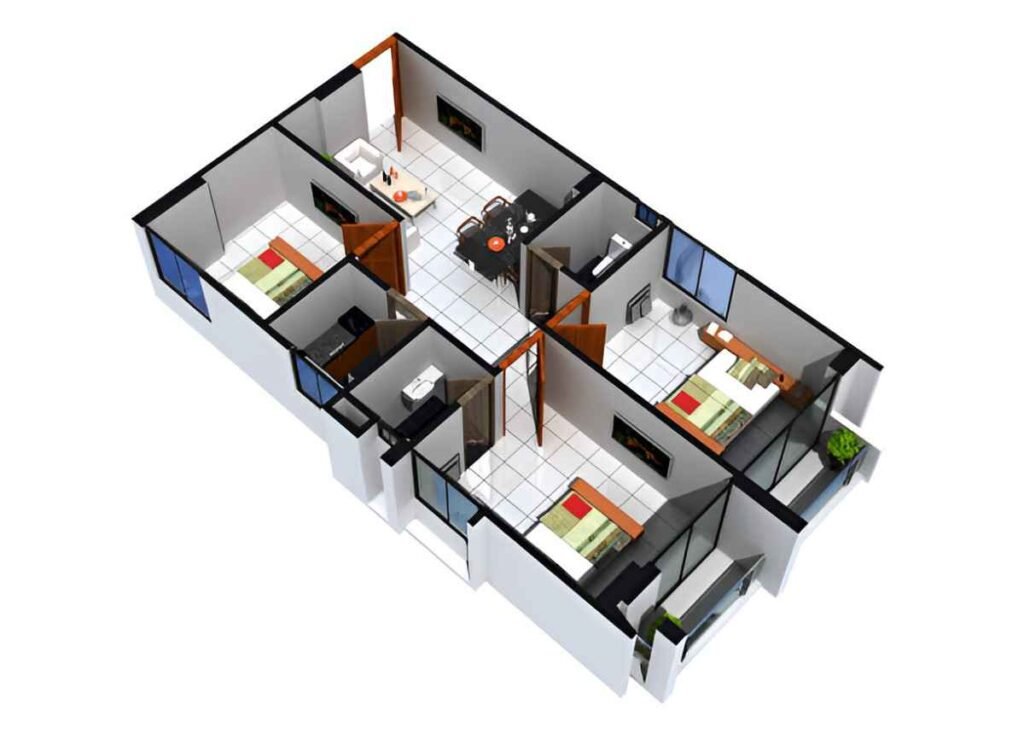
As a finance and investment expert, I often analyze how housing choices impact long-term retirement security. A well-designed 3-bedroom retirement house can balance space, cost, and functionality while ensuring financial sustainability. In this guide, I explore the financial, architectural, and lifestyle considerations of 3-bedroom retirement homes, complete with calculations, comparisons, and real-world examples.
Table of Contents
Why a 3-Bedroom Retirement Home?
Many retirees assume downsizing means moving to a smaller home, but a 3-bedroom house offers flexibility. The extra rooms can serve as guest bedrooms, home offices, or hobby spaces. According to the National Association of Home Builders (NAHB), 58% of buyers aged 55+ prefer 3-bedroom homes for their versatility.
Financial Considerations
The cost of a retirement home depends on location, materials, and design. Let’s break down the financial aspects:
1. Construction Costs
The average cost to build a home in the U.S. is $150 - $200 per square foot. A 1,800 sq. ft. 3-bedroom home would cost:
1800 \text{ sq. ft.} \times \$175 \text{ per sq. ft.} = \$315,000However, costs vary by region:
| Region | Cost per Sq. Ft. | Total Cost (1,800 sq. ft.) |
|---|---|---|
| Midwest | $130 | $234,000 |
| South | $160 | $288,000 |
| Northeast | $220 | $396,000 |
| West | $250 | $450,000 |
2. Mortgage vs. Cash Purchase
If financing, a 30-year mortgage at 4.5% interest on a $300,000 home with a 20% down payment ($60,000) results in a monthly payment of:
M = P \times \frac{r(1 + r)^n}{(1 + r)^n - 1}Where:
- P = \$240,000 (loan amount)
- r = \frac{0.045}{12} = 0.00375 (monthly interest rate)
- n = 360 (number of payments)
Plugging in the values:
M = 240,000 \times \frac{0.00375(1 + 0.00375)^{360}}{(1 + 0.00375)^{360} - 1} = \$1,216.04Retirees must assess whether this fits their budget, especially if relying on fixed-income sources like Social Security or pensions.
Optimal Layouts for Retirement Living
A well-designed 3-bedroom retirement home should prioritize:
- Single-story living (avoiding stairs reduces fall risks)
- Wider doorways and hallways (for wheelchair accessibility)
- Low-maintenance materials (vinyl siding, composite decking)
Example Floor Plan Comparison
| Feature | Traditional Home | Retirement-Optimized Home |
|---|---|---|
| Bedrooms | 3 (upstairs) | 3 (all on main floor) |
| Bathrooms | 2.5 | 2 (both wheelchair-accessible) |
| Garage | 2-car attached | 2-car with ramp entry |
| Lot size | 0.25 acres | 0.15 acres (less upkeep) |
Tax and Insurance Implications
Property taxes and insurance vary by state. For example:
- Texas has high property taxes (~2%) but no state income tax.
- Florida offers homestead exemptions, reducing taxable value.
If a retiree buys a $300,000 home in Texas:
\text{Annual Property Tax} = 300,000 \times 0.02 = \$6,000In Florida, with a $50,000 homestead exemption:
\text{Taxable Value} = 300,000 - 50,000 = 250,000
\text{Annual Property Tax} = 250,000 \times 0.018 = \$4,500Long-Term Value Appreciation
Historically, U.S. homes appreciate at ~3.5% annually. A $300,000 home could be worth:
FV = PV \times (1 + r)^nWhere:
- FV = Future Value
- PV = 300,000
- r = 0.035
This growth can supplement retirement wealth, but retirees should also consider selling costs (~6% commission).
Alternatives: Building vs. Buying Existing
| Factor | Building New | Buying Existing |
|---|---|---|
| Cost | Higher upfront | Lower (possible renovations) |
| Customization | Full control | Limited by current structure |
| Time | 6-12 months | 30-60 days (closing period) |
Final Thoughts
A 3-bedroom retirement home balances space, practicality, and investment potential. By analyzing costs, layouts, and location-specific factors, retirees can make informed decisions that align with their financial goals. Whether building new or renovating, the right home can enhance quality of life while preserving wealth.
Would you prefer a custom build or an existing property? Let me know your thoughts in the comments.



