
Introduction
For many Americans, retirement is not only a financial milestone but also a lifestyle transition. Choosing the right home becomes central to this next phase of life, and for those drawn to the water, coastal retirement house plans are especially appealing. A coastal retirement home blends comfort, accessibility, and functionality with the beauty and tranquility of oceanfront or near-shore living.
Designing or selecting a coastal retirement house plan requires balancing multiple factors: climate resilience, aging-in-place features, budget, community amenities, and long-term maintenance costs. This article explores the elements of coastal retirement home planning from both architectural and financial perspectives, offering examples, comparisons, and practical considerations for retirees in the U.S.
Why Retirees Choose Coastal Homes
- Lifestyle Appeal
- Oceanfront or coastal living promotes relaxation, outdoor activities, and scenic beauty.
- Access to beaches, boating, and walking trails aligns with an active retirement.
- Climate and Weather
- Warmer climates appeal to retirees escaping harsh northern winters.
- Coastal breezes often moderate extreme heat compared to inland areas.
- Community and Services
- Many coastal towns cater to retirees with healthcare facilities, social clubs, and senior services.
- Property Value
- Coastal real estate can hold long-term value, though it also carries risks such as hurricanes and flooding.
Key Design Features in Coastal Retirement House Plans
1. Aging-in-Place Design
- Single-level layouts to avoid stairs.
- Wide hallways and doorways to accommodate walkers or wheelchairs.
- Walk-in showers with seating and grab bars.
- Open floor plans for visibility and mobility.
2. Coastal-Specific Features
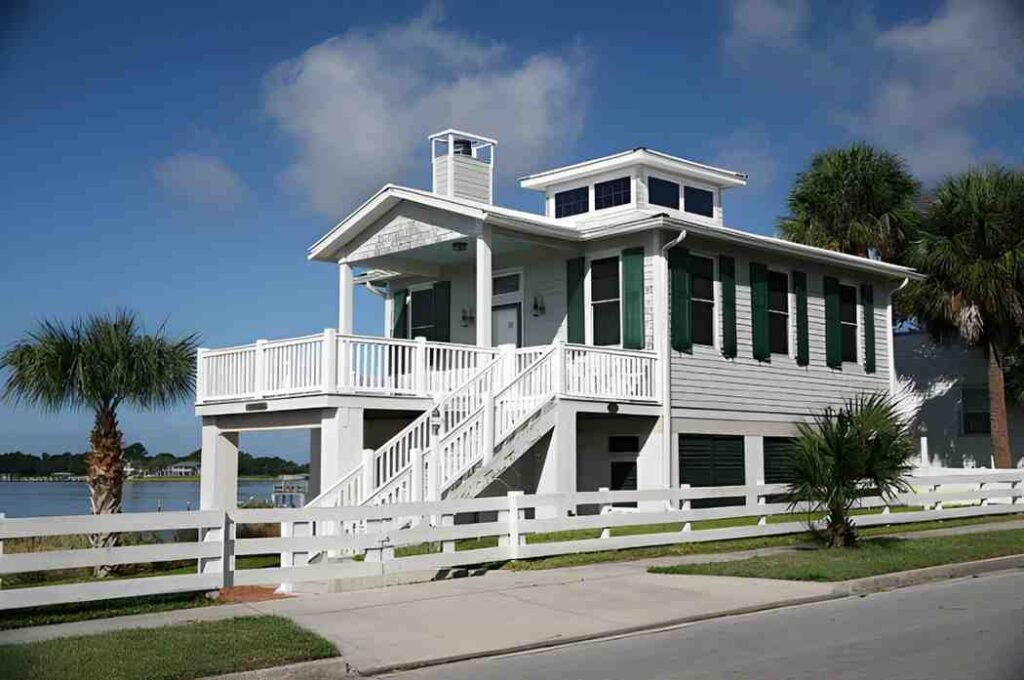
- Elevated foundations to reduce flood risk.
- Storm-resistant windows and roofing.
- Durable materials like fiber cement siding, stainless steel fixtures, and moisture-resistant flooring.
3. Lifestyle Amenities
- Screened porches or decks with ocean views.
- Outdoor kitchens or shaded patios.
- Guest rooms for family visits.
Example: Coastal Retirement House Plan
- Size: 1,800 sq. ft.
- Layout: 3 bedrooms, 2 bathrooms, open kitchen-living area.
- Accessibility: Single-story with wide entrances.
- Coastal protection: Built on pilings 8 feet above grade.
- Estimated build cost: $250 per sq. ft. → 1,800 \times 250 = 450,000.
If purchased with a 30% down payment:
- Down payment = 450,000 \times 0.30 = 135,000.
- Mortgage = $315,000.
- At 6% for 30 years, monthly payment ≈ 315,000 \times \frac{0.06}{1 - (1.06)^{-360}} \approx 1,889.
This illustrates how affordability planning intersects with architectural choices.
Comparing Coastal Retirement House Styles
| Style | Pros | Cons |
|---|---|---|
| Cottage/Bungalow | Cozy, efficient, ideal for downsizing | Limited space for guests |
| Raised Beach House | Strong flood protection, views | Requires stairs or elevator |
| Modern Open Plan | Spacious, adaptable | Higher cost of materials |
| Duplex/Condo Unit | Community amenities, low maintenance | HOA fees, less privacy |
Financial Considerations
- Insurance Costs
- Coastal homes often require flood insurance and windstorm coverage.
- Premiums can be significant, sometimes $5,000–$10,000 annually depending on location.
- Property Taxes
- Coastal properties in high-demand states like Florida or California can have high property taxes.
- Retirees should evaluate tax-friendly states (e.g., Florida, South Carolina).
- Maintenance
- Salt air accelerates corrosion and weathering.
- Annual maintenance costs may run 1–2% of property value.
- Resale Value
- Desirable coastal locations often hold or increase in value.
- However, climate change and sea-level rise may affect long-term appreciation.
Example: Maintenance Budgeting
If a retiree owns a $600,000 coastal home, annual maintenance at 1.5% = 600,000 \times 0.015 = 9,000.
Combined with insurance ($7,500) and property tax ($6,000), annual non-mortgage costs = $22,500. This must be factored into retirement income planning.
Coastal Retirement Destinations
- Florida Panhandle – Affordable, warm, with strong retiree communities.
- Carolinas – Myrtle Beach and Outer Banks offer lifestyle amenities with moderate costs.
- Gulf Coast (Texas, Alabama) – Lower property taxes compared to East Coast.
- Pacific Northwest – Cooler climate with scenic coastlines, higher construction costs.
- New England – Historic coastal towns, though with higher taxes and seasonal weather.
Risk Management for Coastal Retirement Homes
- Flood and Storm Preparedness: Elevated homes and reinforced structures reduce risk.
- Diversification of Assets: Retirees should not over-concentrate wealth in coastal property.
- Estate Planning: Properties in desirable locations may serve as legacy assets for heirs.
Conclusion
Coastal retirement house plans combine lifestyle aspirations with practical financial planning. The most successful designs balance accessibility for aging-in-place, resilience against coastal weather, and affordability within retirement income streams. While the appeal of oceanfront living is strong, retirees must carefully weigh insurance, maintenance, and climate risks against the value of coastal living. For many, a well-designed coastal retirement home represents the ideal blend of security, comfort, and beauty in their later years.



