
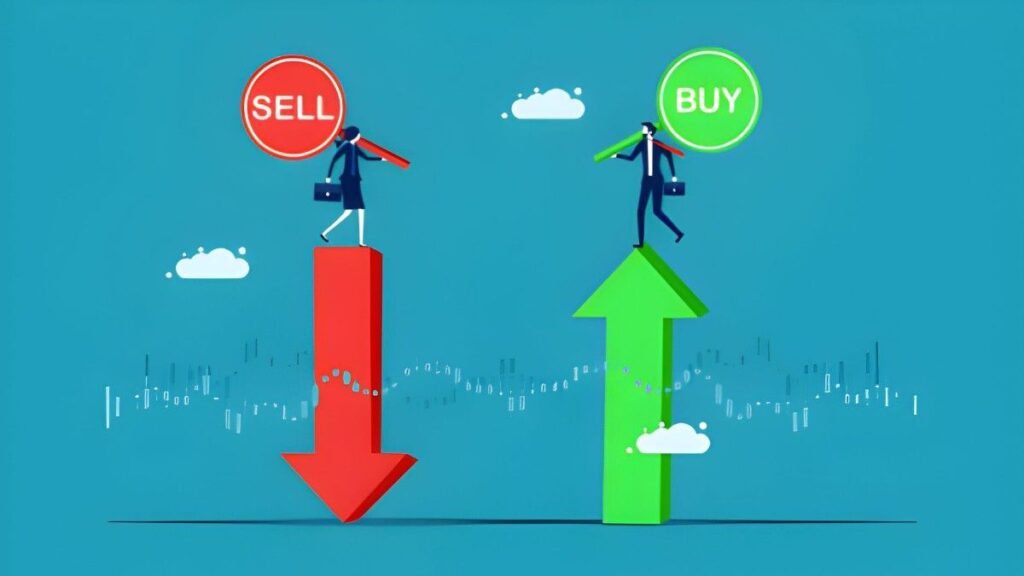
In the landscape of equity strategies, the divide between long-term investing and short-term trading is vast. But within that spectrum, two of the most commonly compared—and commonly confused—approaches are buy and hold and swing trading. From my vantage point as a financial analyst, these are not merely different strategies; they are different disciplines that appeal to different psychological profiles and operate on entirely separate principles. One is a marathon of ownership, the other is a series of calculated sprints. Understanding the core mechanics, demands, and intended outcomes of each is the first step in choosing the path that aligns with your goals, your schedule, and your emotional constitution.
Buy and hold is a long-term wealth-building strategy. An investor identifies high-quality assets—be it individual stocks with durable competitive advantages or, more commonly, low-cost index funds—and holds them for years or decades. The primary return drivers are fundamental economic growth, corporate earnings, dividends, and, most importantly, the relentless power of compound interest. The investor’s role is that of a capital allocator and owner. In stark contrast, swing trading is a short-to-medium-term trading strategy designed to capture gains in an asset over a period of a few days to several weeks. Swing traders capitalize on technical analysis and market momentum to profit from the natural “swings” between optimism and pessimism that occur in any market. The trader’s role is that of a price speculator.
The Fundamental Divide: Philosophy and Time Horizon
The core difference is philosophical and is immediately apparent in the intended holding period.
Buy and Hold:
- Time Horizon: Years to Decades. The holding period is effectively “forever,” or at least until the fundamental reason for ownership dissolves.
- Philosophy: Own pieces of excellent businesses. The market’s short-term fluctuations are irrelevant noise compared to the long-term trend of economic progress and corporate profit growth.
- Analogy: Planting a sequoia tree. You plant it, ensure the conditions are right for growth, and then wait patiently for it to mature over decades.
Swing Trading:
- Time Horizon: Days to Weeks. Rarely longer than a few months. Every position has a predefined exit strategy.
- Philosophy: Price movements, driven by market psychology, follow predictable patterns. It is possible to capture a portion of a price swing without needing to hold through intermediate downtrends.
- Analogy: Surfing. You don’t own the ocean; you simply try to catch a wave at the right time and ride it until it crests, then get out and look for the next one.
The Analytical Engine: Fundamental vs. Technical
The daily activity and research focus of a practitioner in each camp are worlds apart.
Buy and Hold Analysis:
- Primary Tool: Fundamental Analysis. The investor’s research is deep and focused on business quality.
- Focus Areas: A company’s competitive moat, the strength of its balance sheet (e.g., Debt-to-Equity ratio), its free cash flow generation, the quality of its management, and its long-term industry prospects.
- Valuation: Calculating a Discounted Cash Flow (DCF) to estimate intrinsic value. The goal is to buy a dollar’s worth of assets for fifty cents.
\text{Intrinsic Value} = \sum_{t=1}^{n} \frac{CF_t}{(1 + r)^t} - Activity Level: Very low. Research is intense before the initial purchase, but then the portfolio requires minimal maintenance, perhaps a quarterly review.
Swing Trading Analysis:
- Primary Tool: Technical Analysis. The trader’s research is focused on price action and market sentiment.
- Focus Areas: Chart patterns (head and shoulders, flags, triangles), moving averages, momentum indicators (RSI, MACD), and trading volume. The underlying company’s business is largely irrelevant; it’s all about the stock’s price behavior.
- Valuation: Irrelevant. A swing trader will just as readily short an overbought, overvalued stock as go long an oversold one.
- Activity Level: High. Requires daily monitoring of open positions and the broader market to identify new setups and manage risk.
Risk Management: Two Different Worlds
How each strategy handles risk reveals its true nature.
Buy and Hold Risk Management:
- Method: Diversification. Risk is mitigated by owning a wide array of uncorrelated assets. This is why low-cost index ETFs are the preferred vehicle.
- View on Drawdowns: A 20-30% portfolio decline is considered a normal, if unpleasant, part of the market cycle. It is to be endured, as long as the fundamental thesis for ownership remains intact.
- Stop-Losses: Generally not used. Volatility is not seen as risk; permanent capital loss is.
Swing Trading Risk Management:
- Method: Position Sizing and Stop-Loss Orders. Risk is managed on a per-trade basis with surgical precision. This is non-negotiable.
- The Calculation:
- Determine maximum risk per trade (e.g., 1-2% of total capital).
- Determine share risk: \text{Entry Price} - \text{Stop-Loss Price}.
- Calculate position size: \text{Position Size} = \frac{\text{Capital to Risk}}{\text{Share Risk}}
- Example: A trader with a \text{\$100,000} account risks 1% (\text{\$1,000}) per trade. They buy a stock at \text{\$50} with a stop-loss at \text{\$48}. Their risk per share is \text{\$2}. Their position size is \frac{\text{\$1,000}}{\text{\$2}} = 500 shares. This mechanical rule prevents any single trade from causing catastrophic damage.
The Critical Impact of Costs and Taxes
This is where the mathematical advantage tilts overwhelmingly in one direction.
Transaction Costs: While commissions are now zero, the bid-ask spread remains a constant, silent cost for traders. Every entry and exit incurs this friction, which erodes profits over hundreds of trades.
Taxes: The Greatest Divider:
- Swing Trading: Profits are almost always classified as short-term capital gains, which are taxed at your ordinary income tax rate (up to 37%).
- Buy and Hold: Profits from assets held longer than one year are classified as long-term capital gains, which enjoy a preferential tax rate (typically 0%, 15%, or 20%).
Example: Two people realize a \text{\$10,000} gain.
- The Swing Trader pays \text{\$10,000} \times 0.37 = \text{\$3,700} in tax. Net gain = \text{\$6,300}.
- The Buy & Hold Investor pays \text{\$10,000} \times 0.15 = \text{\$1,500} in tax. Net gain = \text{\$8,500}.
The buy and hold investor keeps an extra \text{\$2,200} without doing any extra work. This advantage is monumental over a lifetime.
Which Approach Is Right For You?
The choice is less about which is “better” and more about which suits your identity.
| Aspect | Buy and Hold | Swing Trading |
|---|---|---|
| Time Commitment | Minimal (Hours/Year) | Significant (Hours/Week) |
| Psychological Profile | Patience, Fortitude, Discipline | Decisiveness, Detachment, Discipline |
| Primary Analysis | Fundamental | Technical |
| Tax Efficiency | Very High | Very Low |
| Success Rate | Very High (for those who stay the course) | Very Low (most retail traders lose money) |
| Primary Goal | Long-Term Wealth Building | Short-Term Income Generation |
- Choose Buy and Hold If: You are building long-term wealth for goals like retirement, you have a full-time job, you want to minimize taxes and costs, and you have the temperament to ignore market volatility. This is the strategy for the vast majority of people.
- Choose Swing Trading If: You are interested in market mechanics, you have the time to monitor positions daily, you can adhere to strict risk management rules without emotion, and you understand that you are competing against professionals. It is a demanding, high-risk endeavor that most should avoid.
In the end, buy and hold is a strategy of ownership and compounding, while swing trading is a strategy of speculation and timing. One has the overwhelming weight of historical evidence and mathematical certainty on its side. The other offers the allure of quick profits but is a proven loser’s game for all but the most skilled and disciplined participants. For a secure financial future, the choice is clear for most: embrace the slow, steady, and certain path of long-term ownership.



