
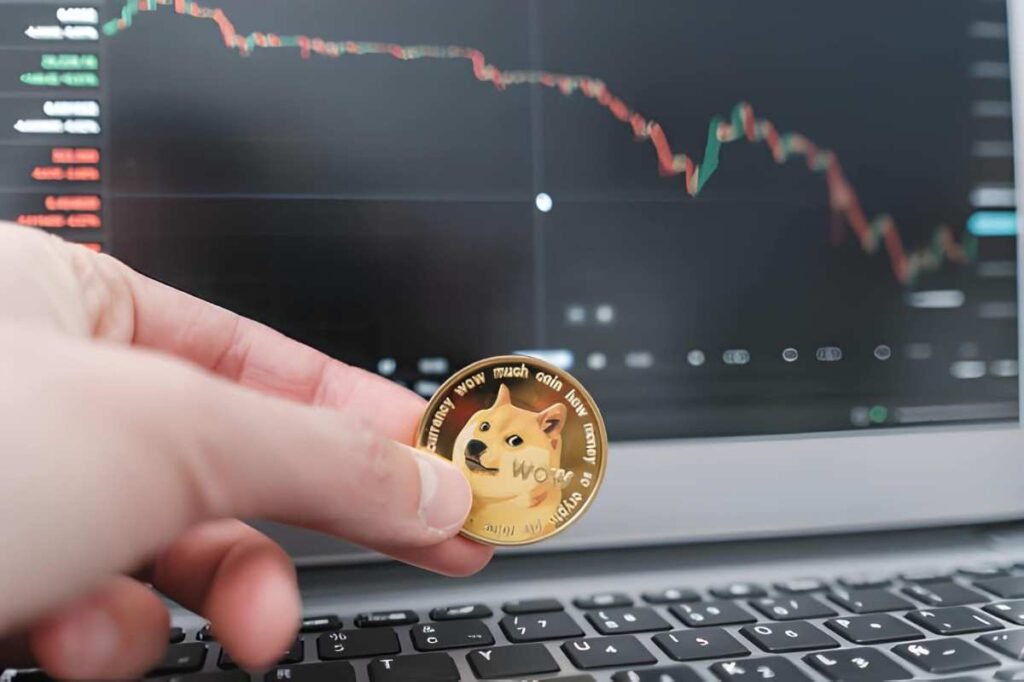
I have analyzed every major asset class, from sovereign bonds to complex derivatives, and I approach the topic of buying and holding Dogecoin with a singular focus on risk and financial reality. It is my duty to state unequivocally that categorizing Dogecoin as an “investment” is a fundamental misapplication of the term. An investment implies the allocation of capital to an asset with the expectation of generating a positive return based on its underlying cash flows, utility, or economic function. Dogecoin possesses none of these qualities. What is often called “investing” in Dogecoin is, in truth, speculation—a bet on the collective sentiment of a crowd, driven by social media and influencer hype, with no anchor to intrinsic value. My analysis is not meant to dismiss the asset outright, but to provide a clear-eyed framework for understanding the extreme risks involved in a buy-and-hold strategy.
Dogecoin was created in 2013 as a joke, a lighthearted parody of the speculative mania surrounding Bitcoin. Its fundamental architecture lacks the key features that give other cryptocurrencies a potential claim to long-term value. Unlike Bitcoin, which has a fixed, scarce supply of 21 million coins, Dogecoin has an inflationary supply. There is no cap on the number of Dogecoins that can be mined. Currently, 5 billion new coins are added to the circulating supply each year. This constant, predictable inflation acts as a perpetual downward pressure on the price per coin, as the supply of coins grows regardless of demand. This is the opposite of a scarce store of value.
The Fatal Flaw: The Lack of a Value Accrual Mechanism
For a buy-and-hold strategy to be successful over decades, the asset must have a mechanism to accrue value. This is what separates productive assets from collectibles or currencies.
- Stocks: Accrue value through earnings, dividends, and growth.
- Real Estate: Accrues value through rental income and scarcity of land.
- Bitcoin/Ethereum: Attempt to accrue value through digital scarcity (Bitcoin) or utility via a platform for decentralized applications (Ethereum).
- Dogecoin: Has no earnings, pays no dividends, has infinite supply, and has minimal unique utility beyond tips and micro-transactions on social media. Its value is purely and exclusively derived from what the next person is willing to pay for it—the definition of the “greater fool” theory.
The Drivers of Price: Momentum and Narrative, Not Fundamentals
The price history of Dogecoin is a textbook study in asset price bubbles driven by social contagion, not underlying value. Its most famous run-up was not triggered by a technological upgrade or a surge in network usage, but by tweets from celebrities and coordinated pumping on platforms like Reddit. This makes its price path unpredictable and inherently fragile. A buy-and-hold strategy assumes the narrative that drove the initial purchase will persist indefinitely, which is a dangerous assumption when the narrative is built on memes and momentum.
A Risk Analysis Framework for the Speculator
If, after understanding these risks, an individual still chooses to allocate capital to Dogecoin, it must be done with a speculator’s mindset and strict rules.
- Position Sizing: This is the most critical rule. Any allocation to Dogecoin should be considered risk capital—money you are psychologically prepared to lose entirely. It should represent a tiny fraction of a well-diversified portfolio (e.g., 1-2% at the absolute maximum). Its failure should have no meaningful impact on your long-term financial health or goals.
- The Psychology of Holding: You must be honest about your reasons for holding. Are you prepared to watch a 80% drawdown without panicking and selling at a loss? The volatility of Dogecoin is extreme. A “hold” strategy requires a stomach for gut-wrenching price swings that are uncorrelated to the broader economy or any rational metric.
- The Exit Strategy: A speculator must have a plan before entering the position. This is not “hold forever.” This could be:
- A Price Target: “I will sell 50% if it reaches $X.”
- A Time-Based Rule: “I will re-evaluate this position in 12 months regardless of price.”
- A Narrative Rule: “I will exit if the key influencers promoting it move on to another asset.”
A Comparative View: Dogecoin vs. Traditional Buy-and-Hold Assets
| Aspect | S&P 500 Index Fund (e.g., VOO) | Dogecoin |
|---|---|---|
| Underlying Value | Ownership in 500 profitable companies | None; memetic value only |
| Cash Flow | Dividends | None |
| Supply | Shares can be retired via buybacks | Infinite, inflationary issuance |
| Price Driver | Corporate earnings, economic growth | Social media sentiment, celebrity tweets |
| Long-Term Historical Trend | Upward bias over decades | Extremely volatile, no established trend |
| Role in Portfolio | Core Growth Engine | Speculative Gamble |
The Verdict: Entertainment, Not Investment
Buying and holding Dogecoin is not an investment strategy; it is a form of entertainment, akin to buying a lottery ticket. There is a non-zero chance it could generate life-changing returns if a particular social media-driven mania recurs. However, the probability of permanent capital impairment is significantly higher than the probability of outsized gains.
For the individual seeking to build long-term wealth, capital is far better deployed in productive assets with a century of data supporting their ability to generate real returns. The relentless, inflationary issuance of Dogecoin is a mathematical headwind that makes it structurally antagonistic to the very principle of long-term holding. If you choose to speculate, do so with eyes wide open, with money you can afford to lose, and with a pre-defined exit plan. Do not confuse a speculative gamble with a sound financial investment. The former can be a hobby; the latter is how you build a secure future.



