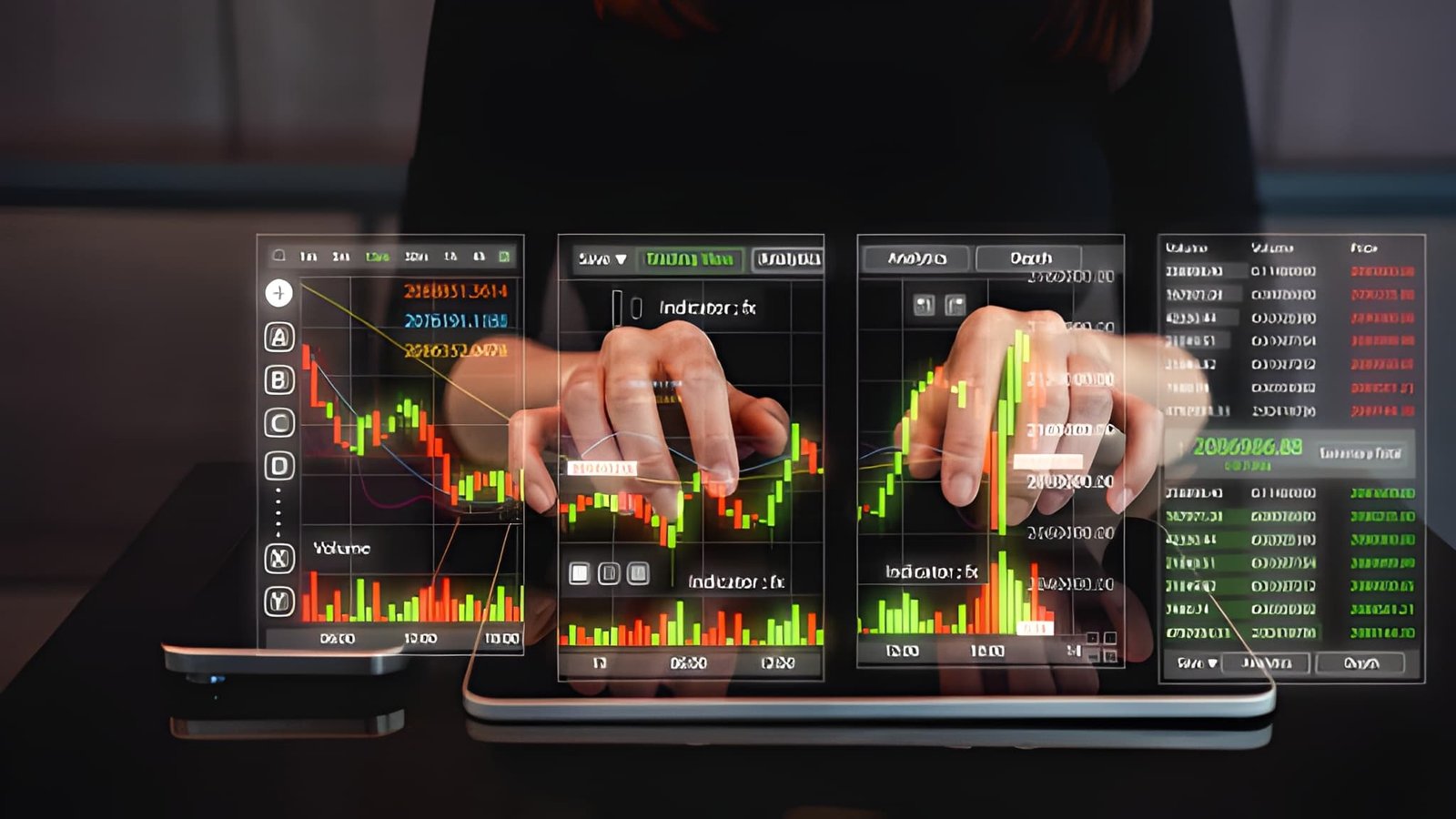
Auto Trading with Technical Analysis Formulas: The Quantitative Blueprint
Translating qualitative market theories into rigid mathematical code for sub-second execution and portfolio scaling.
The Transition to Formulaic Trading
Manual trading relies on the human eye to interpret geometric shapes on a screen. While this "chart reading" has been the standard for decades, it is inherently subjective and prone to cognitive bias. A trader might see a head-and-shoulders pattern during a winning streak but ignore a bearish signal when their ego is involved. Auto trading removes this friction by translating visual patterns into rigid mathematical formulas. In this environment, an entry is not a feeling; it is the result of a boolean statement returning a true value.
The transition to systemic trading requires a shift from seeing "lines" to seeing "functions." Every technical indicator is essentially a mathematical derivative of price and time. By deconstructing these indicators into their base components, a trader can build complex algorithms that monitor thousands of stocks simultaneously. This article explores the specific formulas that drive these automated systems and how to link them into a cohesive execution model.
Expert Perspective: The Quant Advantage
Quantification allows for the objective verification of an edge. If you cannot describe your trading strategy in a formula, you do not have a strategy; you have a collection of anecdotes. Auto trading allows us to stress-test these formulas against decades of data to ensure the edge is statistically significant rather than a product of temporary market luck.
The Math of Moving Averages
Moving averages are the foundational logic for trend-following systems. However, automated systems rarely use a single average. Instead, they look for the rate of change between averages. To automate this, one must understand the difference between the Simple Moving Average (SMA) and the Exponential Moving Average (EMA).
Simple Moving Average (SMA) Formula
The SMA is a simple arithmetic mean. For an automated system, the calculation is refreshed with every new price bar. The formula is:
Exponential Moving Average (EMA) Formula
Automated systems prefer the EMA because it reduces latency. It places more weight on the most recent data point, making it more responsive to sudden price shifts. This is calculated using a Smoothing Constant (Multiplier).
EMA = (Current Price x Multiplier) + (Previous EMA x (1 - Multiplier))
In code, the algorithm compares the 50-period EMA to the 200-period EMA. A "Crossover Event" occurs when the short-term value exceeds the long-term value. For an auto trader, this event triggers a scan of secondary filters to confirm if the trend is backed by liquidity.
Oscillator Logic and Momentum Math
Momentum oscillators help the system identify when a trend is accelerating or exhausting. The Relative Strength Index (RSI) is a staple of automated mean-reversion strategies. Automation requires the system to calculate the relative "velocity" of gains versus losses over a fixed lookback period.
- Calculate the difference between the current close and the previous close.
- Separate these into "U" (Up moves) and "D" (Down moves).
- Calculate the Average Gain and Average Loss over the n periods.
- Relative Strength (RS) = Average Gain / Average Loss.
- RSI Formula: 100 - [100 / (1 + RS)]
An automated script doesn't just look for "RSI < 30" (oversold). Instead, it looks for Momentum Divergence. It stores the price high of the last 20 bars and compares it to the RSI high. If the price reaches a new high but the RSI formula produces a lower value, the system identifies a probability peak and tightens trailing stop-losses automatically.
Volatility Formulas and Range Math
Volatility is the single most important variable for position sizing. Without a volatility formula, an automated system cannot distinguish between a "normal" price move and an "abnormal" market event. The two primary tools are Bollinger Bands and the Average True Range (ATR).
Bollinger Band Logic (Standard Deviation)
Bollinger Bands use the concept of a normal distribution. The system calculates the SMA and then adds/subtracts a multiple of the Standard Deviation. In automation, the "Bollinger Squeeze" is identified when the distance between the bands reaches a historical percentile low.
Lower Band = SMA - (Standard Deviation x 2)
Average True Range (ATR)
The ATR formula is used to set dynamic stop-losses. It measures the "True Range" which accounts for gaps between sessions—something a simple range formula misses. Automated systems often place stops at Current Price - (ATR x 2.5) to ensure they aren't stopped out by intraday noise.
Integrating Logic Gates (AND/OR)
A single formula is a signal, but a combination of formulas is a Strategy. Automated systems use logic gates to filter out low-probability trades. This is the difference between a bot that trades every "Green Candle" and one that only trades high-conviction institutional setups.
| Logic Gate | Market Interpretation | Example Formula Combination |
|---|---|---|
| AND | Requires absolute confluence. High probability, low trade frequency. | (EMA Cross) AND (RSI < 40) AND (Volume > Avg) |
| OR | Flexible entries. Higher frequency, requires tighter risk control. | (Price > VWAP) OR (Volume Spike Detected) |
| NOT | Risk Avoidance. Excludes trades during dangerous regimes. | (Buy Signal) AND NOT (Earnings Today) |
The Automated Execution Pipeline
Once the math determines that a trade should exist, the Execution Engine takes over. This is where the formula meets the broker API. The execution pipeline manages the lifecycle of the order, including entry, stop-loss placement, and profit-taking. For professional systems, this involves sub-second communication with the exchange matching engine.
Risk Control and Probability Models
The math of the signal is secondary to the math of the Account. An automated system must calculate its "Expectancy"—the average amount it wins per dollar risked. This is governed by the Kelly Criterion, a formula used by gamblers and quants alike to determine the optimal bet size to maximize long-term growth while avoiding the "Risk of Ruin."
Professional Risk Math
Systems automate this to ensure the account is never over-leveraged.
- Static Risk: The system ensures that every trade, regardless of price, risks exactly 1% of total equity.
- Profit Factor: The algorithm monitors the ratio of (Total Wins / Total Losses). Professional systems aim for a Profit Factor above 1.5.
- Dynamic Sizing: If the win rate (W) and the win/loss ratio (R) are known, the system uses the Kelly Criterion: f = [W - (1-W)/R] to adjust size.
Optimization and Systemic Fidelity
The final step in auto trading is Backtesting Fidelity. A formula might look profitable in a vacuum, but it may fail when transaction costs and slippage are included. Optimization involves finding the "sweet spot" for variables (like the lookback period of the RSI) without "Curve Fitting"—making the system so specific to past data that it fails in the future.
Professional traders use "Walk-Forward Analysis." They optimize a formula on the first three years of data and then test it on the fourth year (unseen data). If the fidelity holds, the system is robust. If the performance collapses, the logic is flawed. This rigorous testing is only possible because the trading plan has been converted from a human opinion into a mathematical formula.
Auto trading with technical analysis formulas is the pursuit of statistical consistency over individual ego. By codifying the laws of trend, momentum, and volatility into a unified logic gate, the participant moves from being a gambler to being an actuary. While the math of the formulas provides the entry, it is the math of the risk model that ensures survival. In the digital era, the most successful market participants are not those who "feel" the move, but those whose formulas accurately capture its velocity.