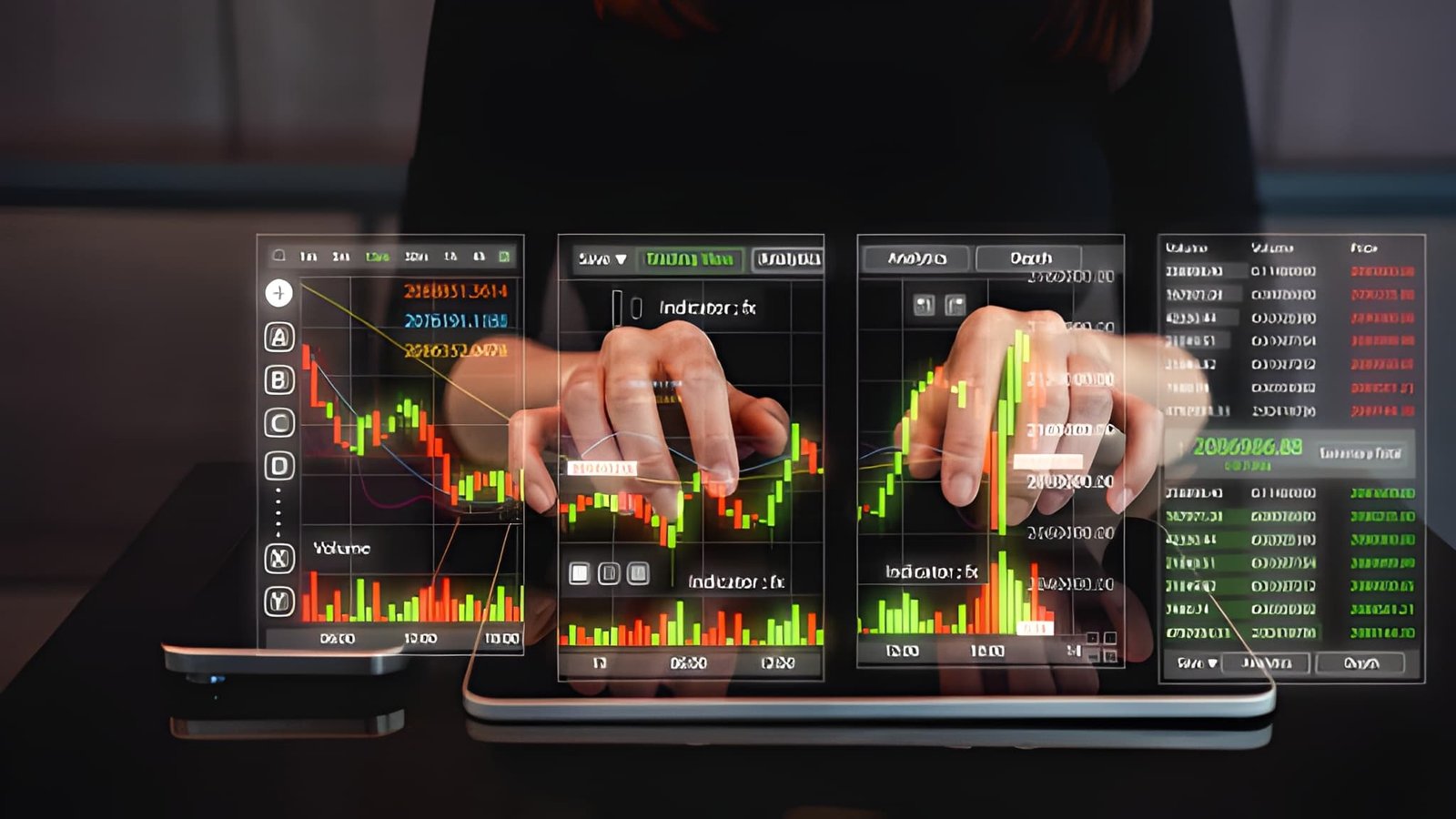
The Principle of Signal Convergence
In high-frequency trading, an indicator used in isolation is a liability. To find high-probability alpha, a professional trader seeks Convergence—moments where three distinct types of market data align to tell the same story. If you only look at price patterns, you miss the volume fuel. If you only look at volume, you miss the structural trend.
As established in momentum_intraday_trading.html and momentum_vs_volume.html, we prioritize data based on its "Realized" state. The best combinations move from the **Polygraph** (Volume) to the **Anchor** (VWAP) to the **Speedometer** (EMA). By layering these tools, you create a "Boolean" system for trade entry: if all conditions are not $True$, the trade does not exist.
The "Holy Trinity" Cluster (Momo/Volume)
The most powerful combination for capturing vertical price extensions consists of three elements. This is the foundation of the simple_momentum_strategy.html execution model.
Relative Volume (RVOL) Filter
The first step. RVOL $> 3.0$ tells you institutional participants have arrived. This validates that any breakout is backed by "Real Money" rather than retail noise.
VWAP Anchor
The second step. Price must be above a rising VWAP. This ensures you are buying into a market where the average cost basis is lower than the current price.
The Third Component (Timing): We add the 9-period EMA. When a stock is above VWAP and has high RVOL, the 9-EMA acts as the entry trigger. We buy the "First 1-Minute Candle to break a high while holding the 9-EMA."
The Regime Filter (ADX/ATR)
Even a perfect bull flag (ref: breakout_momentum_trading.html) will fail if the market is in a "sideways" regime. We use the ADX and ATR Cluster to identify the environment.
An ADX $(14)$ value above $25$ confirms that the asset has transitioned from "Noise" to "Trend." If the ADX is below $20$, do not use momentum indicators; switch to mean-reversion tools like Bollinger Bands.
The Average True Range (ATR) should be used to calibrate your stop-loss. A professional stop is often $2x$ the 5-minute ATR. This ensures that random market "wiggles" don't shake you out of a valid momentum move.
The Exhaustion Suite (BB/RSI)
Momentum traders use indicators to know when to buy, but professional traders use them to know when to Exit. The "Exhaustion Cluster" identifies parabolic peaks (ref: momentum_reversal_strategy.html).
- Bollinger Bands (20, 2): When price closes *outside* the upper band, the stock is statistically overextended.
- 2-Period RSI: While the 14-period RSI is for macro strength, the 2-period RSI is for acute intraday exhaustion. A value over $95$ signals an immediate profit-taking zone.
The Indicator Synergies Matrix
Below is the institutional recommendation for combining indicators based on the current market phase.
| Market Phase | Primary Combo | Secondary Confirmation |
|---|---|---|
| Morning Burst | RVOL + VWAP + ORB High | Tape Speed (Time & Sales) |
| Mid-Day Trend | 9/20 EMA + ADX | Bull Flag Patterns |
| Parabolic Run | 9-EMA Trail + 2-RSI | Bollinger Band Extensions |
| Reversal/Washout | Volume Climax + RSI Div | VWAP Reversion Target |
Combining Timeframes (Flexible Grid)
As detailed in tos_momentum_tutorial.html, the best combination includes Multi-Timeframe Alignment.
The "Triple Screen" Rule: 1. Daily Chart: Look for "Clear Air" (above the 200 SMA). 2. 5-Minute Chart: Look for the 9/20 EMA Ribbon expansion. 3. 1-Minute Chart: Look for the technical breakout of a 1-minute flag.
Common Over-Indicator Traps
The most dangerous state is **Analysis Paralysis**. Having 15 indicators leads to conflicting signals.
The 15-Minute Calibration Routine
Before the 9:30 AM open, perform this audit:
- Reset VWAP: Ensure your platform is set to a "Daily Reset" VWAP.
- Identify ATR: Note the 5-minute ATR for your top 3 watchlist stocks to pre-calculate position size.
- Confirm RVOL: Ensure your scanner (ref: tos_momentum_scanner_guide.html) is active and filtering for at least $3.0$ relative volume.
The "best" combination of indicators is the one that aligns with your **Risk Tolerance** and **Temporal Strength**. For high-velocity momentum, the synergy of VWAP, 9-EMA, and RVOL remains the industry standard for identifying institutional intent.
Indicators do not predict the future; they describe the **physics of the present**. Use them as filters to increase the probability that the breakout you are trading is real. Respect the ADX regime, watch for RSI divergence at the peaks, and always let the volume validate the price. In the high-stakes world of day trading, your dashboard is your eyes; keep it clean, keep it fast, and trust the math of convergence.