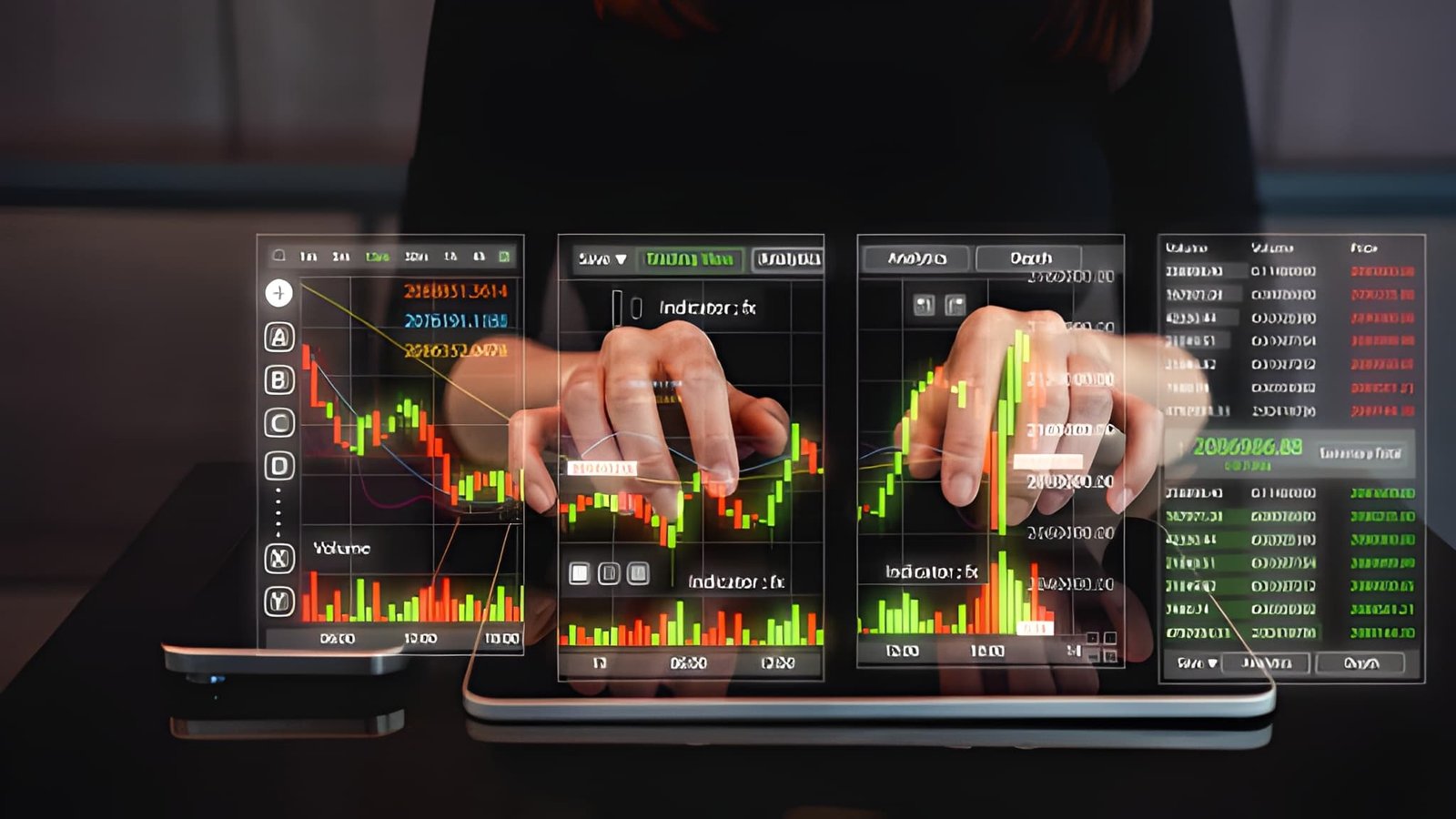
The Frontiers of Technical Trading: Modern Systems and Quantitative Evolution
Beyond Indicators: Navigating Market Microstructure, SMC, and Algorithmic Intelligence.
Strategic Navigation
[Hide]The landscape of technical trading has moved far beyond the simplistic observation of lagging indicators like Moving Averages or the Relative Strength Index (RSI). While these legacy tools still provide a baseline for trend identification, they often fail in the high-frequency, liquidity-driven environment of modern finance. Today’s professional systems prioritize market microstructure—the study of how individual buy and sell orders interact to form price. By looking at the "why" behind price action through the lens of order flow and institutional positioning, traders can anticipate moves before they manifest on a standard candlestick chart.
Order Flow Analysis & Volume Profiles
Order flow analysis involves peering into the "engine room" of the market. Unlike traditional technicals that treat every price tick equally, order flow distinguishes between aggressive market orders and passive limit orders. Tools like the Footprint Chart and Depth of Market (DOM) allow traders to see exactly where volume is being transacted and at what price levels buyers or sellers are becoming aggressive.
A critical component of this is the Volume Profile. Unlike a standard volume histogram that shows volume per unit of time, the Volume Profile shows volume per unit of price. This reveals the "Point of Control" (POC)—the specific price where the most business was conducted. In modern systems, these POCs act as powerful psychological magnets, as they represent the areas of highest consensus value between market participants.
Traditional Charting
Focuses on geometric patterns (Head and Shoulders, Triangles) and lagging oscillators. Relies on the visual repetition of history.
Order Flow Systems
Focuses on the imbalance between Bid and Ask. Identifies "Absorption" where price hits a level but volume increases without further movement—a signal of a reversal.
The Rise of Smart Money Concepts (SMC)
In recent years, the technical community has seen a surge in "Smart Money Concepts" or SMC. This methodology is based on the premise that large institutions (banks, hedge funds) must move significant amounts of capital, creating footprints that retail traders can follow. The central idea is to identify where institutional liquidity resides—often hidden behind what retail traders call "Support and Resistance."
Liquidity Voids and Fair Value Gaps
One of the most potent new concepts in SMC is the Fair Value Gap (FVG). An FVG occurs when the market moves so rapidly in one direction that liquidity is skipped, leaving a "void" in the price delivery. Because the market seeks efficiency, these gaps act as magnets, frequently drawing price back to "fill" the void before the trend continues. Modern technical systems use automated scripts to highlight these zones, treating them as high-probability entry or target levels.
An Order Block is a specific candle or price range where a large institution has placed a significant buy or sell order. When price returns to this level after a breakout, it often finds immediate support or resistance because the institution may be "defending" their position or filling the remainder of their order.
Retail "Stop Losses" are often clustered just above or below obvious support and resistance levels. Institutional algorithms are designed to push price into these clusters to trigger stops, creating the liquidity they need to fill their large opposite positions. Modern systems wait for this "Stop Run" to occur before entering a trade.
AI and Neural Network Technicals
The latest evolution in technical trading is the integration of Machine Learning (ML). Rather than using fixed parameters for an indicator (like a 14-period RSI), ML systems use neural networks to optimize parameters in real-time based on current market volatility. These systems can identify non-linear relationships that a human observer would miss, such as the correlation between the rate of change in volume and the speed of price rejection at a specific Fibonacci level.
These "Adaptive Indicators" automatically adjust their sensitivity. In a trending market, they become less sensitive to avoid premature exits; in a ranging market, they increase sensitivity to capture smaller oscillations. This removes the "curve-fitting" bias that plagues traditional technical strategies.
Quantitative Momentum & Mean Reversion
Modern quantitative technicals often move away from visual charts entirely, focusing instead on Statistical Significance. For example, a system might measure the "Z-Score" of a price—how many standard deviations the current price is away from its mean. When the Z-Score reaches an extreme level (e.g., +3.0), the system identifies a statistically significant mean reversion opportunity.
| Concept | Metric Used | Trading Objective |
|---|---|---|
| Mean Reversion | Z-Score / Bollinger Band Width | Betting on the return to the average price. |
| Trend Following | ADX / Hurst Exponent | Confirming the persistence of the current direction. |
| Volatility Breakout | ATR Expansion / Squeeze Index | Entering as the market moves from low to high volatility. |
| Microstructure Imbalance | Cumulative Delta | Identifying aggressive vs. passive participation. |
Multi-Asset Correlation Matrices
In a globalized financial system, no currency or asset trades in a vacuum. Modern technical systems use Correlation Matrices to confirm trades. For example, a technical breakout in the USD/CAD pair is significantly more likely to succeed if it is accompanied by a simultaneous technical rejection in Crude Oil prices, given the historical inverse correlation between the two. Professional systems monitor these "Inter-market Technicals" to filter out low-probability signals.
Modern Execution & Risk 2.0
Risk management has evolved from simple fixed-percentage models to Volatility-Adjusted Position Sizing. Using the Average True Range (ATR), modern systems calculate the "unit" of risk based on how much the market is currently moving. This ensures that a trader takes smaller positions during high-volatility events (where stop losses must be wider) and larger positions during low-volatility periods.
1. Calculate ATR (14-period) = 45 Pips
2. Set Stop Loss = 2.0 * ATR = 90 Pips
3. Define Risk Amount = $500 (1% of $50,000)
4. Position Size = Risk Amount / (Stop Loss * Pip Value)
5. Execution = $500 / (90 * $10) = 0.55 Lots
Note: This dynamically adjusts your leverage to the specific "breath" of the market.
Finally, the modern technical trader focuses on Trade Expectancy rather than Win Rate. By using sophisticated back-testing engines, they determine the "Edge" of their system over thousands of trades. They understand that a 40% win rate can be highly profitable if the average win is 2.5 times larger than the average loss. This probabilistic mindset is the hallmark of the transition from a discretionary chartist to a systematic technical trader.