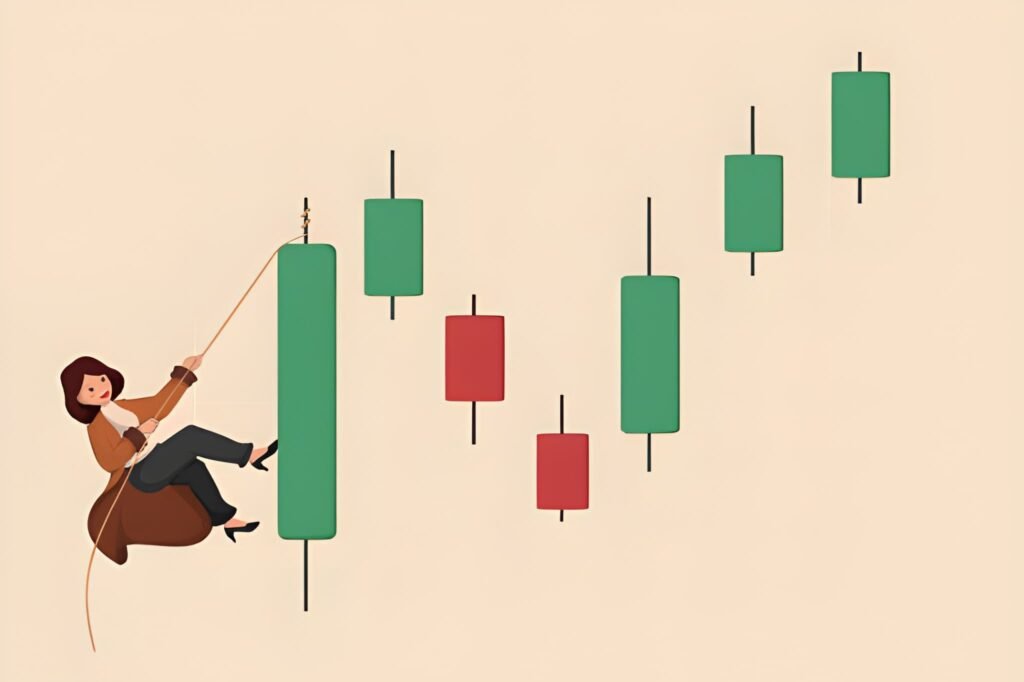
The Architecture of Momentum: Technical Analysis for Swing Trading
Technical analysis for swing trading is the art of identifying a high-probability "turn" in price and riding the resulting momentum for several days to a few weeks. While day traders fight for pennies in the high-frequency noise and long-term investors wait for years for fundamental growth, the swing trader lives in the middle. They seek to capture the "meat" of a market move—the primary expansion that occurs when a stock shifts from an oversold trough to an overbought peak.
Mastering this discipline requires a departure from simple guessing or following news cycles. Instead, the expert practitioner looks at the chart as a map of human emotion and institutional supply. Swing trading is built on the premise that markets move in waves. Our goal is to use technical tools to measure the amplitude and frequency of these waves, positioning ourselves where the path of least resistance becomes clear.
Multi-Timeframe Correlation Analysis
No chart exists in a vacuum. A technical level that looks like major resistance on a 15-minute chart may be completely invisible on a Daily chart. For swing traders, the Daily chart is the primary battlefield, but the Weekly and 4-hour charts provide the necessary context.
The Weekly chart reveals the "Major Trend." It tells us if we are in a bull market, a bear market, or a range-bound consolidation. The Daily chart is where we identify the specific setup—the flag, the bounce, or the breakout. Finally, the 4-hour or 1-hour chart allows for surgical entry timing, helping the trader minimize the distance to their stop loss.
Identifies multi-month supply and demand zones. Prevents trading against institutional currents. Used to set "End of Year" or "End of Quarter" targets.
The core timeframe for swing trading. Shows the 10-day and 20-day momentum. Most technical patterns (Cup and Handle, Flags) are most reliable here.
Market Structure and Trend Definition
Before applying any indicator, a trader must define the market structure. Market structure is the basic arrangement of higher highs and higher lows (uptrend) or lower highs and lower lows (downtrend). Swing trading thrives in Trend Expansion phases.
In an uptrend, a swing trader waits for a "Pullback to Value." Value is often defined as a previous breakout point (resistance turning into support) or a dynamic moving average. In a downtrend, the trader looks for a "Relief Rally" to short. The transition between these phases—the Market Turn—is where the most lucrative, yet difficult, swing trades are found.
| Market Phase | Swing Direction | Key Indicator Signal | Average Duration |
|---|---|---|---|
| Strong Uptrend | Long (Buy the Dip) | 20 EMA Support | 5 - 15 Days |
| Consolidation | Neutral (Wait) | Bollinger Band Squeeze | 2 - 4 Weeks |
| Correction | Short (Sell the Rip) | RSI Bearish Divergence | 3 - 10 Days |
Price Action Patterns for Entries
Price action is the rawest form of technical data. It is the footprint of money. While hundreds of patterns exist, a professional swing trader typically masters three or four reliable setups that repeat across all liquid assets.
A Bull Flag consists of a sharp vertical price move (the pole) followed by a tight, downward-sloping consolidation (the flag). This indicates that buyers are taking a breather before a second leg higher. Swing traders look for a close above the upper flag line with a volume spike to enter.
When a stock deviates too far from its 20-day moving average, it is "stretched." If the stock hits a major historical support level while the RSI is below 30, a mean reversion swing is likely. The target is usually the 20-day moving average or the middle Bollinger Band.
Technical Indicators as Filters
Indicators should never be the sole reason for a trade. Think of indicators as "filters" that confirm what the price action is already suggesting. For swing trading, we focus on tools that measure trend strength and exhaustion.
1. Exponential Moving Averages (EMA)
The 10-period and 20-period EMAs are the "Heartbeat" of a swing trade. In a strong trend, the price should stay above a rising 10 EMA. If the price closes below the 20 EMA, it often signals that the swing is over and a deeper consolidation or reversal is starting.
2. Relative Strength Index (RSI)
The RSI helps us identify exhaustion. However, an expert swing trader knows that a stock can stay "overbought" (RSI above 70) for a long time during a powerful breakout. The most potent signal is RSI Divergence—when price makes a higher high but RSI makes a lower high.
The Role of Volume Confirmation
Volume is the validation of price. A breakout on low volume is often a "Bull Trap," designed to lure retail traders before the big institutions sell their positions. A true swing trade entry should be accompanied by a Volume Expansion—ideally 150% or more of the 20-day average volume.
When volume dries up during a pullback, it is a bullish sign. It suggests that while the price is dropping, there is no aggressive selling pressure. This is known as "Volume Divergence on Retracement," and it is a prime signal that the next swing higher is being prepared.
Risk Modeling and Position Sizing
The most technical part of trading is the math of survival. A swing trader must calculate their risk before they ever look at their potential profit. We use a "Fixed Fractional" risk model, where no single trade can lose more than 1% or 2% of total account capital.
Stock Entry Price: 145.00 Technical Stop Loss: 138.00 Risk per Share: 7.00
Position Size: 250.00 / 7.00 Total Shares to Buy: 35 Shares
By using this calculation, the trader ensures that even if the stock gaps down or hits their stop, the damage to the portfolio is controlled. This mathematical discipline allows the trader to stay in the game long enough for their technical edge to manifest over dozens of trades.
Trade Execution and Exit Protocols
The entry is often the easiest part of a swing trade. The exit is where the profit is actually realized. Experts use a dual-exit strategy: a Price Target and a Trailing Stop.
Once the stock reaches the first target (often a previous resistance level or a 2:1 Reward-to-Risk ratio), the trader sells half of the position to lock in gains. The remaining half is managed using a trailing stop, such as the 10-day EMA or a "Chandelier Exit" based on the Average True Range (ATR). This allows the trader to capture those rare, massive "runaway" moves that significantly boost annual returns.
Placed below a logical technical level (swing low). Non-negotiable. If hit, you exit immediately without questioning the plan.
Moves higher as the trade progresses. Protects unrealized profit. Designed to give the stock "breathing room" while capturing trend extension.
In summary, technical analysis for swing trading is not about being right 100% of the time. It is about creating a system where you are right 50% of the time, your wins are twice as large as your losses, and you never risk enough to be wiped out by a single event. By combining market structure, price action, volume confirmation, and rigorous math, you transform trading from a gamble into a professional financial process.
The market is a sea of information. Technical analysis provides the filters that allow you to ignore the noise and focus on the signals that lead to profitable swings. Stay disciplined, trust your levels, and always respect your stop loss.