
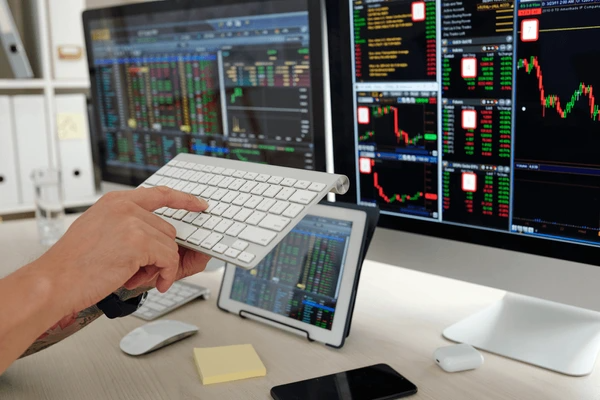
Precision Autonomy: Architecting the Best Automated Algorithmic Trading Systems
A high-level investigation into systematic execution, advanced machine learning integration, and the evolution of institutional-grade risk frameworks.
The contemporary financial market operates as a high-velocity digital ecosystem where human intervention is rapidly becoming an outlier. Automated algorithmic trading represents the terminal phase of this evolution, where capital is deployed through autonomous agents governed by mathematical rigor rather than psychological impulse. The pursuit of the best automated system is no longer merely about coding a set of rules; it is about constructing a comprehensive infrastructure that balances predictive accuracy with extreme execution efficiency.
Current estimates suggest that automated systems facilitate over 80% of total volume in developed equity markets. This dominance creates a self-reinforcing loop where algorithms compete against other algorithms, leading to compressed spreads and vanishingly small windows of opportunity. For the modern investor, success requires moving beyond static logic and embracing adaptive frameworks capable of navigating diverse market regimes.
Understanding Market Microstructure
To architect a superior trading system, one must first master Market Microstructure. This involves studying the mechanics of how orders are matched, the behavior of limit order books (LOB), and the dynamics of liquidity provision. An algorithm that lacks awareness of microstructure will inevitably suffer from high adverse selection—the phenomenon where your orders are filled only when the price is about to move against you.
The limit order book provides a real-time visualization of supply and demand. Sophisticated algorithms analyze "Order Flow Imbalance" to detect whether aggressive buyers or sellers are likely to move the price in the next few milliseconds.
Top-tier systems assess how quickly the order book recovers after a large trade. This resilience metric determines whether a strategy should aggressively take liquidity or wait for a more favorable entry point.
Market microstructure also introduces the concept of Toxic Flow. This refers to order flow from informed participants (such as institutional hedge funds) that predictably depletes the liquidity of market makers. Best-in-class automated systems utilize "Probabilistic Inferred Toxicity" (VPIN) metrics to scale back activity when the risk of being caught on the wrong side of an informed move increases.
Machine Learning and Predictive Edge
While traditional algorithmic trading relied on hard-coded heuristics—such as mean reversion or trend following—modern systems leverage Machine Learning (ML) to extract non-linear patterns from vast datasets. The transition from rules-based logic to predictive modeling allows systems to identify alpha sources that remain invisible to standard technical analysis.
Recurrent Neural Networks (RNNs) and Long Short-Term Memory (LSTM) networks are uniquely suited for financial time-series data. They possess the capacity to "remember" previous price sequences, allowing the algorithm to interpret the current price move within the context of the day's historical volatility. This temporal awareness is critical for identifying whether a breakout is genuine or merely an exhaustion gap.
Ensemble methods combine multiple decision trees to produce a more robust prediction. By averaging the outputs of thousands of individual models, Random Forests reduce the risk of "Overfitting"—the tendency of a model to memorize historical noise rather than learning the underlying signal. This makes the system more resilient to regime shifts.
Hardware and Connectivity Standards
An algorithm is a theoretical construct until it is executed. The physical infrastructure—the servers, the network interface cards, and the proximity to the exchange—determines the realized profitability of a strategy. In the realm of high-frequency trading (HFT), the best automated systems prioritize "Zero-Hop" architectures.
- FPGA Implementation: Field Programmable Gate Arrays allow for hardware-accelerated trading logic. By embedding the strategy directly into the silicon of the network card, traders can achieve "wire-speed" execution, bypassing the latency of the operating system's kernel.
- Microwave Transmission: For arbitrage between fragmented exchanges (e.g., Chicago and New York), fiber optic cables are too slow. Professional firms use microwave towers to transmit signals at the speed of light through the air, shaving milliseconds off the travel time.
- Clock Synchronization: Precision systems utilize Precision Time Protocol (PTP) to synchronize server clocks with atomic-level accuracy. This ensures that data timestamps are consistent across global data centers, which is vital for calculating cross-asset correlations.
Dynamic Risk and Portfolio Optimization
The primary failure point for most automated systems is not the entry signal, but the mismanagement of risk. Institutional systems view risk through the lens of Dynamic Volatility Scaling. Instead of static stop-losses, these systems adjust position sizes in real-time based on the realized volatility of the asset and the correlation with the rest of the portfolio.
While the Sharpe Ratio is common, professionals prefer the Sortino Ratio. It only penalizes the strategy for "downside" volatility. A high Sortino Ratio indicates that the algorithm is capturing upside gains without suffering from the massive drawdowns that characterize amateur systems.
We calculate the Expected Growth of a strategy using the Kelly Criterion to determine the optimal capital allocation. This ensures that the system risks enough to grow the account while minimizing the "Probability of Ruin."
Example:
Win Probability: 0.58 | Loss Probability: 0.42
Profit Ratio (Avg Win / Avg Loss): 1.2
f* = [ (0.58 x 1.2) - 0.42 ] / 1.2 = 0.23 (23% Risk per trade)
Institutional practitioners rarely use the "Full Kelly" due to the risk of extreme drawdowns if the win probability is slightly overestimated. Most systems utilize Fractional Kelly (e.g., 0.1 to 0.25 of the calculated f*) to maintain a margin of safety.
The Rigor of Scientific Backtesting
Backtesting is the laboratory where strategies are verified. However, most backtests suffer from "Selection Bias" and "Look-Ahead Bias." The best automated systems utilize a rigorous Walk-Forward Analysis. This method involves training the model on a historical window, testing it on the subsequent window, and then shifting the entire window forward in time.
| Backtest Pitfall | Institutional Countermeasure | Impact on Performance |
|---|---|---|
| Curve Fitting | Cross-Validation & Regularization | Ensures model generalizes to new data |
| Look-Ahead Bias | Strict Temporal Separation | Prevents using future info to make past trades | Slippage & Latency Modeling | Provides realistic returns after costs |
| Survivorship Bias | Full Universe Historical Data | Includes companies that went bankrupt |
Execution Algorithms and Cost Decay
Even the most accurate predictive model will lose money if the execution is poor. Execution Algorithms—such as TWAP (Time-Weighted Average Price), VWAP (Volume-Weighted Average Price), and Implementation Shortfall (IS)—are designed to minimize the market impact of large orders.
A superior automated system monitors Implementation Shortfall meticulously. This is the difference between the decision price (the price when the algorithm first signaled a buy) and the final realized price. If this gap is widening, it indicates that the market is "sniffing out" the algorithm's intentions, requiring a switch to a more passive execution style or a different dark pool.
The Horizon of Autonomous Intelligence
The future of automated trading lies in Reinforcement Learning (RL). Unlike traditional supervised learning, where the model is told the "correct" answer, an RL agent learns by interacting with the market. It receives rewards for profit and penalties for losses, eventually developing complex strategies—such as learning how to use "Iceberg" orders to hide its true size from other predatory algorithms.
Furthermore, the integration of Natural Language Processing (NLP) allows systems to ingest "Alternative Data" in real-time. By analyzing sentiment from central bank transcripts, earnings calls, and shipping manifests, the algorithm can anticipate macro shifts before they are reflected in the price. The best systems of the future will not just be fast; they will be the most comprehensively informed.
Ultimately, the architecting of an automated trading system is a balance of engineering excellence and financial theory. It requires the humility to acknowledge the randomness of the market and the discipline to adhere to a statistically sound process. In the modern financial area, the algorithm is the ultimate expression of investment intent.


