
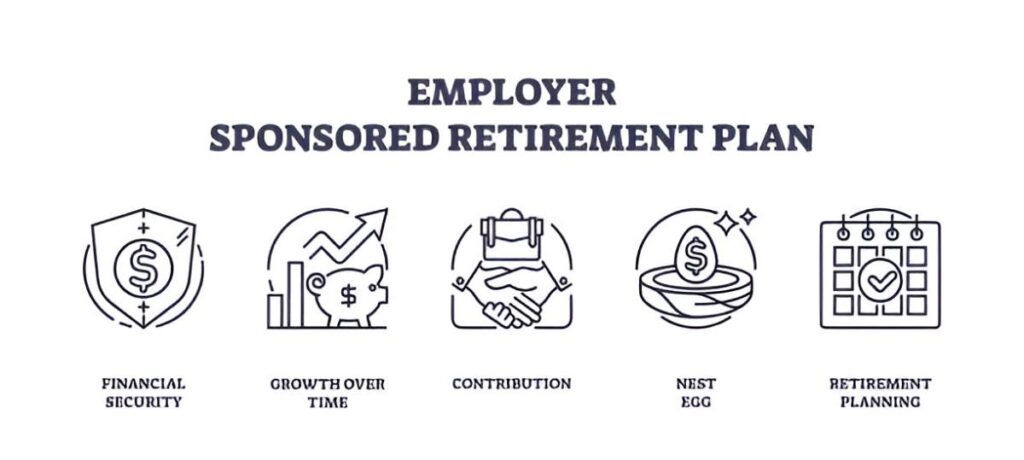
As someone who has spent years analyzing retirement strategies, I find employer-sponsored retirement plans to be one of the most effective tools for building long-term wealth. These plans, such as 401(k)s, 403(b)s, and SIMPLE IRAs, offer unique benefits that individual retirement accounts (IRAs) often cannot match. In this article, I will explore the key advantages of these plans, from tax benefits to employer matching, and explain why they should be a cornerstone of your retirement planning.
Table of Contents
Tax Advantages: Immediate and Deferred Savings
One of the biggest draws of employer-sponsored retirement plans is their tax efficiency. Contributions to traditional 401(k) plans are made with pre-tax dollars, reducing your taxable income for the year. For example, if you earn $80,000 and contribute $10,000 to your 401(k), your taxable income drops to $70,000.
The tax-deferred growth means your investments compound without annual capital gains or dividend taxes. The future value of your retirement account can be calculated using the compound interest formula:
FV = P \times (1 + r)^nWhere:
- FV = Future Value
- P = Principal investment
- r = Annual return rate
- n = Number of years
Suppose you contribute $500 monthly for 30 years with a 7% annual return. The future value would be:
FV = 500 \times \frac{(1.07)^{30} - 1}{0.07} \approx 566764Roth 401(k) options, available in some plans, allow after-tax contributions but tax-free withdrawals in retirement. Choosing between traditional and Roth depends on whether you expect higher taxes now or later.
Employer Matching: Free Money for Your Future
Many employers offer matching contributions, effectively giving you extra compensation. A common match structure is 50% of your contributions up to 6% of your salary. If you earn $60,000 and contribute 6% ($3,600), your employer adds $1,800—a 50% immediate return.
| Contribution Scenario | Employee Contribution | Employer Match | Total Annual Contribution |
|---|---|---|---|
| 3% of $60,000 salary | $1,800 | $900 | $2,700 |
| 6% of $60,000 salary | $3,600 | $1,800 | $5,400 |
| 10% of $60,000 salary | $6,000 | $1,800 | $7,800 |
Failing to contribute enough to get the full match is like leaving free money on the table. I always advise maximizing employer matches before considering other investments.
Higher Contribution Limits Than IRAs
Employer-sponsored plans allow significantly higher contributions than IRAs. In 2024, the 401(k) contribution limit is $23,000 ($30,500 for those 50+), while IRAs cap at $7,000 ($8,000 for 50+). This makes 401(k)s ideal for aggressive savers.
For high earners, after-tax contributions (if permitted) can push total contributions even higher—up to $69,000 including employer matches. This is particularly useful for those aiming for early retirement.
Automatic Payroll Deductions: Behavioral Benefits
Humans tend to procrastinate on savings. Automatic payroll deductions remove the temptation to spend first and save later. Studies show employees are far more likely to save when contributions are automated.
I’ve seen clients who struggled with manual IRA contributions but effortlessly built six-figure balances through 401(k)s simply because the process was automatic.
Creditor Protection and Legal Safeguards
Retirement accounts under ERISA (Employee Retirement Income Security Act) have strong legal protections. In most cases, creditors cannot seize your 401(k) funds in bankruptcy or lawsuits—a level of security rarely matched by taxable accounts.
Access to Institutional Investment Options
Employer plans often provide institutional-class funds with lower expense ratios than retail options. A typical S&P 500 index fund in a 401(k) might charge 0.02%, while a retail investor might pay 0.10%. Over decades, this difference compounds significantly.
\text{Net Return} = \text{Gross Return} - \text{Expense Ratio}If two funds both return 7% annually, but one has a 0.02% fee and the other 0.10%, the net returns are 6.98% vs. 6.90%. Over 30 years on a $100,000 investment:
FV_{\rm low\,fee} = 100000 \times (1.0698)^{30} \approx 761225The lower fee saves $32,680—just from a 0.08% difference.
Loan Provisions (With Caution)
Some 401(k) plans allow loans, letting you borrow against your balance at reasonable interest rates. While I generally discourage this (it disrupts compounding), it can be a lifeline in emergencies compared to high-interest credit cards.
Required Minimum Distributions (RMDs) and Strategic Planning
Traditional 401(k)s require withdrawals starting at age 73 (under SECURE Act 2.0). While some see this as a drawback, proper planning can turn RMDs into a structured income stream. Roth 401(k)s, however, have no RMDs during the original owner’s lifetime.
Case Study: The Power of Early Participation
Consider two employees:
- Alex starts contributing $500/month at age 25.
- Jamie starts at 35 with the same contribution.
Assuming a 7% return:
| Metric | Alex (Starts at 25) | Jamie (Starts at 35) |
|---|---|---|
| Total Contributions by 65 | $240,000 | $180,000 |
| Account Balance at 65 | $1.2 million | $566,764 |
The ten-year headstart gives Alex more than double Jamie’s balance despite contributing only $60,000 more.
Potential Downsides and Mitigations
No system is perfect. Some employer plans have limited investment choices or high fees. If your plan lacks good options, contribute enough to get the match, then consider IRAs or taxable accounts for additional savings.
Final Thoughts
Employer-sponsored retirement plans offer unmatched advantages—tax breaks, free matching money, high limits, and automation. While IRAs and taxable accounts have roles, I always prioritize maximizing employer plan benefits first. The combination of immediate tax savings and long-term compounding creates a wealth-building machine that’s hard to replicate elsewhere.



