
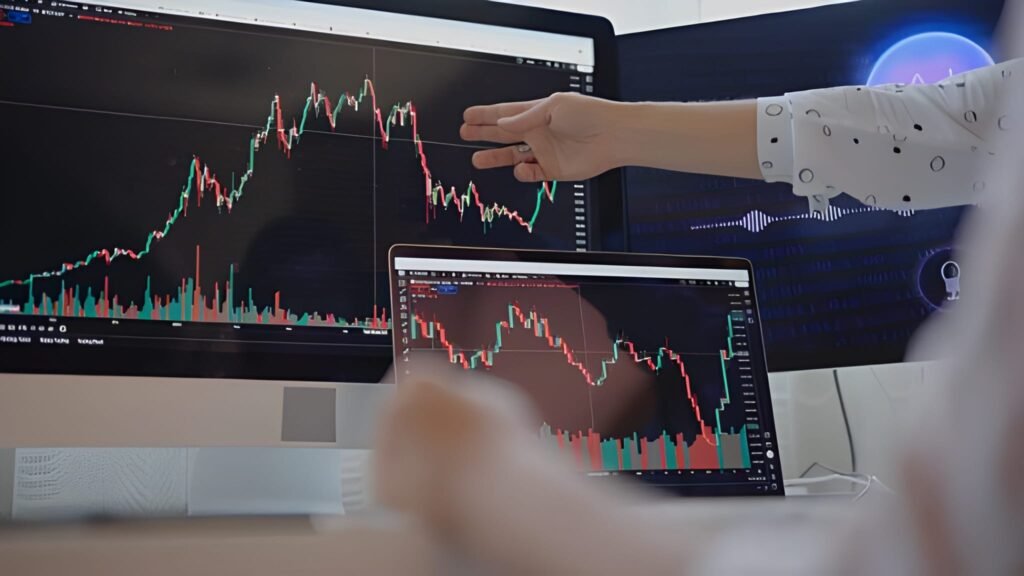
Defining the Momentum Factor
In professional finance, the Momentum Factor describes the empirical observation that assets which have performed well in the recent past tend to continue that performance in the near future. While institutions often view this through a monthly or quarterly lens, day traders utilize this systemic anomaly within the confines of a single trading session. Intraday momentum is the purest expression of supply and demand imbalance, detached from long-term fundamental value and driven entirely by participation velocity.
The factor operates on the principle of Continuity. Unlike mean reversion, which bets on a return to the average, factor-based momentum bets on the extension of the current trend. For the day trader, this means identifying stocks that have achieved "escape velocity"—a state where the weight of buyers so thoroughly overwhelms sellers that price is forced into a directional run. This is not mere technical analysis; it is the identification of a structural market inefficiency.
Identifying the momentum factor requires a shift from looking at what a stock is doing to why it is outperforming its peers. The factor trader looks for the leaders of the market, the top 1% of performers that attract institutional "chasing" and retail frenzy. By joining these high-conviction moves, the trader aligns themselves with the path of least resistance.
Behavioral Logic of Intraday Trends
Markets do not move on data alone; they move on the human and algorithmic interpretation of data. The momentum factor thrives because of specific cognitive biases that manifest in the order book.
Initial Underreaction
When news breaks, many participants hesitate to buy immediately. They wait for confirmation. This staggered entry creates a multi-wave trend rather than a single vertical spike, providing the "factor" its duration.
The Herding Phase
Once a stock is visibly trending, late-arriving buyers (driven by FOMO) pile in. This non-discretionary buying pushes price beyond rational levels, extending the momentum phase long after the catalyst is digested.
Investors tend to sell winners too early to lock in profits while holding losers too long. This creates a constant supply of shares in trending stocks that buyers must "eat through." As the buyers absorb this supply, it creates a steady, trending price action that momentum traders capitalize on.
Traders often anchor to a stock's previous high or a major whole number. When the price breaks these psychological barriers, it forces a rapid revaluation. The resulting surge in orders is the momentum factor manifesting as a volatility event.
Quantifying Momentum Intensity
To trade the factor systematically, you must move beyond "gut feelings" and quantify intensity. We use a Momentum Scoring Matrix to rank the universe of stocks. This allows us to focus only on the names where the factor is currently strongest.
| Metric | High Intensity Level | Trading Implication |
|---|---|---|
| Relative Strength (RS) | Stock is in the top 1% of the sector | Leader status; high probability of follow-through. |
| Volume Flow (VFlow) | 300% above 60-day average | Institutional participation is confirmed. |
| Gap Persistence | Holds top 25% of the morning gap | Buyers are supporting the higher prices. |
| Intraday ADX | Value > 35 and rising | The trend has transitioned from noise to momentum. |
Cross-Sectional vs. Time-Series
Intraday momentum exists in two primary forms. Understanding the difference is vital for asset selection.
Time-Series Momentum: This looks at a stock's past performance against its own history. If a stock is up 10% from its 9:30 AM open, it has positive time-series momentum. This is the "absolute" strength of the move.
Cross-Sectional Momentum: This is the more powerful tool for day traders. It compares the stock against its peers. If the Tech sector is up 1% but Nvidia is up 4%, Nvidia has significant cross-sectional momentum. It is the Relative Winner. In a market sell-off, the cross-sectional leader will often hold its ground or drop significantly less than the index, signaling hidden strength.
Building Systematic Scanners
A factor trader relies on scanners to identify candidates in real-time. We don't wait for the price to move; we wait for the Factor Signature to appear.
Your scanner should filter for:
- The "Gap and Hold": Stocks that gapped up 4% or more and have spent the first 30 minutes trading above the VWAP.
- RelVol Spike: A sudden increase in volume (relative to the stock's own history) that accompanies a new high of the day.
- Low Float Velocity: (For small caps) Stocks with under 20 million shares that are rotating their float on high volume.
- Sector Laggards Catching Up: Identifying the second and third strongest stocks in a trending sector before they make their move.
Calculations for Factor Decay
Momentum is a decaying asset. It has a beginning, a middle, and an end. The Rate of Change (ROC) calculation helps us determine where we are in that cycle.
A common way to score momentum is using the following calculation:
Factor Score = (Current Price - Price[30 mins ago]) / Price[30 mins ago] * (Volume / Average Volume)
If the Factor Score is increasing, the momentum is accelerating. If the price is still rising but the Factor Score is dropping, you are witnessing Factor Decay. This is your signal to tighten your stop-loss or take partial profits.
In day trading, the decay usually happens near whole numbers or as the lunch-time lull approaches (11:30 AM EST). Professional factor traders look for "Velocity Peaks"—the moment when the volume is highest but the price struggles to make a new high. This indicates that supply has finally met demand.
Risk Management and Reversals
The greatest risk to a momentum trader is the Trend Reversal. Because momentum stocks are often overextended, the drop can be violent when the factor exhausts.
To manage this, we use the 9-period Exponential Moving Average (EMA) as a dynamic guide. In a true momentum move, the price will "ride" the 9 EMA. A candle close below this level indicates that the momentum factor is breaking.
Market Microstructure Edge
Behind every momentum trend is the Order Flow. To trade the factor with precision, you must understand how orders are being filled.
Watch the Tape (Time and Sales). In a strong momentum move, the green prints (buys at the ask) will come in large blocks, while the red prints (sells at the bid) will be small and sporadic. If the tape starts showing large "Block Sells" while the price is at a new high, institutional participants are using the liquidity of the momentum move to exit their positions. This is the first sign of an impending reversal.
Precision Entry Protocols
Entry is not about buying the breakout; it is about buying the Confirmation of the Factor.
- Wait for the Consolidation: After the initial surge, a stock will "coil." This is a tight range where price stays above the 9 EMA.
- Check the Relative Strength: Ensure the stock is still outperforming its sector during the consolidation.
- Buy the Micro-Break: Enter when price breaks the high of the consolidation range on a volume spike.
- The "Line in the Sand": Place your stop-loss at the low of the consolidation range. This minimizes your risk while allowing for maximum upside.
The momentum factor is the most reliable intraday anomaly for traders who prioritize velocity and discipline. It is a systematic recognition of the market's tendency to herd and its inability to price news instantaneously. Success does not come from predicting the future; it comes from the rigorous identification of the present.
By combining quantitative scoring with an understanding of behavioral psychology and market microstructure, you move from being a gambler to a factor specialist. Remember that the momentum factor is a guest that eventually leaves. Your job is to stay as long as the party is active but have your hand on the door the moment the music slows down. The trend is not just your friend; it is the mathematical edge that sustains a professional trading career.


