
Introduction
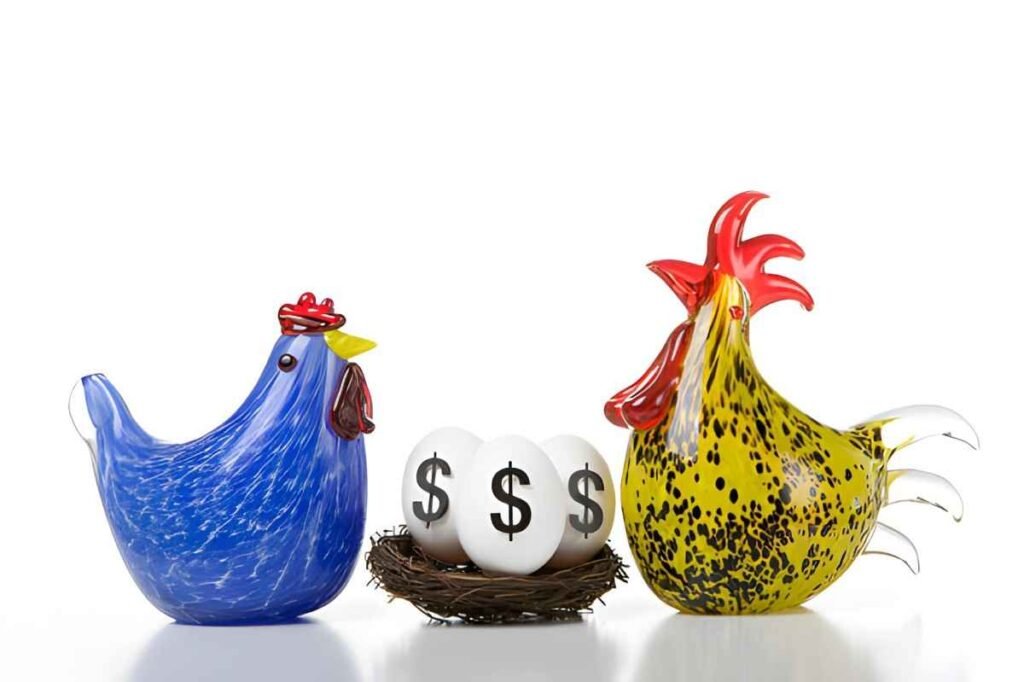
Dividend investing can be better understood through a simple analogy: chickens and eggs. This metaphor captures the essence of building a sustainable income stream from investments while highlighting the importance of patience, compounding, and reinvestment.
The Analogy
- Chickens = Dividend Stocks: Each dividend-paying stock represents a chicken. The more healthy, productive chickens you have, the more eggs you receive. In investing terms, the “chickens” are your income-generating assets.
- Eggs = Dividend Payments: Dividends are the “eggs” produced by each stock. You can consume them (spend the dividends) or reinvest them to acquire more chickens (buy more stocks).
Step 1: Start with a Few Chickens
- Early investors may begin with a small number of dividend stocks.
- The goal is to select strong, reliable companies that consistently pay dividends.
- Quality matters: a sick or unproductive chicken (a weak company) may stop producing eggs.
Example
Investing $10,000 in a dividend stock with a 4% annual yield produces:
\text{Annual Dividend} = 10,000 \times 0.04 = 400Here, $400 represents your “eggs” for the year.
Step 2: Reinvest Eggs to Grow Your Flock
- Reinvesting dividends allows you to purchase more shares of dividend stocks, creating additional “chickens.”
- Over time, this accelerates wealth accumulation through compounding.
Example
If you reinvest the $400 dividend at the same 4% yield:
\text{New Investment} = 400Next year’s dividend:
\text{Dividend} = (10,000 + 400) \times 0.04 = 416Compounding grows both your dividend income and the total value of your portfolio.
Step 3: Diversify Your Flock
- Owning multiple dividend-paying stocks reduces risk if one company reduces or suspends its dividend.
- Diversification ensures steady “egg production” even during market fluctuations.
Table: Diversified Dividend Portfolio
| Stock | Investment | Yield | Annual Dividend |
|---|---|---|---|
| Stock A | $5,000 | 3.5% | $175 |
| Stock B | $3,000 | 4.5% | $135 |
| Stock C | $2,000 | 5% | $100 |
| Total | $10,000 | — | $410 |
- Total dividends: $410, slightly higher than the single-stock example, and less vulnerable to any one stock cutting its dividend.
Step 4: Time and Patience
- Dividend investing requires patience. A single chicken does not produce enough eggs to sustain long-term income.
- Over years, consistent reinvestment grows your “flock,” providing reliable income even in market downturns.
Conceptual Illustration
- Year 1: 1 chicken → 1 egg
- Year 2: 1 chicken + reinvested egg → 1.04 chickens → 1.04 eggs
- Year 10: 1 chicken + compounding → ~1.48 chickens → 1.48 eggs
- This illustrates the power of compounding dividends over time.
Step 5: Spending Eggs vs. Reinvesting
- Spending Eggs: Provides immediate income but slows portfolio growth.
- Reinvesting Eggs: Slows current income but accelerates long-term compounding and retirement income potential.
- Many retirees gradually shift from reinvestment to spending as they transition from accumulation to income phase.
Conclusion
The chickens and eggs analogy effectively illustrates key principles of dividend investing: selecting reliable dividend stocks (chickens), earning dividends (eggs), reinvesting to grow the portfolio, diversifying, and exercising patience. By understanding this metaphor, investors can appreciate the power of compounding dividends, making dividend investing a reliable strategy for long-term wealth and retirement income.



