
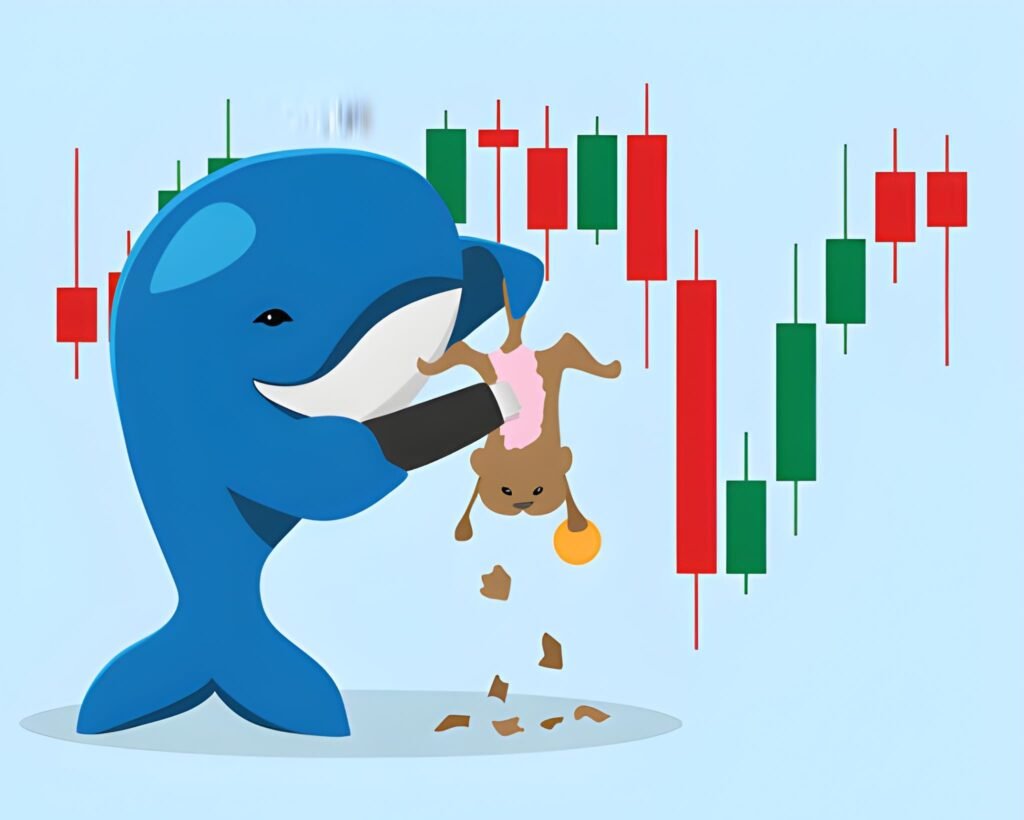
Apex Predator of Order Flow
The financial market operates as a complex ecosystem where participants occupy specific roles in the food chain. At the very top sits the Momentum Trading Shark. This persona describes a participant who does not merely follow trends but hunts for specific, high-probability imbalances where other traders face maximum distress. To trade like a shark, one must understand that profit is often the result of capturing the "forced" movement of the weak.
Shark trading involves a unique synthesis of Harmonic Geometry and Market Microstructure. While standard momentum traders enter on simple breakouts, the shark enters at the precise moment of a failed reversal or a structural overextension. They look for the "Blood in the Water"—clusters of stop-losses sitting just outside a recognizable pattern. When these stops trigger, they create a non-discretionary surge in volume that the shark uses to propel their position into immediate profit.
This strategy prioritizes Velocity over duration. A shark trader aims to be in the market for the fastest 20% of a price move, capturing the exponential phase where liquidity vanishes and price lunges toward a new equilibrium. They swim where the currents are strongest, focusing on stocks with extreme relative volume, fresh fundamental catalysts, and low institutional ownership, which allows for more dramatic, predator-driven movements.
Anatomy of the Harmonic Shark
In technical analysis, the Shark Pattern is a specialized harmonic structure discovered by Scott Carney. Unlike traditional patterns like the Bat or the Gartley, the Shark is a 5-point structure that anticipates a violent thrust. It is specifically designed to identify "over-extended" markets that are about to experience a rapid revaluation.
Point C: The Overrun
The defining characteristic of a Shark is that Point C exceeds the original starting point (X). This represents a "False Breakout" that traps early trend-followers. The shark waits for this trap to spring before entering.
The 0-5 Resolution
The Shark pattern typically resolves into a 5-0 pattern. This is the "Momentum Phase" where the predator captures the resulting lunge as the market reverts toward the 50% retracement level with high speed.
For a momentum shark, this pattern serves as a Timing Mechanism. When the market prints a vertical lunge that exceeds its previous high (the C point), retail traders begin to "chase" the move. The shark recognizes this as the exhaustion peak. They wait for the price to snap back, entering the momentum of the reversal at the precise second the "chasers" begin to panic and sell.
Geometric Ratios and Precise Pips
Shark trading is not a game of guesswork; it is a game of Fibonacci Precision. The pattern relies on three critical ratios that define the boundaries of the "Kill Zone."
| Leg Segment | Shark Ratio | Market Implication |
|---|---|---|
| AB / XA | 1.13 to 1.618 | Indicates an aggressive extension beyond the base. |
| BC / AB | 1.618 to 2.24 | The "Overrun" phase where retail FOMO peaks. |
| Final Target | 0.886 to 1.13 | The "Kill Zone" where the shark enters the trade. |
Scent of Blood: Predatory Scanners
To find these setups in real-time, the shark utilizes Quantitative Scanners that look for "Abnormal Signatures." A standard scanner finds what is moving; a predatory scanner finds what is Stretching.
The shark's watchlist consists of stocks exhibiting the following signatures:
- RelVol Spike > 4.0: Volume is 4x the 60-day average, signaling mass arrival.
- Extension > 3 ATR: Price is more than 3 Average True Ranges away from its 20-period EMA.
- The "Wick" Signature: The 1-minute chart shows long upper wicks at new daily highs, indicating hidden sellers are absorbing the buy orders.
- Liquidity Gaps: The Level 2 order book shows "thinness" above or below current price, allowing for slippage-free vertical moves.
Mindset: Execution Without Mercy
Psychology in shark trading is built on Detachment. A shark has no loyalty to a ticker or a story. They view every trade as a mechanical extraction of capital from an inefficient auction. To survive, you must eliminate the human desire to be "right" and replace it with the desire to be Fast.
If the momentum shark enters a trade and the price goes sideways for more than 5 minutes, the trade is dead. The coiling energy has dissipated. A shark does not "wait and see." They exit immediately at break-even or a tiny loss, freeing up capital for a fresh hunt. This high-turnover mindset protects the shark from "Slow Bleed" losses.
Sharks do not use mental stops. They use Hard Market Stops placed the microsecond the trade is live. If the "trap" doesn't spring, the shark is out. They accept a 40% win rate because their "Capture Ratio"—the size of a win versus a loss—is typically 3-to-1 or higher.
The Liquidity Trap Maneuver
The shark's most profitable maneuver is the Liquidity Trap. This involves identifying a "Congestion Zone"—a range where thousands of traders have placed their stop-losses just outside the boundaries.
When price approaches these stops, the shark does not buy the breakout. They wait for the "Stop Run." As the stops are triggered, they create a massive vertical lunge on the tape. The shark observes the Tape Velocity. If the velocity slows down immediately after the stops are hit, it indicates there is no "New Money" behind the move. The shark then enters a position Against the breakout, riding the vacuum as the trapped traders scramble to exit their failing positions.
Swimming in High Volatility Currents
Momentum sharks thrive in high-volatility environments where the VIX (Volatility Index) is rising. In a calm market, price follows fundamentals. In a volatile market, price follows Liquidity.
The shark uses the Standard Deviation of price swings to size their positions. If a stock is moving 5% per 5-minute candle, the shark reduces their share size but widens their target. This "Dynamic Sizing" ensures that the shark's dollar risk remains constant even when the market's "current" becomes violent.
Risk Protocols for the Top Decile
The momentum shark operates in the most dangerous quadrant of the market. To avoid total ruin, they follow a Binary Risk Model.
The 2-Unit Exit Strategy
A shark enters with two equal units. Unit 1 is sold at a 1:1 Reward-to-Risk ratio to "finance" the trade. Unit 2 is the "Predator Unit," held for a parabolic extension. Once Unit 1 is sold, the stop-loss for Unit 2 is moved to entry. This ensures that the worst-case scenario for the trade is a net profit of zero, while the best-case scenario is a 10% portfolio gain.
Calculation for the Kill Zone:
Entry: 10.50 (Point D in the Shark Pattern)
Stop Loss: 10.20 (Point X)
Risk per share: 0.30
Primary Target: 11.40 (The 50% Fibonacci level)
Reward-to-Risk: 3 : 1. If the geometry does not offer at least a 2.5:1 ratio, the shark lets the prey go and waits for a better opportunity.
Conclusion: Strategic Dominance
Becoming a Momentum Trading Shark is a journey of psychological and technical evolution. It requires you to stop viewing the market as a place of investment and start viewing it as a Mechanical Auction. By mastering the harmonic Shark pattern, identifying liquidity traps, and executing with predatory discipline, you move from being the participant who provides the liquidity to the participant who extracts the alpha.
The path to dominance involves thousands of hours of tape watching. You must learn the "Signatures" of institutional exhaustion and the "Smell" of retail panic. Remember: price is a number, but order flow is a narrative of fear and greed. Swim where the volume is highest, respect the geometry of the pattern, and never hesitate to cut a trade that loses its velocity. In the financial food chain, speed and precision are the only things that matter. The ocean of the market is vast, but for the disciplined shark, the opportunities for the kill are endless.


