
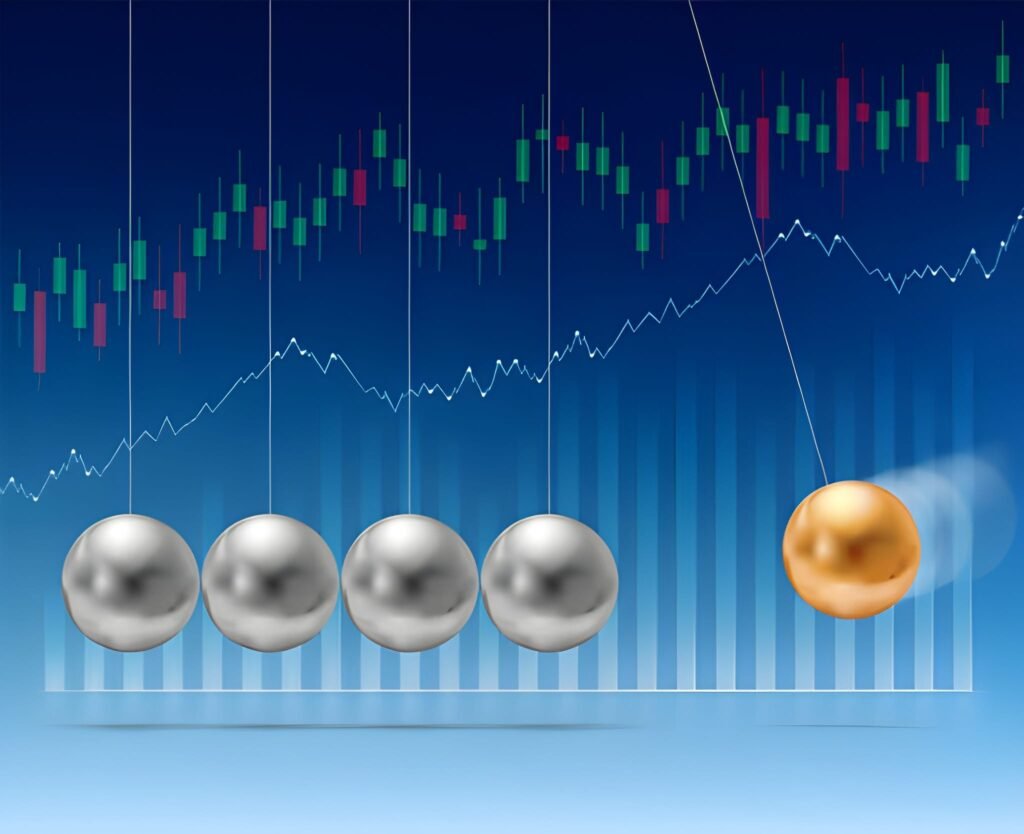
Harmonic Velocity: The Scientific Foundation of Swing Trading Momentum
- Defining Swing Momentum Science
- The Physics of Autocorrelation
- Behavioral Finance & Momentum Loops
- Anatomy of a Kinetic Consolidation
- The Science of Volatility Expansion
- Relative Strength as a Momentum Filter
- Expectancy and Risk Management
- Optimal Exit Dynamics & Decay
- Market Regime Synchronization
- Synthesis: Systematic Execution
Financial markets are frequently analyzed as chaotic environments, yet beneath the erratic noise of daily price action lies a predictable structure governed by the science of momentum. Swing trading momentum is not a pursuit based on "gut feeling" or speculative hope; it is a clinical discipline centered on the exploitation of price persistence. Academic research into the momentum factor confirms that assets displaying significant directional velocity over multi-day periods possess a higher statistical probability of continuing that trajectory than of reverting instantly.
For the professional swing trader, the objective is to move beyond descriptive technical analysis and into the realm of predictive probability. This requires a profound understanding of why trends persist, how capital flows create inertia, and how human psychology creates the "slow-motion" price adjustments that momentum strategies capture. This guide deconstructs the mechanical, behavioral, and mathematical pillars of swing trading momentum, providing a professional framework for systemic growth.
Defining Swing Momentum Science
In classical physics, momentum is defined as the product of mass and velocity. In the financial markets, "mass" is represented by Institutional Conviction (volume and order flow intensity) and "velocity" by the Rate of Change (ROC) in price. Swing trading momentum targets the specific window where these two forces converge to create an impulse wave that lasts between three and ten trading days.
Unlike day trading, which seeks to exploit micro-inefficiencies, swing momentum focuses on Price Discovery. We identify assets where the market is undergoing a fundamental revaluation. The "science" lies in identifying the inflection point where a stationary asset overcomes its inertia to begin a new trend. This transition from low volatility to high velocity provides the most consistent profits for the disciplined practitioner.
The Physics of Autocorrelation and Inertia
Autocorrelation is the mathematical core of momentum. It describes the relationship between a variable and a lagged version of itself. If a stock rises 5 percent today, autocorrelation asks: what is the probability it rises tomorrow? In efficient markets, this should be a random walk (zero correlation). However, in actual markets, institutional capital flow creates Trend Inertia.
Large mutual funds and hedge funds cannot enter multi-million dollar positions in a single day without creating massive price slippage. Instead, they deploy capital in waves over multiple sessions. This staggered entry provides the "fuel" for the momentum engine. The swing trader’s edge comes from identifying these Institutional Footprints early in the accumulation cycle and riding the subsequent wave of price discovery.
Behavioral Finance & Momentum Loops
Why do prices not adjust instantly to new information? The answer lies in human evolutionary biology. Behavioral finance identifies three primary drivers that create the momentum anomaly:
The Disposition Effect further supports momentum. Investors tend to sell winning stocks too early to lock in small gains, which provides a steady supply that slows the price rise. This prevent the price from "jumping" to fair value instantly, allowing the momentum trader to capture a structured, persistent trend over several days.
Anatomy of a Kinetic Consolidation
Momentum is not born from chaos; it is born from Compression. A kinetic consolidation is a period where price moves sideways on shrinking volume, indicating that supply and demand have reached a temporary equilibrium. We look for specific geometric structures that signal the "coiling" of energy.
The Science of Volatility Expansion
Profitable swing trades occur when volatility transitions from dormant to active. We utilize the Average True Range (ATR) and Bollinger Band width to identify these "Squeeze" environments. When Bollinger Bands contract to their tightest levels in months, the market is signaling that a breakout is imminent.
The "Expansion Candle" is the trigger. A professional entry requires a wide-range candle that closes near its high on volume that is significantly higher than the 50-day average. This confirms that the energy stored during the consolidation phase has been released with conviction. Without the volume spike, the move is likely a "bull trap" or a random fluctuation rather than a structural momentum shift.
Relative Strength as a Momentum Filter
Not all momentum is equal. We seek Alpha Momentum, which is price persistence that exceeds the performance of the broad market. We utilize Relative Strength (RS) as our primary filter. If the S&P 500 is dropping 1 percent and a specific stock is flat or rising, that stock possesses extreme relative strength.
This stock is like a beach ball being held underwater. The market is the hand holding it down. As soon as the market pressure is released (the index stops falling), the RS leader will pop up the fastest. Focusing on the top 2 percent of RS leaders ensures that your capital is always positioned in the strongest currents of the global market.
Expectancy and Risk Management Math
Risk management in momentum trading is not about avoiding losses; it is about optimizing the payout ratio. We view trading as a game of probability where "Expectancy" is the only metric that matters. Expectancy is the average amount you expect to win (or lose) per dollar at risk.
2. Determine Average Win (AW): 3.0 (3:1 Ratio)
3. Determine Average Loss (AL): 1.0
Expectancy = (W * AW) - ((1 - W) * AL)
Expectancy = (0.4 * 3) - (0.6 * 1) = +0.60
Interpretation: For every $1,000 risked, this system generates $600 in net profit over time.
Position sizing is the engine of risk management. We use the 1% Risk Rule: the distance between your entry price and your stop-loss must never represent more than 1 percent of your total account equity. This ensures that even a string of ten consecutive losses results in only a 10% drawdown, preserving your "psychological capital" for the next winning cycle.
Optimal Exit Dynamics & Velocity Decay
The hardest part of swing trading is knowing when to sell. Momentum moves eventually reach a state of exhaustion. We identify this through velocity decay—the narrowing of candle ranges and the decrease in relative volume while price is still rising. This is the signal that the "smart money" is exiting into the retail FOMO.
| Exit Reason | Signal Definition | Tactical Action |
|---|---|---|
| Stop Loss | Price breaks below technical pivot. | Liquidate 100% immediately. |
| Climax Run | Vertical move; 20%+ extension from 20 EMA. | Sell 50% into strength; tighten trailing stop. |
| Velocity Decay | Narrowing ranges; lower highs on RSI. | Sell remaining 50% at first close below 10 EMA. |
| Time Stop | Trade is flat after 3-5 days. | Exit to free up capital for high-velocity assets. |
Market Regime Synchronization
Momentum strategies fail in "Mean Reversion" regimes. To protect your capital, you must monitor the Market Regime Filter. We utilize the 200-day Simple Moving Average (SMA) on the S&P 500. If the index is below its 200-day SMA, the probability of momentum breakouts "failing" or "fading" increases by over 300 percent.
A professional swing trader is often in 100% cash during bear market regimes. Patience is a form of momentum trading. By waiting for a "Risk-On" environment (index above its 50-day and 200-day SMA), you ensure that you are trading with the wind at your back, maximizing the persistence of your individual stock setups.
Synthesis: Systematic Execution
Mastering the science of swing trading momentum is a journey of transition from an emotional observer to a clinical technician. It involves recognizing that price action is the final result of institutional capital flow and behavioral psychology. By utilizing quantitative compression patterns, filtering for relative strength, and adhering to rigid risk math, a trader can systematically extract alpha from the market's most explosive trends.
Ultimately, momentum trading is the practice of Verified Strength. We do not buy "potential"; we buy "proof." The market tells you which assets are in a markup phase through their velocity and structural conviction. Your job is to act as a disciplined executor of a system that honors the inescapable laws of market physics. Respect the trend, honor the stop, and allow the mathematical power of momentum to compound your wealth.


