
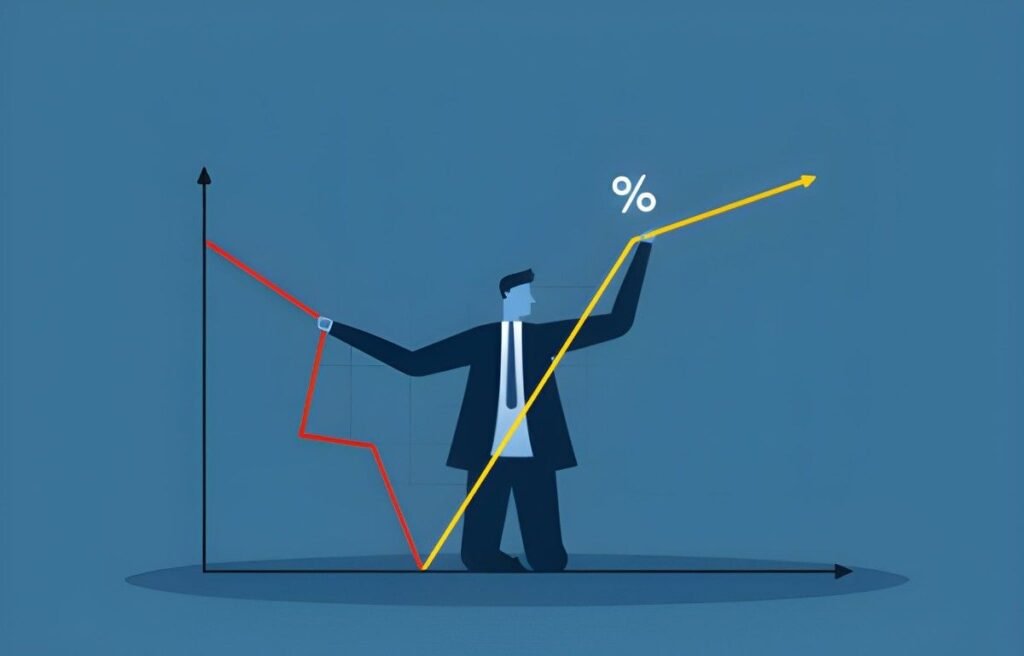
Investment and Economic Growth
Investment plays a central role in economic growth, as it directly affects capital accumulation, productivity, and the economy’s productive capacity. In macroeconomic models, investment refers to expenditures on physical capital such as machinery, infrastructure, and technology, which increase the economy’s capital stock over time.
The long-run growth of an economy depends on how capital accumulation interacts with labor growth and technological progress. The relationship between investment and growth is particularly evident in models like the Solow-Swan model and endogenous growth theories.
Decreasing Investment and Capital Accumulation
Investment increases the capital stock K, which contributes to output Y through a production function, commonly expressed as a Cobb-Douglas function:
Y = K^\alpha L^{1-\alpha}Where:
- Y = output
- K = capital stock
- L = labor input
- \alpha = output elasticity of capital
The evolution of capital stock over time is given by:
\Delta K = I - \delta KWhere I is investment and \delta is the depreciation rate.
A decrease in investment I reduces the net increase in capital:
- If investment remains above depreciation, capital still grows, but at a slower rate.
- If investment falls below depreciation, capital declines, reducing output in the long run.
Solow Model Perspective
In the Solow-Swan model, long-run economic growth in output per worker depends on:
- Capital accumulation (K)
- Labor growth (n)
- Technological progress (A)
Without technological progress, the economy converges to a steady-state level of output per worker, where investment equals depreciation plus capital needed for labor growth:
s f(k) = (\delta + n) kWhere s is the savings/investment rate, and k^* is steady-state capital per worker.
Effects of Decreasing Investment
- Lower Steady-State Capital
A reduction in s lowers the steady-state capital stock k^*. The economy will converge to a lower level of capital per worker. - Reduced Steady-State Output
Since output depends on capital per worker, a lower k^* results in lower long-run output per worker.
Example:
Suppose y = k^{0.5}, depreciation \delta = 0.05, population growth n = 0.02, and initial savings rate s = 0.2:
k^* = \left(\frac{s}{\delta + n}\right)^2 = \left(\frac{0.2}{0.07}\right)^2 \approx 8.16
y^* = (k^*)^{0.5} \approx 2.86If s decreases to 0.1:
k^*_{new} = \left(\frac{0.1}{0.07}\right)^2 \approx 2.04 y^*{new} = (k^*{new})^{0.5} \approx 1.43This demonstrates that a lower investment rate reduces the long-run level of output per worker.
- Transitional Dynamics
After a decrease in investment, the economy experiences a period of adjustment:
- Capital growth slows or reverses if depreciation exceeds investment
- Output per worker declines until the new steady-state is reached
Endogenous Growth Models
Unlike the Solow model, endogenous growth theories suggest that long-run growth can be influenced by policy, innovation, and investment in human and physical capital. In these models:
- Investment in capital has a persistent effect on growth
- A sustained decrease in investment can lower the long-run growth rate of output per worker
- Investment in R&D, education, and innovation is critical to maintaining growth momentum
Illustrative Insight:
In an economy where output follows Y = A K^\alpha with constant returns to scale and no exogenous technological progress, a permanent reduction in I reduces capital accumulation and thus the growth rate of output indefinitely.
Policy Implications
- Maintaining Investment Levels: Policies that encourage savings and investment—such as tax incentives, subsidies, or infrastructure spending—help sustain long-run growth.
- Balancing Consumption and Investment: Reducing investment for short-term consumption may increase immediate welfare but lowers future output and standard of living.
- Promoting Human Capital and Innovation: Investment in education, technology, and R&D can offset reductions in physical capital investment and support sustained growth.
Conclusion
A decrease in the investment rate directly impacts capital accumulation, lowers the steady-state level of output per worker in the Solow model, and can reduce long-run economic growth in endogenous growth frameworks. While the effect on growth rates may be temporary in models with exogenous technological progress, the level of output is permanently affected. Sustained investment is therefore essential to maintaining both long-term growth and higher living standards.



