
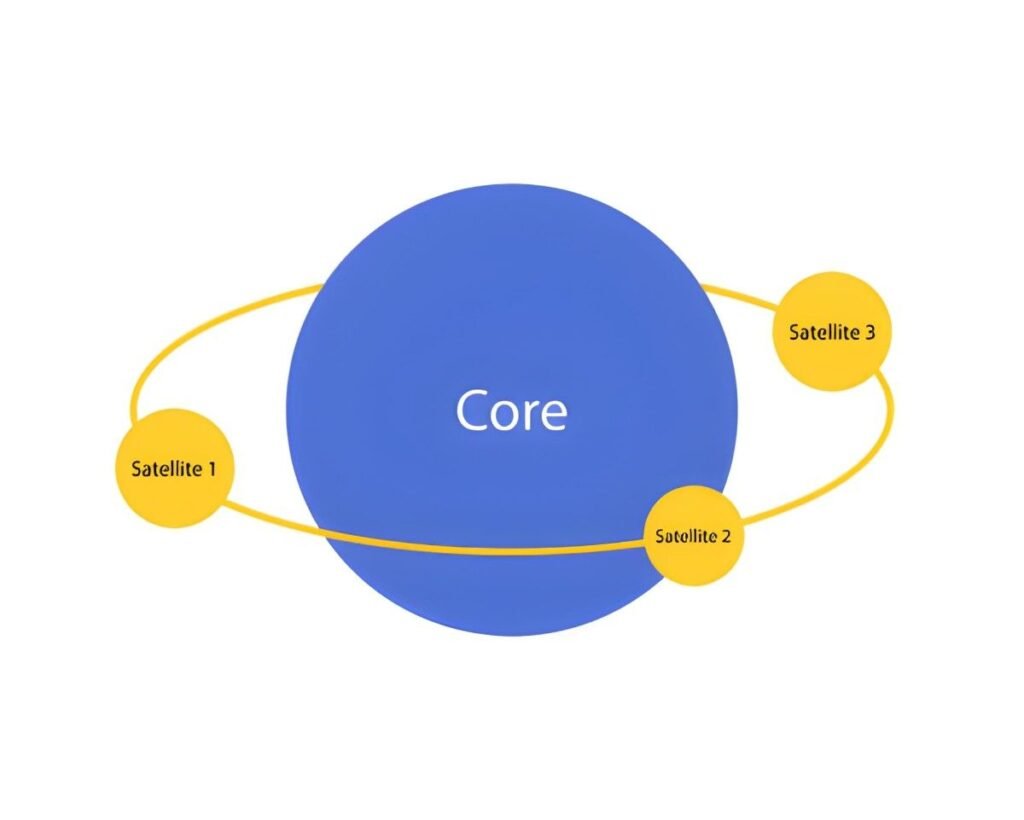
The core-satellite approach to asset allocation is a widely used investment strategy that blends stability with targeted growth opportunities. It combines a “core” portfolio, designed for broad market exposure and risk management, with “satellite” holdings focused on higher-risk, higher-return assets. This framework enables investors to pursue alpha while maintaining a disciplined, diversified foundation.
Understanding the Core-Satellite Structure
The core-satellite approach divides the portfolio into two distinct components:
- Core Portfolio – Represents the majority of the portfolio, typically 60–80%, and is invested in broadly diversified, low-cost instruments. The primary goals are:
- Market-matching returns
- Risk mitigation
- Stability and liquidity
- Satellite Portfolio – Typically 20–40% of the portfolio, targeting higher-risk, higher-return opportunities. Satellites are actively managed and can include:
- Sector or thematic ETFs
- Small-cap or emerging-market stocks
- Alternative investments like real estate, commodities, or private equity
This structure allows investors to pursue additional returns without compromising the portfolio’s stability.
Core Portfolio Characteristics
| Feature | Description |
|---|---|
| Asset Types | Broad-market equities, bonds, ETFs |
| Risk Level | Low to moderate |
| Expected Return | Market-average |
| Management Style | Passive, low-cost |
| Purpose | Stability, diversification, foundation |
Example Core Allocation
| Asset Class | Allocation | Purpose |
|---|---|---|
| U.S. Total Market ETF | 50% | Broad equity growth |
| International Equity ETF | 20% | Global diversification |
| Bond Index Fund | 20% | Income and risk mitigation |
| Cash / Short-Term Instruments | 10% | Liquidity |
The core portfolio provides a stable anchor, allowing satellite investments to pursue growth without significantly increasing overall portfolio risk.
Satellite Portfolio Characteristics
| Feature | Description |
|---|---|
| Asset Types | Sector ETFs, small-cap stocks, alternative investments |
| Risk Level | Moderate to high |
| Expected Return | Above-market potential |
| Management Style | Active, tactical, or opportunistic |
| Purpose | Alpha generation, thematic or strategic exposure |
Example Satellite Allocation
- 10% Technology ETF – Capturing high-growth innovations
- 5% Real Estate Investment Trusts (REITs) – Income and diversification
- 5% Emerging Markets ETF – Exposure to high-growth international markets
Satellite investments are flexible and tactical, allowing portfolio managers to adapt to changing market conditions or emerging opportunities.
Benefits of the Core-Satellite Approach
- Diversification and Stability – The core ensures broad market exposure and reduces volatility.
- Targeted Growth – Satellites allow selective pursuit of alpha without risking the foundation.
- Cost Efficiency – Core investments are typically low-cost passive vehicles, minimizing fees.
- Flexibility – Satellite allocation can be adjusted based on market trends, investor objectives, or risk tolerance.
- Behavioral Advantages – Reduces the temptation to trade excessively, since the core provides stability.
Implementation Considerations
- Determining Core-Satellite Split – Depends on investor risk tolerance, time horizon, and return objectives. Common ranges:
- Core: 60–80%
- Satellite: 20–40%
- Rebalancing – Regularly adjust allocations to maintain target weights and risk exposure.
Example:
- Target allocation: Core 70%, Satellite 30%
- Current: Core 72%, Satellite 28%, Total portfolio $500,000
- Rebalance: Sell $10,000 of core holdings and invest in satellite positions.
- Risk Management – Ensure satellite positions do not dominate the portfolio or create unintended concentration risk.
- Cost Management – Satellites may involve higher management fees; monitor expenses relative to potential returns.
Suitability
- Long-Term Investors – Ideal for retirement accounts and wealth accumulation strategies.
- Moderate to Aggressive Risk Tolerance – Balances the need for growth with risk management.
- Diversified Portfolios – Supports integration of alternative or thematic investments without destabilizing the core.
Example Portfolio
| Segment | Allocation | Example Investments | Objective |
|---|---|---|---|
| Core | 70% | Total Market ETF, Bond Index Fund | Stability, broad market exposure |
| Satellite | 30% | Technology ETF, REITs, Emerging Markets ETF | Growth, alpha, thematic exposure |
Assuming a total portfolio value of $500,000:
- Core: $350,000
- Satellite: $150,000
The satellite segment enhances returns while the core maintains a stable risk-adjusted foundation.
Conclusion
The core-satellite approach to asset allocation provides a balanced framework for long-term investors. The core offers stability, diversification, and cost efficiency, while satellite investments allow tactical growth, sector exposure, and higher-risk opportunities. This structure delivers flexibility, risk management, and potential for enhanced returns, making it an effective strategy for achieving long-term financial objectives while maintaining discipline and stability.



