
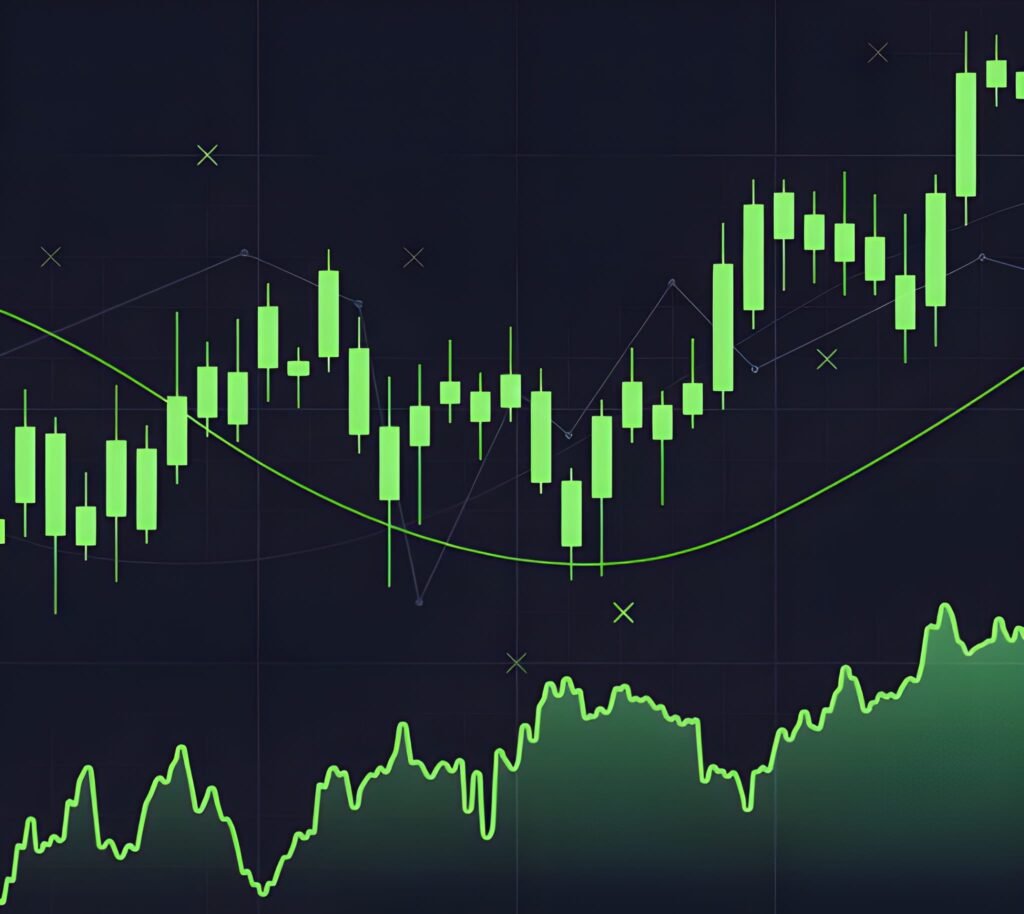
Convergence & Divergence: The Logic of Spread Momentum
Harnessing Relative Price Velocity and Statistical Imbalances to Capture Market-Neutral Momentum Alpha
Defining Spread Momentum: Beyond Directional Risk
Traditional momentum trading focuses on the absolute path of a single asset. Spread momentum trading, however, focuses on the delta between two correlated assets. It is the practice of identifying when a relationship—such as the ratio between Gold and Silver, or two competing technology stocks—begins to expand or contract with significant velocity. This methodology assumptions that while the individual assets may be volatile, their relative performance often follows a more predictable structural trend.
The primary advantage of spread momentum is the reduction of "Beta" risk. By being long the stronger asset and short the weaker one, the trader creates a position that is largely insulated from broad market crashes. If the entire market drops 10%, but your long leg drops only 8% while your short leg drops 12%, the spread has gained 4%. This is the essence of "Market Neutral" momentum, where the goal is to harvest alpha from relative strength rather than directional luck.
Success in spread momentum requires a transition from "stock picking" to statistical relationship mapping. We are not betting on a stock; we are betting on a dislocation. We identify when a historical correlation breaks and use momentum indicators to determine if that break is a "Noise Event" (mean reversion candidate) or a "Structural Shift" (momentum candidate).
The Mathematics of the Spread: Ratio vs. Difference
To analyze spread momentum, we must first define the spread mathematically. There are two primary models used by quantitative desks: the Price Difference and the Price Ratio.
The Difference model (Asset A - Asset B) is standard for futures where the point values are equal (e.g., Crude Oil vs. Heating Oil). For equities, the Ratio model (Asset A / Asset B) is superior because it accounts for the disparate price levels of the assets. We then apply momentum oscillators (RSI, ROC) directly to the Resultant Curve of this calculation.
Spread_Curve = Price_Asset_A / Price_Asset_B
Spread_Momentum = (Spread_Curve_Current - Spread_Curve_20D_Ago) / Spread_Curve_20D_Ago
# Implementation Rule:
If Spread_Momentum > 2.0 * Std_Dev(Spread_Momentum):
Action = Buy Spread (Long A, Short B)
Pairs Trading Momentum: The Competitive Advantage
Pairs trading is the classic equity spread strategy. We pair two companies in the same sub-industry (e.g., Coca-Cola vs. Pepsi, or AMD vs. NVIDIA). Under normal conditions, these stocks move in lockstep. A momentum opportunity arises when one company releases a Structural Catalyst—such as an earnings acceleration or a technological breakthrough—that causes it to decouple from its peer.
We look for the "Momentum Breakout" of the spread ratio. If the ratio has been sideways for six months and suddenly surges on high relative volume (volume in A > volume in B), it signals that institutional capital is re-weighting the sector. The spread momentum specialist enters at this pivot, betting that the "Winner" will continue to outpace the "Laggard" for the duration of the cycle.
Statistical Arb
Focuses on mean reversion. Sells the spread when it is "too wide" and buys when "too narrow." High win rate, low profit-per-trade.
Spread Momentum
Focuses on trend persistence. Buys the spread as it widens, betting on continued divergence. High profit-per-trade, lower win rate.
Hedged Sector Momentum
Long the leading sector (XLK) and short the lagging sector (XLP). Captures macro-rotation velocity with reduced market exposure.
Inter-Commodity Velocity: The Global Macro Impulse
Commodity spreads are the "Pure" version of spread momentum. Because commodities have physical supply/demand relationships, their spreads often exhibit vertical, multi-month momentum phases. Common spreads include:
- The Crack Spread: Crude Oil vs. Gasoline. Measures the profitability of refiners.
- The Gold/Silver Ratio: Measures monetary vs. industrial demand.
- The Soybean Crush: Raw Soybeans vs. Soy Meal and Oil.
In these markets, momentum is driven by Physical Shortages. If a refinery fire occurs, the spread between Gasoline and Crude Oil will exhibit explosive momentum as Gasoline accelerates while Crude remains stable. These trends are often more durable than equity trends because they are constrained by the physical laws of production.
Spread Breakout Triggers: Identifying the Turn
To execute spread momentum, we utilize Volatility Bands applied to the Spread Curve. We plot a 20-period moving average of the spread ratio with a 2.0 standard deviation band.
A momentum signal is triggered when the spread curve closes outside the band and remains there for three consecutive sessions. This "Band Walking" in a spread is the undeniable sign of institutional capital migration. We utilize the same candlestick "Ignition Bar" logic discussed in our Price Action Guide, but applied to the synthetic ratio line.
Legging Risk & Volatility Normalization
The greatest danger in spread momentum is Legging Risk—the danger that one side of your trade executes while the other fails, or that the volatility of the two legs is not properly balanced.
Expert traders use Beta-Neutral Position Sizing. If Stock A is twice as volatile as Stock B, you cannot trade them 1-for-1. You must hold half as much of Stock A to ensure that a 1% move in Stock A has the same dollar impact as a 1% move in Stock B. Without this volatility normalization, your "spread" is actually just a directional bet on the more volatile asset.
A spread momentum trade is predicated on the assets being related. If the 60-day correlation between Asset A and Asset B drops below 0.5, the spread is no longer statistically valid. The "momentum" may be random noise. A professional exits spread trades immediately if the underlying assets become "un-correlated," as the risk-reduction benefits of the spread vanish.
Institutional Spread Routing
Executing spreads requires a platform that supports Simultaneous Multi-Leg Routing. If you manually buy A and then manually sell B, you suffer from "Execution Lag," which can erode 10-20% of your momentum edge.
Professional platforms (as discussed in our Platform Analysis) utilize "Synthetic Spread Routings." You send a single order to buy the ratio at a specific level, and the broker's algorithm manages the execution of both legs simultaneously to ensure the spread value is locked in. This is the only way to trade high-velocity spreads without succumbing to slippage.
Final Investment Verdict
Spread momentum trading is the ultimate high-performance discipline for the analytical trader. It strips away the uncertainty of the broad market and focuses exclusively on the Competitive Efficiency of assets. By identifying when relationships break and aligning with the velocity of that break, you capture a form of alpha that is invisible to the retail crowd.
The strategy requires the discipline to manage two positions as one unit and the mathematical rigor to normalize for volatility. Success is found not in the news cycle, but in the widening gap between the leaders and the laggards. Master the ratio, respect the correlation, and let the relative velocity drive your returns.
Relative Velocity Summary
Identify related pairs, define the ratio, wait for the volatility band breakout, and ensure beta-neutral sizing. Momentum in spreads is the signature of structural market change.
Execution Status: Spread-Neutral Active
Expert Technical References:
1. Whistler, M. (2004). Trading Pairs: Relative Value Trading Strategies. Wiley.
2. Vidyamurthy, G. (2004). Pairs Trading: Quantitative Methods and Analysis. Wiley Finance.
3. Meissner, G. (2016). Correlation Risk Modeling and Management. Wiley.


