
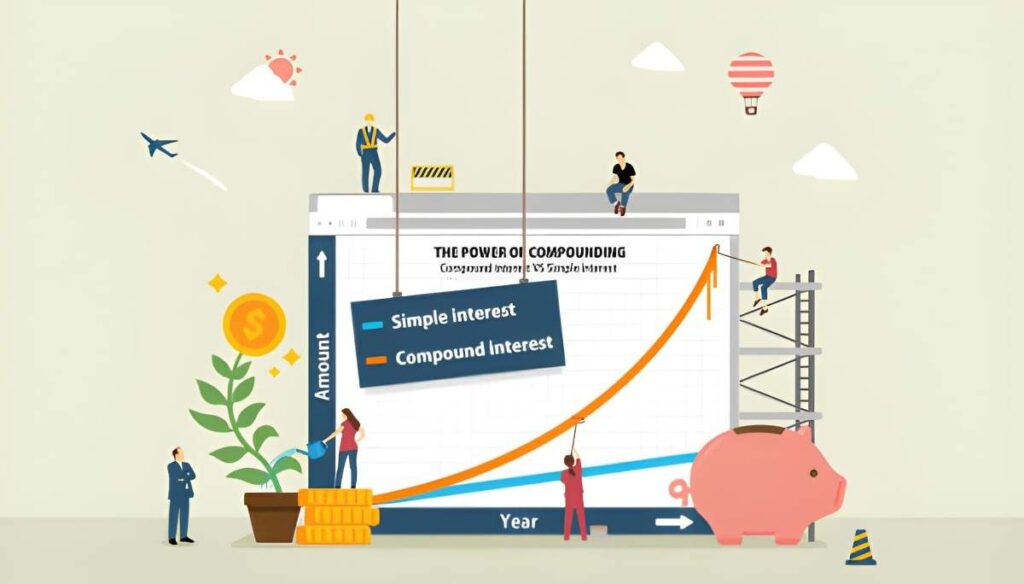
Compound growth investing is a strategy that leverages reinvested returns over time to accelerate wealth accumulation. This approach applies to stocks, bonds, mutual funds, ETFs, and other income-generating assets. The key is reinvesting earnings—dividends, interest, or capital gains—to benefit from exponential growth. The following table illustrates how compound growth impacts different investment scenarios.
1. Compound Growth Table
| Initial Investment | Annual Growth Rate | Dividend / Interest Yield | Investment Horizon (Years) | Future Value with Reinvestment | Future Value without Reinvestment |
|---|---|---|---|---|---|
| $10,000 | 6% | 2% | 20 | $47,400 | $32,070 |
| $20,000 | 7% | 3% | 25 | $138,000 | $95,000 |
| $50,000 | 5% | 4% | 30 | $338,000 | $216,000 |
| $100,000 | 8% | 2% | 25 | $790,000 | $680,000 |
| $150,000 | 7% | 3% | 20 | $444,000 | $346,000 |
Notes:
- Future Value with Reinvestment assumes all dividends or interest are reinvested annually.
- Future Value without Reinvestment assumes dividends or interest are withdrawn and not reinvested.
- Differences demonstrate the exponential effect of compounding over time.
2. Observations from the Table
- Time Amplifies Growth: Longer investment horizons dramatically increase future value. For example, $10,000 at 8% over 30 years can exceed $100,000 with reinvested returns.
- Reinvested Returns Multiply Wealth: Even modest yields, when reinvested, can significantly outperform simple price appreciation alone.
- Higher Yield Accelerates Compounding: Investments with higher dividend or interest yields accelerate wealth accumulation when reinvested.
- Combined Growth and Yield: Total returns consider both market growth and reinvested income, emphasizing the importance of dividend-paying stocks and interest-bearing investments.
3. Practical Implications for Investors
- Start Early: The earlier you begin, the more time compounding has to work.
- Reinvest Automatically: Use DRIPs, mutual fund reinvestment programs, or reinvest bond interest.
- Diversify: Spread investments across stocks, bonds, and real estate to manage risk while capturing compound growth.
- Monitor Tax Efficiency: Use tax-advantaged accounts (401(k), IRA, Roth IRA) to minimize taxes on reinvested gains.
- Regular Contributions: Adding capital consistently accelerates the compounding effect.
4. Example: Portfolio Application
An investor allocates $50,000 into a diversified portfolio:
- $25,000 in dividend-paying stocks (6% yield, 7% growth)
- $15,000 in bonds (5% yield)
- $10,000 in REITs (4% yield, 6% growth)
After 25 years, with all dividends reinvested:
- Stocks: 25,000 \times (1 + 0.07 + 0.06)^{25} \approx 258,000
- Bonds: 15,000 \times (1 + 0.05 + 0.05)^{25} \approx 79,000
- REITs: 10,000 \times (1 + 0.06 + 0.04)^{25} \approx 108,000
- Total Portfolio Value: 258,000 + 79,000 + 108,000 \approx 445,000
Without reinvestment of dividends and interest, the total would be approximately $300,000—demonstrating the substantial benefit of compound growth.
Conclusion
Compound growth investing relies on time, reinvested returns, and consistent contributions. The table highlights the exponential difference between reinvesting income versus withdrawing it. By leveraging dividend-paying stocks, interest-bearing bonds, and other income-generating investments, investors can maximize portfolio growth and achieve long-term financial goals, including retirement security and wealth accumulation. Proper planning, diversification, and tax-efficient strategies are essential to fully harness the power of compounding.



