
Asset allocation shapes the foundation of any investment strategy. As a finance expert, I see investors struggle with balancing risk and return. The average American investor often lacks a clear framework. This article explores how typical U.S. households allocate assets, the math behind optimal portfolios, and practical steps to improve diversification.
Table of Contents
Understanding Asset Allocation
Asset allocation divides investments across categories like stocks, bonds, real estate, and cash. The goal is to maximize returns while managing risk. The right mix depends on age, goals, and risk tolerance.
The Math Behind Asset Allocation
Modern Portfolio Theory (MPT) suggests that diversification reduces risk. The expected return E(R_p) of a portfolio is the weighted sum of individual asset returns:
E(R_p) = \sum_{i=1}^{n} w_i E(R_i)Where:
- w_i = weight of asset i
- E(R_i) = expected return of asset i
Risk (standard deviation) of the portfolio considers covariance between assets:
\sigma_p = \sqrt{\sum_{i=1}^{n} \sum_{j=1}^{n} w_i w_j \sigma_i \sigma_j \rho_{ij}}Where:
- \sigma_i, \sigma_j = standard deviations of assets i and j
- \rho_{ij} = correlation coefficient between assets
How the Average American Allocates Assets
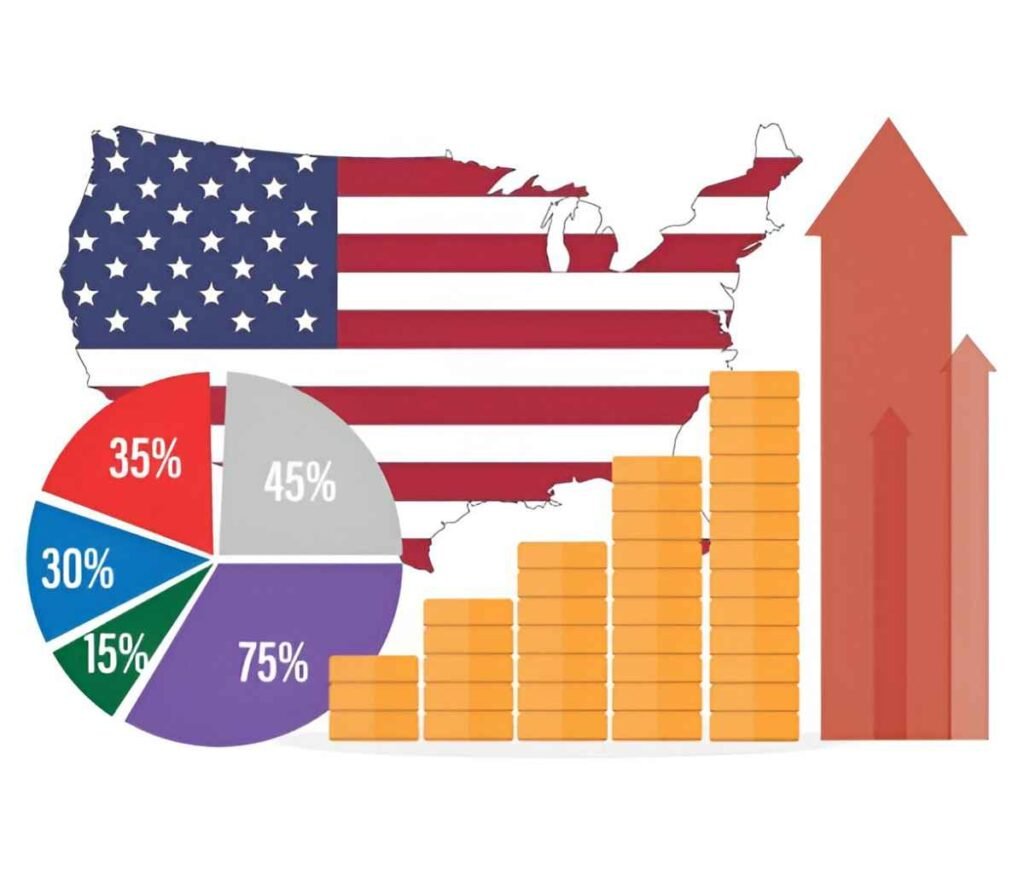
Most U.S. households follow a conservative approach. Federal Reserve data (2022) shows:
| Asset Class | Average Allocation (%) |
|---|---|
| Stocks | 35% |
| Bonds | 15% |
| Real Estate | 30% |
| Cash | 20% |
This allocation leans toward homeownership and cash, often at the expense of equities. Younger investors typically hold more stocks, while retirees favor bonds and cash.
Common Mistakes in Asset Allocation
Overweighting Home Equity
Many Americans treat their home as a primary investment. Real estate is illiquid and concentrated. A 30% allocation may limit portfolio growth.
Holding Too Much Cash
Fear of market downturns leads to excessive cash holdings. Inflation erodes purchasing power. A 20% cash allocation is often too high for long-term growth.
Ignoring Tax Efficiency
Taxable accounts, 401(k)s, and IRAs have different tax implications. Bonds belong in tax-deferred accounts, while stocks fit taxable accounts due to lower capital gains rates.
Optimal Asset Allocation Strategies
The 60/40 Portfolio
A classic mix of 60% stocks and 40% bonds balances growth and stability. Historical returns (1926-2023) show:
- Stocks: ~10% annual return
- Bonds: ~5% annual return
This portfolio returned ~8% annually with lower volatility than pure equities.
Age-Based Allocation
A simple rule is 100 - \text{age} = \text{stock allocation}. A 40-year-old would hold 60% stocks. This adjusts risk as retirement nears.
Risk-Adjusted Approaches
Investors can use the Sharpe ratio to compare portfolios:
\text{Sharpe Ratio} = \frac{E(R_p) - R_f}{\sigma_p}Where:
- R_f = risk-free rate
A higher Sharpe ratio means better risk-adjusted returns.
Case Study: Adjusting an Average Portfolio
Suppose a 45-year-old has:
- 50% in stocks
- 10% in bonds
- 30% in real estate
- 10% in cash
This portfolio is too conservative. I recommend:
- Increase stocks to 65% (S&P 500 + international)
- Bonds to 25% (Treasuries + corporate)
- Reduce real estate to 5% (REITs instead of direct ownership)
- Cut cash to 5%
This shift improves expected returns while maintaining diversification.
Behavioral Factors in Asset Allocation
Investors often chase past performance. After a stock rally, many overallocate to equities. Conversely, market crashes trigger panic selling. Discipline matters more than timing.
Final Thoughts
The average American investor holds too much cash and real estate. A structured approach—using age, risk tolerance, and tax efficiency—creates a stronger portfolio. Math guides decisions, but behavior determines success. Start with a simple 60/40 split, then adjust based on personal factors. The key is consistency, not complexity.



