
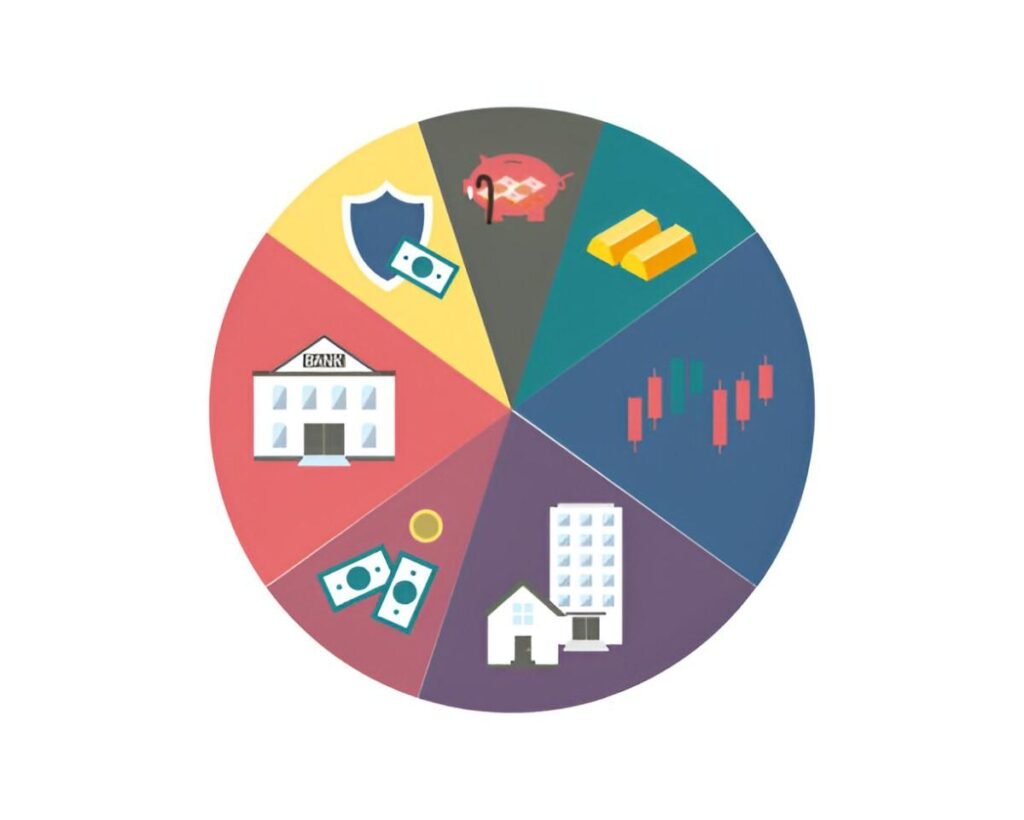
Asset allocation determines how I split my investments among different asset classes like stocks, bonds, and cash. The right mix balances risk and reward based on my financial goals, time horizon, and risk tolerance. Many investors make the mistake of chasing past performance or reacting to market swings, leading to poor allocation decisions. In this guide, I break down how to fix my asset allocation, optimize returns, and reduce unnecessary risk.
Table of Contents
Why Asset Allocation Matters
Studies show that asset allocation drives over 90% of portfolio performance, far more than individual stock picks or market timing (Ibbotson & Kaplan, 2000). A well-structured mix helps me:
- Reduce volatility – Diversification smooths out returns.
- Improve risk-adjusted returns – I get more reward per unit of risk.
- Stay disciplined – A clear strategy prevents emotional decisions.
The Role of Risk Tolerance
Before fixing my allocation, I need to assess my risk tolerance. A simple rule: the longer my time horizon, the more risk I can take. A 30-year-old saving for retirement can afford more stocks than a 60-year-old nearing retirement.
The Core Asset Classes
I categorize investments into three main buckets:
- Equities (Stocks) – High growth potential but volatile.
- Fixed Income (Bonds) – Lower returns but stable.
- Cash & Equivalents – Minimal risk, minimal return.
Historical Performance
Looking at historical data helps me set realistic expectations:
| Asset Class | Avg. Annual Return (1928-2023) | Worst Year | Best Year |
|---|---|---|---|
| Large-Cap Stocks | 10.2% | -43.1% (1931) | 54.2% (1933) |
| Bonds | 5.5% | -8.1% (1969) | 32.6% (1982) |
| Cash (T-Bills) | 3.4% | 0.0% (2021) | 14.7% (1981) |
Source: S&P 500, Bloomberg Barclays Indices
How to Determine My Ideal Allocation
The 100 Minus Age Rule
A traditional approach suggests:
\text{Stock Allocation} = 100 - \text{Age}If I’m 40, I’d hold 60% stocks and 40% bonds. However, this may be too conservative for longer lifespans today.
Modern Adjustments
A more aggressive variant:
\text{Stock Allocation} = 120 - \text{Age}This keeps me invested longer, capturing more growth.
Risk-Based Allocation
Instead of age, I can base my mix on risk tolerance:
| Risk Profile | Stocks | Bonds | Cash |
|---|---|---|---|
| Conservative | 40% | 50% | 10% |
| Moderate | 60% | 35% | 5% |
| Aggressive | 80% | 15% | 5% |
The Math Behind Optimal Allocation
Expected Return Calculation
My portfolio’s expected return (E(R_p)) is a weighted average of each asset’s return:
E(R_p) = w_s \times E(R_s) + w_b \times E(R_b) + w_c \times E(R_c)Where:
- w_s, w_b, w_c = weights of stocks, bonds, cash
- E(R_s), E(R_b), E(R_c) = expected returns
Example: If I have 70% stocks (expected return 8%), 25% bonds (expected return 3%), and 5% cash (expected return 1%), my portfolio’s expected return is:
E(R_p) = 0.70 \times 0.08 + 0.25 \times 0.03 + 0.05 \times 0.01 = 0.056 + 0.0075 + 0.0005 = 6.4\%Risk Measurement (Standard Deviation)
Diversification reduces overall risk. The portfolio variance (\sigma_p^2) is:
\sigma_p^2 = w_s^2 \sigma_s^2 + w_b^2 \sigma_b^2 + 2 w_s w_b \rho_{s,b} \sigma_s \sigma_bWhere:
- \sigma_s, \sigma_b = standard deviations of stocks and bonds
- \rho_{s,b} = correlation between stocks and bonds
Historically, stocks and bonds have low correlation (\rho \approx -0.2), meaning bonds often rise when stocks fall.
Rebalancing: Keeping My Mix on Track
Over time, market movements shift my allocation. Rebalancing restores my target mix.
Example of Rebalancing
Suppose I start with:
- Stocks: $60,000 (60%)
- Bonds: $40,000 (40%)
After a year:
- Stocks grow 10% → $66,000
- Bonds grow 2% → $40,800
- New total: $106,800
Now, stocks make up \frac{66,000}{106,800} = 61.8\%, and bonds are 38.2%. To rebalance, I sell some stocks and buy bonds to return to 60/40.
When to Rebalance?
- Time-based: Quarterly, annually.
- Threshold-based: When an asset deviates by ±5%.
Tax Considerations
Rebalancing in taxable accounts triggers capital gains. To minimize taxes, I can:
- Rebalance in tax-advantaged accounts (401(k), IRA).
- Use dividends to buy underweight assets.
Common Mistakes to Avoid
- Overconcentration in One Asset – Holding too much in employer stock or tech shares increases risk.
- Ignoring Inflation – Cash-heavy portfolios lose purchasing power over time.
- Chasing Performance – Buying high and selling low destroys returns.
Final Thoughts
Fixing my asset allocation requires discipline, math, and self-awareness. By setting a clear mix, rebalancing regularly, and avoiding emotional decisions, I position myself for long-term success. The right allocation isn’t static—it evolves with my life stage and market conditions. The key is staying the course.



