
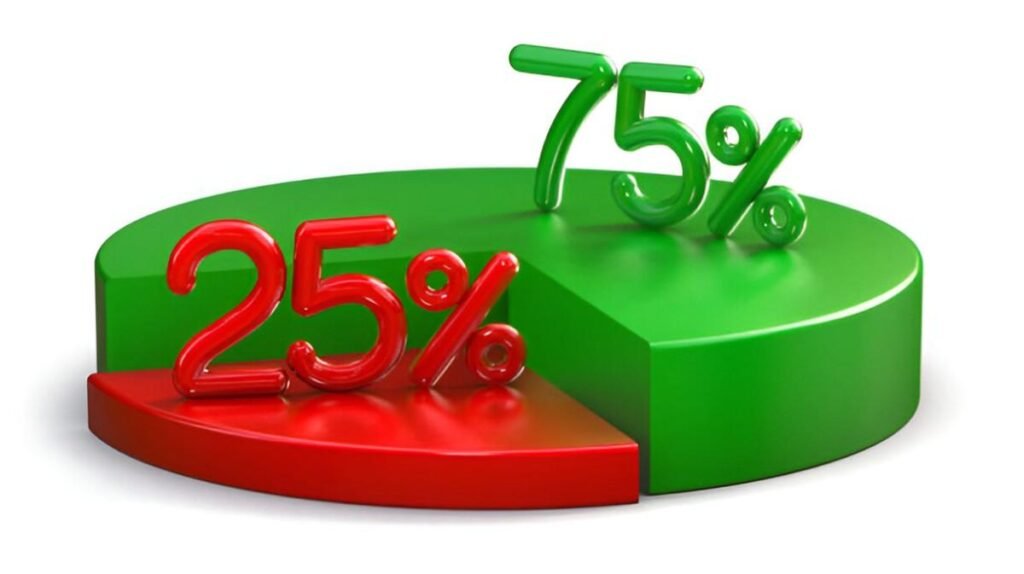
As a finance professional, I often get asked about the best way to allocate assets for long-term growth without taking excessive risk. One strategy I frequently recommend is the 75/25 asset allocation—a balanced mix of 75% equities and 25% bonds. This approach strikes a middle ground between aggressive growth and capital preservation, making it suitable for investors with moderate risk tolerance.
Table of Contents
Understanding Asset Allocation
Asset allocation is the process of dividing investments among different asset classes—such as stocks, bonds, and cash—to balance risk and reward. The 75/25 split leans toward growth while maintaining a defensive cushion.
Why 75% Stocks?
Stocks historically outperform other asset classes over the long term. According to data from Morningstar (2023), the S&P 500 has delivered an average annual return of about 10% before inflation since 1926. By allocating 75% to equities, investors capture substantial growth potential.
Why 25% Bonds?
Bonds provide stability. When stocks decline, bonds often rise or hold their value, reducing portfolio volatility. The Bloomberg U.S. Aggregate Bond Index has returned roughly 4-6% annually over the past 30 years. A 25% bond allocation softens market downturns.
The Math Behind 75/25 Allocation
A well-structured portfolio isn’t just about percentages—it’s about how these assets interact. Let’s examine expected returns and risk using basic portfolio theory.
Expected Portfolio Return
The expected return E(R_p) of a 75/25 portfolio can be calculated as:
E(R_p) = w_s \times E(R_s) + w_b \times E(R_b)Where:
- w_s = weight of stocks (75%)
- E(R_s) = expected return of stocks (10%)
- w_b = weight of bonds (25%)
- E(R_b) = expected return of bonds (5%)
Plugging in the numbers:
E(R_p) = 0.75 \times 10\% + 0.25 \times 5\% = 8.75\%This suggests an 8.75% expected annual return before costs and taxes.
Portfolio Risk (Standard Deviation)
Risk is measured by standard deviation (\sigma). A diversified portfolio’s risk isn’t just a weighted average—it also depends on correlation (\rho).
The formula for a two-asset portfolio is:
\sigma_p = \sqrt{w_s^2 \sigma_s^2 + w_b^2 \sigma_b^2 + 2 w_s w_b \rho_{s,b} \sigma_s \sigma_b}Assume:
- Stocks (\sigma_s) = 15%
- Bonds (\sigma_b) = 5%
- Correlation (\rho_{s,b}) = -0.2 (historically, stocks and bonds often move inversely)
Then:
\sigma_p = \sqrt{(0.75^2 \times 15^2) + (0.25^2 \times 5^2) + (2 \times 0.75 \times 0.25 \times -0.2 \times 15 \times 5)} \sigma_p = \sqrt{126.5625 + 1.5625 - 5.625} = \sqrt{122.5} \approx 11.07\%This means the portfolio’s volatility is 11.07%, lower than pure equities (15%) but higher than bonds alone (5%).
Historical Performance of 75/25 vs. Other Allocations
How has this allocation performed in real markets? Below is a comparison of different stock/bond mixes from 1972 to 2022 (source: Portfolio Visualizer).
| Allocation (Stocks/Bonds) | CAGR (%) | Max Drawdown | Best Year | Worst Year |
|---|---|---|---|---|
| 100/0 | 10.24 | -50.89% | 37.20% | -37.04% |
| 75/25 | 9.51 | -35.99% | 29.72% | -26.61% |
| 60/40 | 9.09 | -30.31% | 25.86% | -22.42% |
| 50/50 | 8.69 | -26.54% | 22.85% | -19.74% |
Key takeaways:
- The 75/25 portfolio delivered 9.51% annualized returns—only 0.73% less than 100% stocks but with 30% smaller drawdowns.
- It outperformed the classic 60/40 portfolio by 0.42% annually while still being less volatile than all-equities.
When Does 75/25 Work Best?
This allocation shines in moderate-growth environments where investors want:
- Higher returns than conservative portfolios (e.g., 50/50)
- Lower volatility than aggressive portfolios (e.g., 90/10)
Ideal Investor Profile
- Age: 30-50 (accumulation phase)
- Risk Tolerance: Moderate (can handle 20-30% declines)
- Time Horizon: 10+ years
Adjustments for Different Scenarios
- Near Retirement? Shift to 60/40 to reduce sequence-of-returns risk.
- Bull Market? Rebalance to lock in gains.
- High Inflation? Increase TIPS (Treasury Inflation-Protected Securities) within the bond portion.
Rebalancing Strategies
A 75/25 allocation requires periodic rebalancing to maintain the target mix. Two common methods:
- Time-Based Rebalancing (e.g., annually)
- Threshold-Based Rebalancing (e.g., when allocations deviate by ±5%)
Example: Rebalancing After a Market Rally
Assume:
- Initial portfolio: $100,000 (75% stocks, 25% bonds)
- Stocks surge 20%, bonds stay flat.
- New values:
- Stocks: $90,000 × 1.20 = $108,000
- Bonds: $25,000
- Total: $133,000
- New weights: 81.2% stocks, 18.8% bonds
To rebalance:
- Sell $8,475 of stocks
- Buy $8,475 of bonds
- Final: $99,525 stocks (75%), $33,475 bonds (25%)
This disciplined selling high and buying low enhances returns over time.
Tax Considerations
In taxable accounts, rebalancing can trigger capital gains. Strategies to minimize taxes:
- Use tax-advantaged accounts (401(k), IRA) for rebalancing.
- Employ tax-loss harvesting to offset gains.
- Consider ETF tax efficiency over mutual funds.
Criticisms of 75/25
No strategy is perfect. Some argue:
- Bonds drag down returns in long bull markets.
- Correlation shifts—if stocks and bonds fall together (as in 2022), diversification benefits weaken.
- Low bond yields post-2008 reduce expected returns.
Yet, for most investors, the trade-off between risk and reward remains favorable.
Final Thoughts
The 75/25 asset allocation is a robust middle-ground strategy. It provides growth through equities while mitigating risk with bonds. Historical data supports its effectiveness, and the math behind portfolio construction confirms its stability.



