
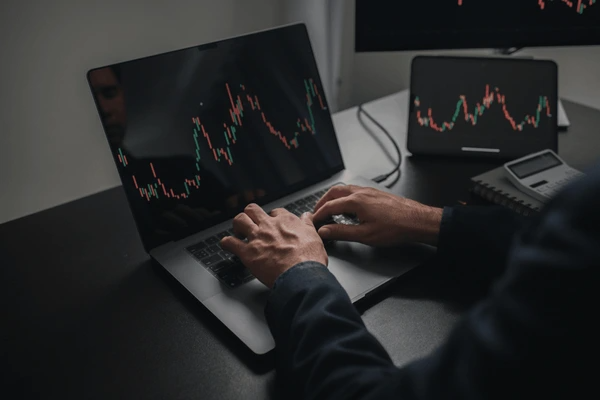
Small Capital, Big Logic: The Quantitative Path for a $5,000 Account
Evaluating the mathematics, regulatory hurdles, and strategic survival of the micro-quant.
The Democratization of the Trading Stack
For decades, algorithmic trading was a gated community. The entry fee was measured in millions of dollars—capital required to fund high-speed servers, proprietary data feeds, and institutional prime brokerage seats. Today, that landscape is unrecognizable. A trader with $5,000 has access to the same Python libraries, the same execution APIs, and largely the same market data as a boutique hedge fund. This democratization has turned algorithmic trading from an institutional secret into a scalable retail venture.
But the question remains: Can a $5,000 account actually generate meaningful profits? The answer is a qualified yes, but it requires a fundamental shift in mindset. You are no longer "trading the markets" in the traditional sense; you are managing a statistical factory. In this factory, $5,000 is your initial inventory, and your algorithm is the machine that processes that inventory into profit. The challenge is not the market itself, but the friction of the world around it.
The $5,000 Hurdle: Fixed Costs vs. Returns
The biggest enemy of a small account is not a bad trade, but fixed costs. In the quantitative world, costs like data feeds, server hosting (VPS), and software licensing do not scale with your account size. If a data feed costs $100 per month, that is a negligible 0.001% for a million-dollar fund, but it is a massive 2% per month hurdle for a $5,000 account. You are already starting the month down 24% annually just to keep the lights on.
The Retail Squeeze
Small accounts must prioritize "Low-Friction" environments. This means seeking out brokers with zero commissions and free data feeds, or utilizing assets like Spot Forex or Crypto where data costs are often baked into the spread.
The Scale Paradox
As your capital grows, your percentage overhead drops. The first $5,000 is the hardest to trade because the "Drag" of operational costs is at its peak. Efficiency must be your primary metric.
The Regulatory Wall: Navigating the PDT Rule
For US-based traders focusing on equities, the Pattern Day Trader (PDT) Rule is the most significant hurdle. This SEC regulation requires a minimum equity of $25,000 to day trade in a margin account. If you attempt to run a high-frequency equity algorithm with $5,000, your broker will likely freeze your account after the third day of trading.
Traders with $5,000 who insist on equities must either use a "Cash Account"—which limits you to trading only settled funds (meaning you can't trade the same dollar twice in two days)—or focus on swing-trading strategies where positions are held for multiple days, thus avoiding the "day trader" designation entirely.
Leverage and Margin: The Double-Edged Blade
With only $5,000, leverage becomes a seductive necessity. In the Forex market, brokers might offer 50:1 leverage. In the Futures market, a "Micro" contract allows you to control $15,000 worth of the S&P 500 with just a few hundred dollars of margin. Leverage allows you to amplify your $5,000 into a larger functional size, but for an algorithm, leverage is a risk multiplier.
An algorithm that is 10x leveraged only needs the market to move 10% against it to wipe out the entire $5,000 account. Because algorithms execute based on logic rather than intuition, they can rapidly enter a series of losing trades during a "regime shift," liquidating a small account before the human operator can even log in to check the server status.
High-Probability Strategies for Small Accounts
Certain strategies are mathematically better suited for small capital. When you have $5,000, you cannot afford to "wait out" a 20% drawdown. You need strategies with high win rates and low correlations.
| Strategy Class | Best Asset | Frequency | Risk Profile |
|---|---|---|---|
| Mean Reversion | Forex Pairs | Intraday | Lower Volatility, High Win Rate |
| Momentum | Crypto (Altcoins) | Multi-Day | High Volatility, Trend Following |
| Basis Arbitrage | Futures/Spot | Continuous | Market Neutral, Low Margin |
| Statistical Arb | Micro-Futures | Intraday | Pair-based, High Turnover |
Compounding Simulation: A $5,000 Roadmap
The power of algorithmic trading is not in the "home run" trade, but in the law of large numbers. Let's look at a realistic simulation of a micro-quant strategy focused on consistent, small gains.
Starting Capital: $5,000
Average Trades per Week: 20
Win Rate: 55%
Average Winner: $75
Average Loser: $50
Expectancy Calculation:
(0.55 * 75) - (0.45 * 50) = 41.25 - 22.50 = $18.75 per trade
Weekly Profit: 20 * 18.75 = $375
Monthly Profit: $1,500 (30% Monthly Return)
// Caution: This assumes a 1.5 Reward-to-Risk ratio and does not include slippage or commissions. In reality, commissions on 20 trades per week could eat $40-$100 of that profit.
While a 30% monthly return sounds legendary, it is achievable on small capital because you are trading tiny sizes that the market doesn't even notice. As your account grows to $50,000 or $500,000, your slippage will increase, making these percentages much harder to maintain. The "Micro-Account Alpha" is a real phenomenon where smaller is often nimbler.
Broker Selection: Optimizing for Capital Efficiency
For a $5,000 account, your broker is your most important strategic partner. You need a broker that provides an API at no extra cost and offers "fractional" or "micro" assets to allow for proper position sizing.
The "Gold Standard" for serious quants. IBKR offers access to everything from Micro-Futures to Global Forex. Their API is robust, but their data fees can be complex. For a $5,000 account, focus on their tiered commission structure to keep costs at the absolute minimum.
Modern, API-first brokers. Alpaca offers commission-free trading on stocks and crypto. This is ideal for $5,000 accounts because it removes the commission "drag." However, remember the PDT rule if you choose to trade US stocks here.
Excellent for $5,000 accounts. They allow for "unit-based" trading, meaning you can trade as little as 1 unit of a currency. This allows for incredibly precise risk management that isn't possible in the futures or stock markets.
Risk Management and the "Ruin" Threshold
In a $5,000 account, your biggest risk is Mathematical Ruin. Ruin occurs when your account balance drops so low that you no longer have the required margin to place the next trade. If you lose $2,500 (50%), you need to make 100% just to get back to zero. This "asymmetry of loss" is what kills most micro-accounts.
Professional quants use the Kelly Criterion or a fixed-fractional model to ensure they never risk too much on a single signal. For a $5,000 account, a "Max Risk per Trade" should rarely exceed 0.5% ($25). While this feels slow, it ensures that your "factory" can survive a string of 10 or 20 losing trades—which is statistically guaranteed to happen eventually.
Building a Future-Proofed Trading Career
Is algorithmic trading profitable with $5,000? Absolutely. But its true value is not the money you make in the first year; it is the infrastructure you build. If you can successfully manage a $5,000 account using code, you have developed a skill set that is infinitely scalable. The same algorithm that manages $5,000 can, with minor adjustments to execution logic, manage $500,000.
Focus on the "Process" over the "PnL." Document your trades, optimize your API calls, and maintain your server with the discipline of an institutional desk. In the quantitative world, capital is the easy part—the world is full of money looking for an edge. The hard part is building the logic. If you treat your $5,000 account as a world-class laboratory, the profitability will follow as a natural byproduct of your statistical rigor.


