
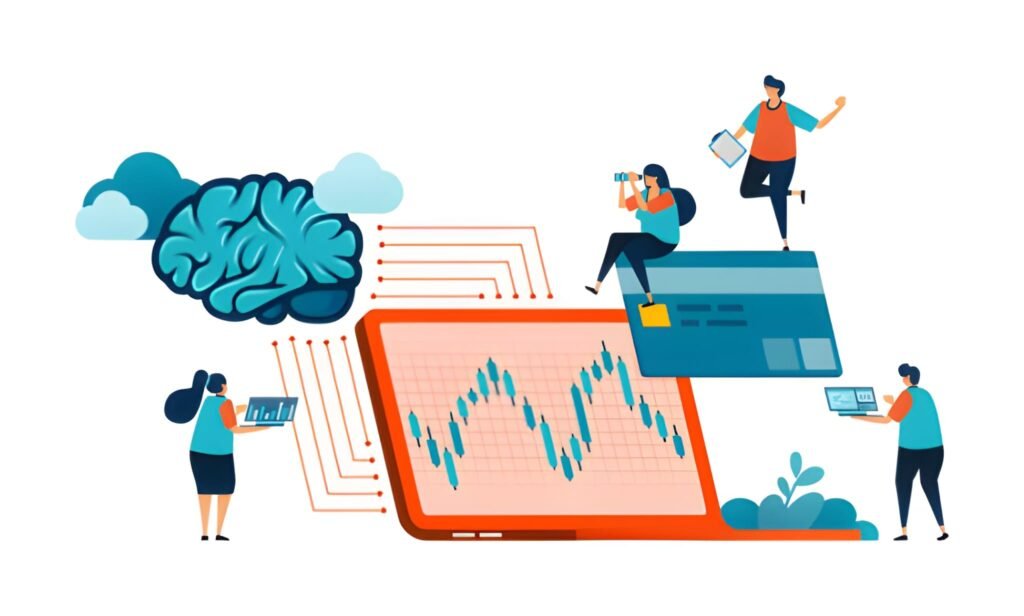
Financial markets are often described as the collective expression of human emotion. Greed, fear, and hope circulate through the order books, manifesting as price movements and volume spikes. In the traditional discretionary era, these emotions were visible in the shouting of brokers on the floor. Today, the marketplace is dominated by cold, calculating algorithms. However, a significant misconception persists: that algorithmic trading has removed psychology from the markets. On the contrary, algorithms have merely digitized it. By understanding the intersection of algorithmic trading and behavioural finance, investors can see how automated systems not only fall victim to human biases but actively exploit the irrationality of the crowd to extract value.
- 1. The Paradox of the Rational Machine
- 2. The Developer's Mirror: Biases in Algorithm Design
- 3. Predatory Algorithms: Exploiting Human Irrationality
- 4. Quantifying the Crowd: Sentiment and NLP
- 5. The Feedback Loop: When Bots Mirror Crowds
- 6. Calculation Case: Loss Aversion and Sizing Logic
- 7. Mitigation Strategies: Building Bias-Resistant Systems
- 8. The Future of Psycho-Quantitative Finance
1. The Paradox of the Rational Machine
The primary promise of algorithmic trading is the elimination of the emotional trader. A computer does not panic when the S&P 500 drops 3% in ten minutes, nor does it feel the "Fear Of Missing Out" (FOMO) when a speculative asset rallies. This objectivity is the cornerstone of systematic performance. However, a paradox exists: algorithms are built by humans. Every line of code, every parameter, and every risk limit is an expression of the developer's own beliefs and biases. Thus, the machine is not truly rational; it is an automated version of its creator's logic.
Behavioural finance teaches us that humans are not "Econs"—the perfectly rational agents found in textbook models. Instead, we are prone to cognitive shortcuts and emotional blind spots. When these flaws are codified into a trading program, they can lead to catastrophic failures. The "Ghost in the Machine" refers to the subtle human irrationality that survives the transition to automation. To build truly robust systems, quantitative researchers must account for the psychological landscape of the market participants they compete against.
2. The Developer's Mirror: Biases in Algorithm Design
Before a bot ever places a trade, it is vulnerable to the psychological state of its architect. The research and development phase is a minefield of cognitive biases that can render a strategy worthless before it reaches live production.
Hindsight bias leads developers to believe that past market events were more predictable than they actually were. In backtesting, this manifests as "data snooping." A researcher might test 500 different combinations of moving averages until they find the one that worked perfectly over the last three years. They convince themselves they found a signal, but in reality, they found a coincidence. The algorithm is then optimized for a world that no longer exists.
Developers often become emotionally attached to a strategy they spent months building. When the bot starts losing money in the live market, the "Endowment Effect" makes them value their strategy more than the market data suggests. Instead of turning it off, they "tweak" the parameters or find reasons why the market is "wrong," leading to greater losses. This is a digitized version of refusing to sell a losing stock.
If the market has been highly volatile over the last month, a developer may over-weight that volatility in their risk models. This recency bias causes the algorithm to be too defensive when conditions stabilize, or too aggressive if a recent "bull run" is expected to continue indefinitely. The algorithm essentially "learns" to fight the last war.
3. Predatory Algorithms: Exploiting Human Irrationality
Some of the most profitable algorithmic strategies are designed specifically to exploit the predictable irrationality of retail and discretionary traders. These "predatory" algorithms look for specific psychological signatures in the order book. When humans behave predictably, they become liquidity sources for automated systems.
Humans tend to place stop-losses at "round numbers" (e.g., 100.00, 50.00) or obvious technical levels. Algorithms can detect these clusters of orders. By briefly pushing the price toward these levels, the algorithm triggers a cascade of selling, allowing the bot to buy the asset at a temporary discount before the price rebounds. This exploits Regret Aversion and Herding.
Algorithms can trigger "false breakouts" by placing aggressive buy orders at the top of a range. This attracts momentum-chasing humans suffering from FOMO. Once the humans jump in and drive the price further up, the algorithm quietly exits its position, leaving the human traders holding the bag when the price reverts. This is a mechanical exploitation of Representativeness Heuristic.
4. Quantifying the Crowd: Sentiment and NLP
Behavioural finance has traditionally been a qualitative field, but Natural Language Processing (NLP) has turned it into a quantitative one. Modern algorithms do not just look at price and volume; they "read" the mood of the market. By scanning thousands of news articles, earnings transcripts, and social media posts every second, algorithms can assign a numerical value to market sentiment.
These "Sentiment Bots" look for deviations from the emotional norm. For example, if a company's stock is flat but social media sentiment is turning aggressively negative due to a product failure, the algorithm can short the stock before the general public has even finished reading the news. This is a direct play on Availability Bias—the human tendency to over-weight information that is immediate and emotionally charged. By reacting faster than a human can process a sentence, the algorithm captures the "irrationality premium."
5. The Feedback Loop: When Bots Mirror Crowds
While algorithms are intended to be contrarian, they often end up being pro-cyclical. This creates a dangerous feedback loop where machine behavior reinforces human bias. During a market rally, human overconfidence leads to buying. This buying creates a "Trend Signal" for momentum algorithms. As the bots buy, the price rises further, attracting more human buyers. The market becomes a psychological echo chamber.
This dynamic is most visible during "Flash Crashes." A human trader might see a sudden 5% drop and pause to evaluate. An algorithm sees the drop, calculates that its "Volatility Limit" has been reached, and executes a sell order. This sell order triggers other bots' stop-losses. In seconds, the collective "logic" of the machines mirrors the collective "panic" of a human crowd. The result is a total collapse of liquidity. In these moments, the machine is not a logical stabilizer; it is a force multiplier for market irrationality.
6. Calculation Case: Loss Aversion and Sizing Logic
One of the most powerful concepts in behavioural finance is Prospect Theory, which suggests that the pain of losing is twice as powerful as the joy of winning. This leads humans to "hold losers" too long and "cut winners" too early. A professional trading algorithm is designed to invert this psychology through strict mathematical sizing and the Kelly Criterion.
7. Mitigation Strategies: Building Bias-Resistant Systems
To survive in the long term, a finance expert must build "Bias-Resistant" systems. This involves implementing psychological checks at the code level. Instead of assuming the market is rational, the algorithm is built with the assumption that participants (including itself) are periodically irrational.
| Bias Risk | Behavioural Impact | Algorithmic Solution |
|---|---|---|
| Overconfidence Bias | Taking excessively large positions. | Hard-coded Volatility-Adjusted sizing. |
| Recency Bias | Changing logic based on last month. | Long-term walk-forward optimization. |
| Disposition Effect | Failing to exit losing trades. | Automated hard-stops with no override. |
| Anchoring Bias | Valuing a stock based on an old price. | Relative-value logic (Z-Score analysis). |
8. The Future of Psycho-Quantitative Finance
The next frontier is the development of algorithms that possess "Artificial Emotional Intelligence." We are moving beyond simple sentiment analysis toward models that can predict how a human crowd will react to specific stress points. These models use agents to simulate a market environment, essentially playing out thousands of "What If" psychological scenarios before a single real trade is placed.
As AI and Machine Learning continue to evolve, the line between "quantitative" and "behavioural" will blur. The most successful algorithms of the future will not be those that are the most logical, but those that best understand the pervasive illogic of the world they inhabit. In a world of machines, the ultimate edge remains a deep, mathematical understanding of the human heart. The market will always be a mirror of our collective psyche; the successful quant simply knows how to trade the reflection.
Ultimately, the marriage of algorithmic trading and behavioural finance proves that the market is a living, breathing organism. Logic provides the structure, but psychology provides the movement. For the professional investor, the goal is not to ignore the human element, but to master it through the tireless, unbiased hand of the algorithm. By recognizing the cognitive biases in our own designs and the emotional vulnerabilities in our rivals, we can build systems that don't just survive the markets—they transcend them.
As you refine your systematic approaches, remember that the most dangerous part of any algorithm is the person who turned it on. Stay vigilant, stay disciplined, and always respect the power of the invisible psychology that drives the tape.


