
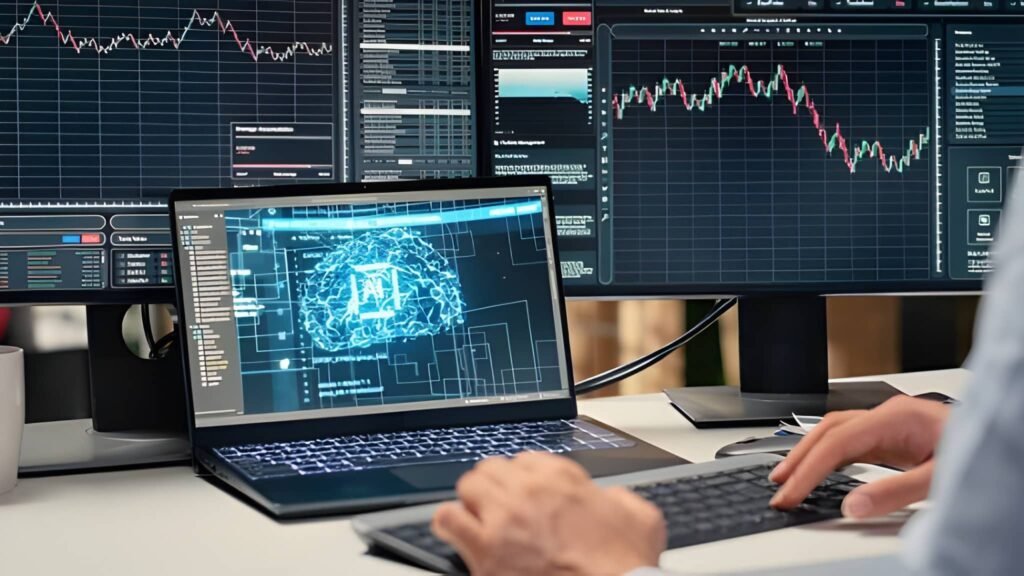
The Digital Architects of Value: Understanding Computational Finance and Algorithmic Trading
Modern financial markets operate as vast, interconnected computational networks where traditional asset valuation intersects with high-speed digital execution. Computational finance provides the mathematical and statistical scaffolding for this environment, while algorithmic trading serves as the active mechanism that translates theoretical models into market action. This synergy has redefined the concept of liquidity, transformed the role of the investment professional, and effectively eliminated the latency between information arrival and price discovery.
In the current institutional landscape, the ability to build and deploy complex mathematical models is no longer a luxury—it is the primary competitive advantage. Whether managing a pension fund or a high-frequency prop desk, the integration of computational tools allows for the processing of multi-dimensional datasets that exceed human cognitive limits. This article explores the architectural pillars of these systems and the sophisticated methodologies that drive global capital flows.
Market Microstructure and Data Dynamics
Before an algorithm can fire a trade, it must navigate the market microstructure—the specific rules and mechanics that govern how orders are matched and prices are formed. Unlike the clean, continuous charts seen by retail traders, the reality of the market is a discrete, chaotic stream of limit orders, cancellations, and executions.
Computational finance experts focus on the Limit Order Book (LOB). The LOB is a real-time database of all buy and sell orders at every price level. Algorithms analyze the "imbalance" of this book to predict short-term price movements. If the "bid" depth significantly outweighs the "ask" depth, the algorithm might anticipate an upward price tick and execute a buy order in milliseconds.
| Market Element | Traditional View | Computational View |
|---|---|---|
| Liquidity | Availability of buyers/sellers | Probability of fill at a specific price/time |
| Price | Fair value of the asset | Weighted average of the last 10,000 ticks |
| Volatility | Standard deviation of returns | High-frequency realized variance and "jump" risk |
| Execution | Placing a trade via broker | Order-slicing and routing across 50+ venues |
Stochastic Modeling and Pricing Engines
Computational finance is built on stochastic calculus, a branch of mathematics that deals with processes evolving randomly over time. The most famous application is the Black-Scholes model for option pricing, but modern computational finance extends this logic to handle "Fat Tails" (excess kurtosis) and "Volatility Smiles" (non-constant volatility).
To price a complex derivative, quants use Monte Carlo Simulations. Instead of solving a single equation, a computer simulates millions of potential future paths for an asset's price. The average outcome of these millions of paths provides the "fair value." This approach is computationally expensive but necessary for managing modern portfolios containing complex hedges.
Simple Risk-Neutral Pricing Logic
A computational model calculates the expected value of an asset under a probability measure where all assets earn the risk-free rate.
Current Price = Expected Value (Future Price * Discount Factor)If the simulation suggests the current market price is lower than this calculated value, the algorithm identifies a buy signal. The speed of this calculation is critical; if the calculation takes 1 second but the market price changes in 100 milliseconds, the "Alpha" (profit potential) vanishes.
Algorithmic Strategy Frameworks
Algorithmic trading is not a monolith; it is a taxonomy of diverse strategies designed to capture specific market inefficiencies. Institutional desks categorize these strategies based on their turnover and risk profiles.
Arbitrage seeks to profit from price discrepancies for the same asset in different locations. Computational finance enables "Cross-Asset Arbitrage," where the algorithm monitors the relationship between a stock, its futures contract, and its options. When the relationship deviates from mathematical equilibrium, the system executes a market-neutral trade to capture the spread.
These algorithms use time-series analysis to identify persistent price directions. Instead of looking at simple moving averages, they use "Kalman Filters" and "Hurst Exponents" to determine if a price move is a genuine trend or just random noise. This statistical validation prevents "whipsaws"—losses incurred from false signals.
Computational market makers profit from the bid-ask spread. They use sophisticated "Inventory Management" algorithms to ensure they don't hold too much of one asset while providing quotes to other traders. If they buy too much, they instantly lower their bid price to discourage further sellers and lower their ask price to attract buyers.
Hardware Acceleration and Latency Warfare
In the most aggressive tiers of algorithmic trading—High-Frequency Trading (HFT)—the limitation is no longer the software, but the hardware and the speed of light. Computational finance in the HFT space has moved into the realm of FPGA (Field Programmable Gate Array) and ASIC design.
Standard CPUs are general-purpose; they can run a web browser or a trading app. FPGAs are specialized chips where the trading logic is "burned" directly into the silicon gates. This allows the system to receive a market message and send a response in nanoseconds, bypassing the entire software operating system.
The Latency Barrier
A human eye blink takes 300 milliseconds. An institutional HFT system can execute 300,000 trades in that same window. For these firms, the location of their servers is vital. "Colocation"—placing servers in the same data center as the exchange—is mandatory to avoid the microseconds of delay introduced by miles of fiber optic cable.
Computational Risk Management
The automation of trading creates a unique type of systemic risk. When a computer can lose millions of dollars in seconds, the risk management framework must be equally automated. Computational finance professionals utilize "Real-Time Risk Gates."
The primary tool is Value at Risk (VaR), which calculates the maximum expected loss over a specific timeframe with a given confidence level. However, modern desks have moved toward Expected Shortfall (Conditional VaR), which measures the "tail risk"—the average loss in the absolute worst-case scenarios.
The 95% Value at Risk Concept
An algorithm monitors a $100 million portfolio. Based on a Monte Carlo simulation of 10,000 market paths:
VaR Calculation: 500th worst path shows a loss of $2.5 million.The system concludes: "There is a 95% probability that we will not lose more than $2.5 million in a single day." If a trade is proposed that pushes this number to $3.0 million, the risk gate automatically blocks the execution.
Machine Learning and the Future of AI
We are currently transitioning from rule-based algorithms to learning-based algorithms. Machine Learning (ML) allows a system to identify patterns without being explicitly programmed to find them. Specifically, Reinforcement Learning (RL) is the new frontier.
In Reinforcement Learning, an "Agent" is placed in a simulated market. It is given a goal (maximize profit) and a set of actions (buy, sell, hold). Through millions of trials, the agent discovers strategies that a human might never consider. These agents are particularly good at "Smart Order Routing"—finding the best way to execute a large order across 20 different exchanges without alerting other traders.
Impact on Global Market Efficiency
The proliferation of computational finance has significantly altered the socioeconomic landscape. Proponents argue that algorithmic trading has lowered the cost of capital by narrowing bid-ask spreads and increasing liquidity. A retail investor in the United States today can trade stocks with zero commission and sub-penny spreads—a feat that was impossible thirty years ago.
However, this efficiency comes with the risk of "Flash Crashes"—moments where interacting algorithms create a negative feedback loop and liquidity vanishes instantly. This necessitates a new type of regulatory oversight: Computational Regulation. Regulators now use their own algorithms to monitor the market for "Spoofing" and "Layering," ensuring that the digital speed of the market is matched by a digital standard of fairness.
Ultimately, computational finance and algorithmic trading represent the evolution of the market from a physical gathering to a mathematical abstraction. For the professional investor, the challenge is to remain a "Digital Architect"—designing systems that are not just fast, but resilient, ethical, and grounded in the fundamental realities of economic value.


