
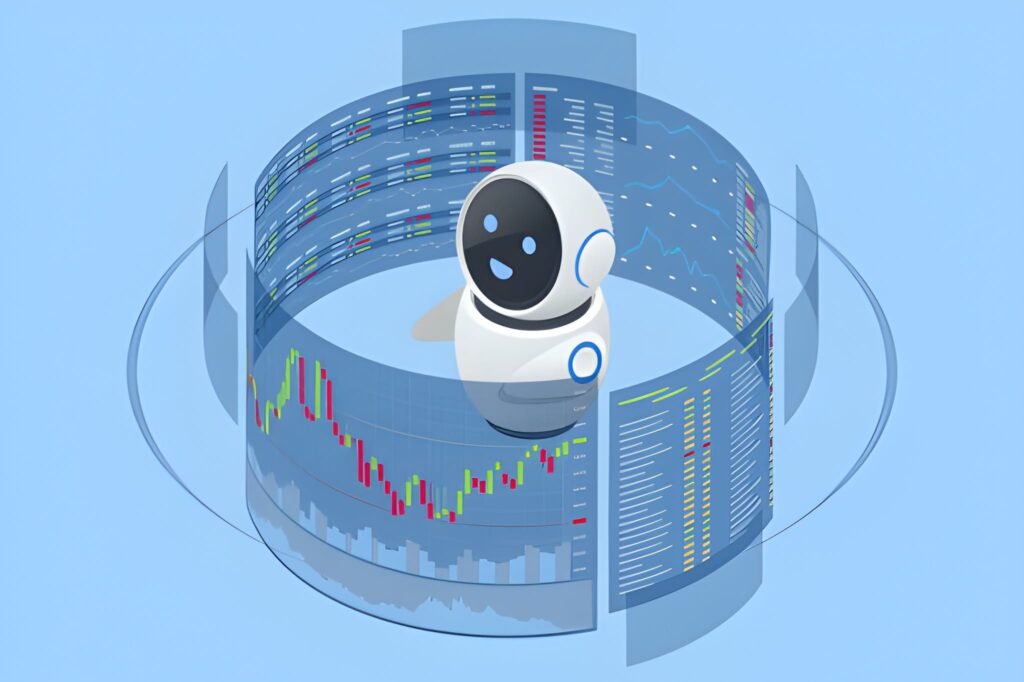
Algorithmic trading funds represent one of the most transformative evolutions in modern finance. These funds rely on sophisticated mathematical models and automated systems to execute trades with minimal human intervention. Rather than depending on subjective decisions or market sentiment, they systematically apply quantitative strategies to exploit inefficiencies across asset classes. From hedge funds to ETF providers, algorithmic trading funds now shape a large portion of daily market volume worldwide. This article explores how they operate, their mathematical and financial foundations, and the implications for investors—especially within the U.S. market.
What Are Algorithmic Trading Funds?
Algorithmic trading funds (also called quantitative funds) use computer algorithms to make investment decisions. Their core is a rule-based system designed to analyze data, generate signals, and execute trades. The algorithms define when to buy, sell, or hold assets based on variables like price, volatility, volume, and correlation.
In simple terms, an algorithmic trading fund is built on this logical structure:
Trade\ Signal = f(Price,\ Volume,\ Time,\ Indicators,\ Market\ Regime)Once a signal triggers, trades are placed automatically through electronic communication networks (ECNs) or broker APIs.
These funds can pursue a range of strategies—market making, statistical arbitrage, momentum trading, or long-short equity—depending on their design.
How Algorithmic Trading Funds Differ from Traditional Funds
| Aspect | Algorithmic Fund | Traditional Fund |
|---|---|---|
| Decision Making | Based on mathematical models | Based on human judgment |
| Execution | Automated | Manual or semi-manual |
| Speed | Milliseconds | Minutes to hours |
| Emotion | None | Influenced by bias and sentiment |
| Transparency | Rule-defined, data-driven | Often discretionary |
| Typical Manager | Quantitative analysts, data scientists | Portfolio managers, analysts |
Algorithmic funds remove emotional bias, enabling faster reaction to market events. They rely heavily on computing infrastructure and quantitative expertise, which traditional managers might lack.
Types of Algorithmic Trading Funds
- High-Frequency Trading (HFT) Funds – Focus on microsecond-level trades, capturing small inefficiencies.
- Statistical Arbitrage Funds – Use mean-reversion and correlation models to find mispricings.
- Trend-Following Funds – Apply momentum indicators to ride market trends.
- Market-Neutral Funds – Balance long and short positions to minimize exposure to market direction.
- Machine Learning Funds – Employ neural networks or reinforcement learning to predict asset movements.
- Factor-Based Funds – Allocate based on quantifiable characteristics like value, momentum, or size.
The Mathematical Core of Algorithmic Trading Funds
The success of algorithmic funds depends on precise quantitative modeling. Let’s consider an example using expected return and risk-adjusted performance.
The expected return of a portfolio is:
E[R_p] = \sum_{i=1}^{n} w_i E[R_i]where w_i represents the weight of each asset, and E[R_i] is its expected return.
The portfolio variance (risk) is:
\sigma_p^2 = \sum_{i=1}^{n}\sum_{j=1}^{n} w_i w_j Cov(R_i, R_j)The Sharpe Ratio, which measures return per unit of risk, is:
Sharpe = \frac{E[R_p - R_f]}{\sigma_p}Funds continuously optimize portfolios to maximize Sharpe Ratio, ensuring that for every unit of volatility, returns are maximized.
Example: Mean-Reversion Strategy
Suppose an algorithmic fund tracks the deviation of a stock’s price from its moving average. When the price diverges significantly, the algorithm assumes it will revert to the mean.
The deviation can be expressed as:
Z = \frac{P_t - SMA_t}{\sigma_t}Where Z is the z-score, P_t is the current price, SMA_t is the simple moving average, and \sigma_t is the standard deviation.
A trade rule might be:
- Buy if Z < -2
- Sell if Z > 2
This captures price overextensions and reversion opportunities.
Backtesting and Validation
Before a strategy is deployed, algorithmic funds perform backtesting—testing historical data to evaluate performance.
If R_i represents the return per trade and N the total number of trades, the cumulative return is:
CR = \prod_{i=1}^{N} (1 + R_i) - 1For example, with trade returns of 1.5%, -0.5%, 2%, and 1%:
CR = (1.015 \times 0.995 \times 1.02 \times 1.01) - 1 = 0.049 = 4.9%This 4.9% cumulative gain over the backtest period provides a baseline before going live.
Execution Algorithms
Execution quality determines profitability. Even small inefficiencies can erode returns. Common execution algorithms include:
| Type | Description |
|---|---|
| VWAP (Volume-Weighted Average Price) | Spreads trades to match market volume flow |
| TWAP (Time-Weighted Average Price) | Executes evenly over time intervals |
| Implementation Shortfall | Balances execution cost and market impact |
| Liquidity Seeking | Splits orders across multiple venues to minimize slippage |
For VWAP:
VWAP = \frac{\sum_{i=1}^{N} Price_i \times Volume_i}{\sum_{i=1}^{N} Volume_i}If executed prices are near VWAP, the algorithm performs efficiently.
Risk Management Framework
Algorithmic trading funds enforce strict risk parameters. A typical approach includes limits on drawdown, leverage, and exposure per trade.
If a fund manages $50 million and limits risk per position to 0.5%, then:
Max\ Loss = Account\ Equity \times Risk\ Per\ Trade = 50000000 \times 0.005 = 250000Thus, no single trade should risk more than $250,000.
Leverage and Position Sizing
Funds often employ leverage to amplify returns. If leverage ratio L = 2, then:
Effective\ Exposure = L \times Equity = 2 \times 50000000 = 100000000While leverage magnifies profits, it equally amplifies losses—demanding precise control.
Performance Metrics
| Metric | Formula | Meaning |
|---|---|---|
| Win Rate | Win\ Rate = \frac{Winning\ Trades}{Total\ Trades} \times 100 | Measures consistency |
| Profit Factor | PF = \frac{Gross\ Profit}{Gross\ Loss} | Measures profitability |
| Sortino Ratio | Sortino = \frac{E[R_p - R_f]}{\sigma_{downside}} | Considers downside volatility |
| Max Drawdown | MDD = \frac{Peak - Trough}{Peak} | Indicates worst-case loss |
Example Table: Comparing Fund Strategies
| Fund Type | Typical Return | Volatility | Drawdown | Ideal Investor |
|---|---|---|---|---|
| Trend-Following Fund | 12% | Moderate | -10% | Long-term growth seekers |
| Statistical Arbitrage Fund | 8% | Low | -3% | Conservative quant investors |
| High-Frequency Fund | 20% | High | -15% | Aggressive risk-takers |
| Market-Neutral Fund | 6% | Very Low | -2% | Risk-averse institutions |
Data Infrastructure
Algorithmic funds rely on multiple data streams:
- Market data: Tick-level price and volume.
- Fundamental data: Earnings, economic reports.
- Alternative data: Sentiment, satellite imagery, shipping trends.
The performance of these models depends on data precision. A simple delay or missing tick can distort an entire signal cascade.
Machine Learning in Algorithmic Funds
Modern algorithmic funds integrate machine learning (ML) to adapt dynamically to market changes. Instead of fixed parameters, ML-based models continuously learn from new data.
For example, a random forest model predicts asset direction based on multiple inputs (x_1, x_2, ..., x_n):
\hat{y} = f(x_1, x_2, ..., x_n)Each tree in the ensemble votes on a direction—buy, sell, or hold—producing a probabilistic forecast.
U.S. Market Context
In the U.S., algorithmic funds dominate trading volume, accounting for roughly 60–70% of equity trades. Regulatory oversight comes primarily from:
- SEC (Securities and Exchange Commission) – Enforces fair market access.
- FINRA (Financial Industry Regulatory Authority) – Monitors broker-dealer compliance.
- CFTC (Commodity Futures Trading Commission) – Oversees derivatives and futures markets.
Funds must adhere to Reg NMS and MiFID II (for global operations) to ensure best execution practices and transparency.
Investor Perspective
For retail and institutional investors, algorithmic funds offer several advantages:
- Diversification through data-driven methods
- Emotion-free trading discipline
- Consistent performance under varying conditions
However, they come with caveats: reliance on historical data, potential for overfitting, and sensitivity to regime shifts.
Ethical and Market Implications
Critics argue that algorithmic funds can amplify volatility or cause “flash crashes” due to herd-like reactions. However, regulators and exchanges now enforce circuit breakers and throttling to mitigate such risks.
The real ethical debate lies in data fairness—whether firms with superior data access hold an undue advantage.
Building a Small-Scale Algorithmic Fund
Entrepreneurs and independent quants can establish small algorithmic funds under an LLC or registered investment advisor (RIA) structure. Steps include:
- Designing and backtesting strategies.
- Establishing broker relationships (e.g., Interactive Brokers).
- Implementing compliance and audit protocols.
- Setting up investor reporting dashboards.
Risk disclosures and registration requirements vary by state and fund size.
Future Outlook
As computational power grows and AI models mature, algorithmic trading funds will evolve beyond pattern recognition into predictive reasoning. Expect integration of large-scale reinforcement learning, cross-asset optimization, and blockchain-based execution protocols.
Conclusion
Algorithmic trading funds blend mathematics, engineering, and economics into a single operational system. Their disciplined, data-centric nature contrasts with emotional, narrative-driven investing. For investors and fund managers alike, the key advantage lies in consistency—the ability to apply a model systematically without deviation.
In the coming decade, algorithmic trading funds will continue to shape market microstructure, redefine investment philosophy, and influence how both institutional and individual investors view financial decision-making. Their precision, adaptability, and scalability position them not just as participants in modern finance, but as its architects.


