
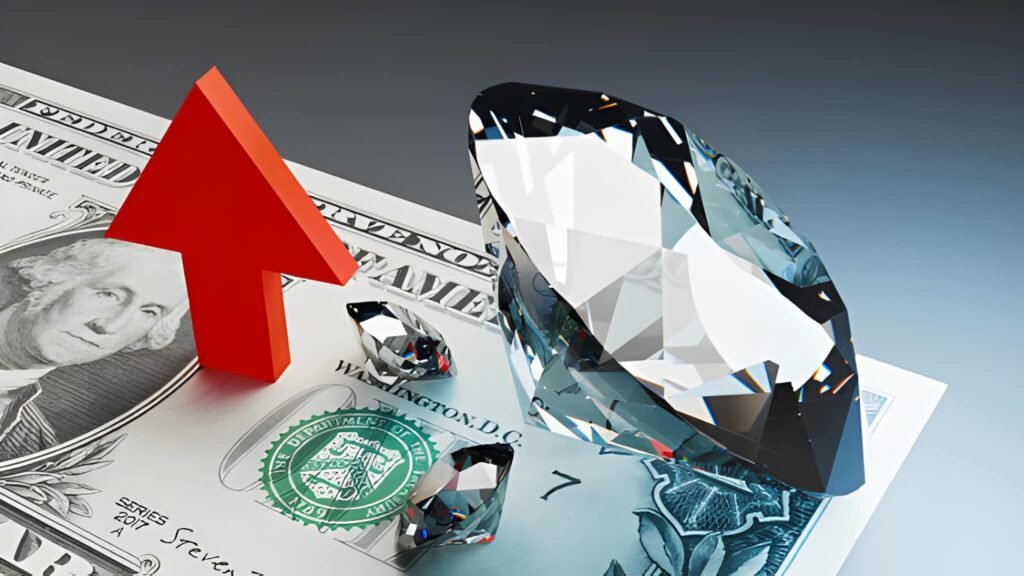
Diamonds have long symbolized wealth, status, and permanence. Yet in modern finance, their role as an investment asset remains complex. Unlike equities or bonds, diamonds are physical, non-yielding assets with subjective valuation and limited liquidity. Still, investors increasingly view them as a hedge against inflation and a store of value in volatile markets. This discussion explores the key factors in assessing diamonds as an investment, including valuation metrics, market structure, growth potential, and portfolio diversification benefits.
Understanding Diamond Investment Fundamentals
Diamonds are tangible assets, meaning their value is tied to physical properties and market demand rather than future cash flows. Unlike gold, diamonds are not traded on centralized exchanges. Their prices depend on unique attributes summarized by the Four Cs: carat weight, color, clarity, and cut. Each of these affects rarity and desirability, influencing price growth and resale potential.
The Four Cs and Their Financial Impact
| Attribute | Description | Financial Impact |
|---|---|---|
| Carat | Weight of the diamond; 1 carat = 0.2 grams | Price increases exponentially with size due to rarity |
| Color | Graded D (colorless) to Z (light color) | Higher grades retain value better over time |
| Clarity | Measures inclusions or blemishes | High clarity grades (IF, VVS) command premium resale value |
| Cut | Proportion and symmetry of facets | Impacts brilliance and marketability |
High-grade diamonds often appreciate faster because of scarcity and global demand consistency, particularly from luxury markets in the U.S., China, and the Middle East.
Valuing Diamonds as Financial Assets
Unlike publicly traded assets, diamonds do not generate income streams such as dividends or interest. Thus, valuation depends on market comparables, historical pricing, and professional grading reports (typically from GIA or IGI). The price structure can be expressed as:
V = P_c + P_{col} + P_{clar} + P_{cut} + M_dWhere:
- V = Total diamond value
- P_c = Price per carat
- P_{col} = Premium/discount for color
- P_{clar} = Premium/discount for clarity
- P_{cut} = Premium/discount for cut
- M_d = Market demand adjustment factor
The Rapaport Diamond Price List, published weekly, provides a benchmark for evaluating wholesale prices. Investors use this reference to determine fair market value and estimate appreciation potential.
Example: Calculating Investment Growth
Suppose an investor purchases a 1-carat, D-color, IF-clarity diamond for $20,000. Market data shows high-quality stones of similar type appreciate by about 3% annually.
Using the future value formula:
FV = PV \times (1 + r)^nSubstitute:
FV = 20000 \times (1 + 0.03)^{10} = 20000 \times 1.3439 = 26878After 10 years, the estimated resale value is $26,878, assuming stable demand and no structural market disruption. Though this represents modest nominal growth, it provides a hedge against inflation and currency devaluation.
Comparing Diamonds with Other Assets
| Asset Type | Average Annual Return | Liquidity | Risk Type | Inflation Hedge |
|---|---|---|---|---|
| Stocks | 8–10% | High | Market risk | Moderate |
| Bonds | 3–5% | High | Interest rate risk | Low |
| Gold | 4–6% | High | Commodity volatility | Strong |
| Diamonds | 2–5% | Low–Medium | Valuation and demand risk | Strong |
| Real Estate | 6–8% | Medium | Market and maintenance risk | Strong |
Diamonds underperform equities in growth rate but outperform traditional savings instruments when inflation-adjusted. Their advantage lies in portability, privacy, and independence from traditional financial systems.
Market Structure and Price Drivers
The global diamond market operates through a vertical supply chain dominated by mining companies, cutters, wholesalers, and retailers. Key suppliers like De Beers, Alrosa, and Rio Tinto influence market prices by controlling supply. Recent trends, including lab-grown diamonds, have begun reshaping the industry landscape.
Key Drivers of Diamond Prices
- Global Economic Growth: Rising income in emerging economies increases luxury consumption.
- Currency Movements: A weaker dollar tends to boost diamond prices in U.S. terms.
- Supply Constraints: Limited new mine discoveries constrain future availability.
- Technological Substitutes: Growth in lab-grown diamond adoption may suppress natural stone premiums.
- Cultural and Emotional Demand: Marriage and milestone purchases sustain base-level consumption.
Lab-Grown Diamonds and Market Disruption
Lab-grown diamonds, chemically identical to natural ones, offer transparency and affordability. However, they depreciate faster due to mass production scalability. Investors focusing on long-term appreciation should prefer natural diamonds with strong grading certification and documented provenance.
Price Comparison Example
| Type | 1-Carat, D-Color, IF-Clarity Price | 5-Year Expected Value | Resale Retention |
|---|---|---|---|
| Natural | $20,000 | $23,000–$25,000 | 90–95% |
| Lab-Grown | $5,000 | $2,000–$3,000 | 40–60% |
Natural diamonds preserve intrinsic scarcity value, whereas lab-grown stones behave more like consumer goods.
Risk and Liquidity Considerations
Diamond investments face valuation opacity and low liquidity. Unlike publicly traded assets, selling often requires private transactions or auction houses, leading to price variation and transaction fees. Additionally, emotional factors and branding affect resale value, making diamonds less standardized than other commodities.
Risk Assessment Matrix
| Risk Type | Description | Mitigation Strategy |
|---|---|---|
| Valuation Risk | Subjective grading differences | Purchase only GIA-certified stones |
| Liquidity Risk | Limited resale markets | Use established dealers or auctions |
| Fraud Risk | Synthetic or altered stones | Require certification and authentication |
| Market Risk | Shifting consumer demand | Diversify across asset classes |
Diversifying with Diamond-Linked Instruments
Sophisticated investors may access diamond exposure through exchange-traded instruments or funded collectibles. For instance, specialized funds pool capital to acquire high-grade stones and manage storage, insurance, and resale logistics. These provide diversification without the physical handling risk.
Alternatively, digital tokenization enables fractional ownership of investment-grade diamonds, enhancing liquidity through blockchain-based marketplaces. This innovation aims to transform a traditionally opaque asset into a transparent, tradable product.
Strategic Role in a Portfolio
Diamonds should represent a small, alternative allocation, typically 2–5% of total assets, serving as a non-correlated hedge. Their low correlation with equities and bonds enhances portfolio resilience during economic downturns.
Correlation Matrix Example
| Asset | Stocks | Bonds | Gold | Diamonds |
|---|---|---|---|---|
| Stocks | 1.00 | -0.25 | -0.35 | -0.40 |
| Bonds | -0.25 | 1.00 | 0.10 | 0.05 |
| Gold | -0.35 | 0.10 | 1.00 | 0.45 |
| Diamonds | -0.40 | 0.05 | 0.45 | 1.00 |
Negative correlation with equities demonstrates their defensive utility in market turbulence.
Taxation and Regulatory Aspects
In the U.S., profits from diamond sales are treated as capital gains. Long-term holdings (more than one year) qualify for favorable tax rates, though collectible assets like diamonds may face a 28% maximum rate under IRS guidelines. Proper recordkeeping, certification, and proof of purchase are essential for compliance and valuation at disposal.
Ethical and Sustainability Considerations
Modern investors increasingly prioritize conflict-free sourcing and environmental responsibility. The Kimberley Process Certification Scheme (KPCS) ensures that diamonds are not funding armed conflict. Furthermore, many firms emphasize traceable supply chains and sustainable mining practices, enhancing both ethical appeal and long-term brand value.
Example: Portfolio Integration and Return Estimation
An investor allocates $100,000 across multiple assets, including 5% in high-grade diamonds.
| Asset Class | Allocation | Expected Annual Return | Projected 10-Year Value |
|---|---|---|---|
| Equities | 60% | 8% | $215,892 |
| Bonds | 25% | 4% | $37,006 |
| Real Estate | 10% | 6% | $17,908 |
| Diamonds | 5% | 3% | $13,439 |
| Total Portfolio | 100% | — | $284,245 |
Including diamonds modestly enhances diversification, slightly reduces volatility, and provides a hedge against systemic shocks.
Practical Guidelines for Diamond Investors
- Buy only certified stones with verifiable grading from reputable labs (GIA, IGI).
- Focus on investment-grade diamonds—D–F color, IF–VS clarity, and excellent cut.
- Avoid overpaying retail premiums; purchase at wholesale or through auction platforms.
- Insure and store properly using secure facilities with professional valuation updates.
- Plan for long holding periods, typically 5–15 years, to realize meaningful appreciation.
- Diversify within alternatives—combine diamonds with gold, art, or real estate for stability.
Conclusion
Diamonds can serve as a strategic store of value in a diversified portfolio, offering stability, privacy, and inflation protection. Yet they remain an illiquid and specialized asset class—best suited for investors seeking long-term preservation rather than short-term profit. Their worth depends on rarity, certification, and macroeconomic context, not income generation.



