
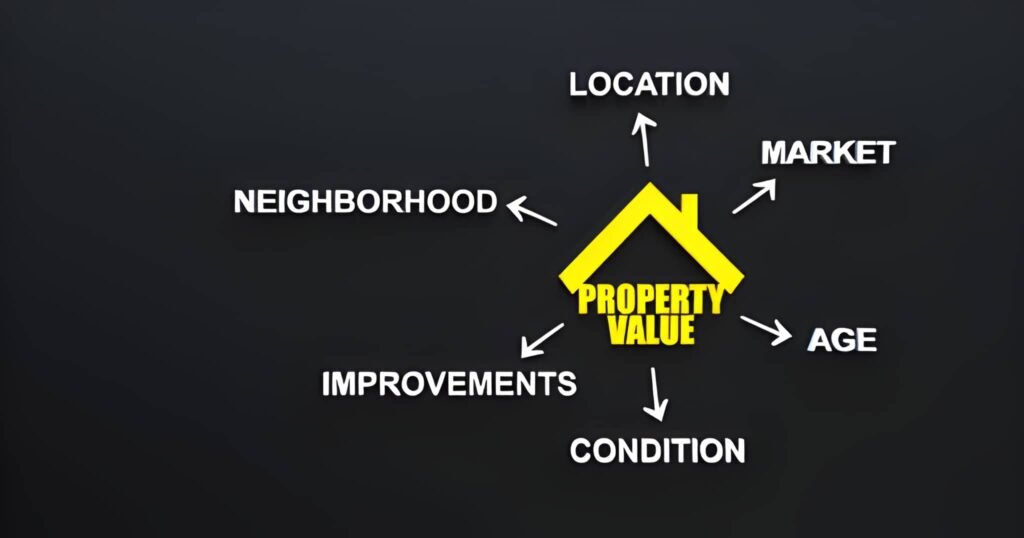
Understanding Fair Value in Real Estate
Fair value of investment property represents the estimated price at which a property would be exchanged between a willing buyer and a willing seller in an arm’s-length transaction, assuming both parties have reasonable knowledge of relevant facts and are not under compulsion to act. Unlike historical cost, fair value reflects current market conditions, investor expectations, and potential income-generating capacity.
Investment property includes residential rental buildings, commercial real estate, industrial facilities, and land held for capital appreciation or rental income.
Fair value is essential for financial reporting under accounting standards (such as IFRS and GAAP), for taxation, and for making informed investment decisions.
Key Approaches to Determine Fair Value
1. Market Approach
The market approach, also called the sales comparison approach, estimates fair value by comparing the property to recently sold, similar properties in the same location.
Steps:
- Identify comparable properties with similar size, location, and features.
- Adjust for differences in amenities, condition, or market timing.
- Calculate a weighted average price per square foot or unit.
Example:
A 10-unit apartment building is compared to similar properties sold recently:
| Comparable Property | Sale Price | Units | Price per Unit |
|---|---|---|---|
| Property 1 | $1,500,000 | 10 | $150,000 |
| Property 2 | $1,350,000 | 9 | $150,000 |
| Property 3 | $1,800,000 | 12 | $150,000 |
Average price per unit = $150,000 → Fair value estimate for 10 units = $1,500,000.
2. Income Approach
The income approach, or discounted cash flow (DCF) method, values property based on the present value of expected future cash flows, often derived from rental income.
The formula:
FV = \sum_{t=1}^{n} \frac{CF_t}{(1+r)^t} + \frac{RV}{(1+r)^n}Where:
- CF_t = expected net cash flow from rental in year t
- r = discount rate (reflecting risk and opportunity cost)
- n = investment horizon
- RV = reversion value or expected sale price at the end of n years
Example:
An office building generates $120,000 net rental income annually for 5 years, with expected resale at $1,000,000. Discount rate = 8%.
Present value of cash flows:
PV_{CF} = \frac{120,000}{1.08} + \frac{120,000}{(1.08)^2} + \frac{120,000}{(1.08)^3} + \frac{120,000}{(1.08)^4} + \frac{120,000}{(1.08)^5}PV of reversion:
PV_{RV} = \frac{1,000,000}{(1.08)^5} \approx 680,583Total fair value:
FV = PV_{CF} + PV_{RV} \approx 534,644 + 680,583 \approx 1,215,2273. Cost Approach
The cost approach estimates fair value based on the cost to replace or reproduce the property, minus depreciation for age, wear, or functional obsolescence.
Formula:
FV = Replacement\ Cost - Accumulated\ DepreciationExample:
- Replacement cost of building: $1,200,000
- Depreciation (physical and functional): $200,000
This method is most reliable for newer properties or specialized structures with limited market comparables.
Factors Affecting Fair Value
- Location: Proximity to amenities, infrastructure, and economic centers.
- Property Condition: Age, maintenance, and functional layout.
- Market Conditions: Supply-demand balance, interest rates, and economic trends.
- Tenant Quality and Lease Terms: Long-term leases with stable tenants increase value.
- Regulatory Environment: Zoning laws, taxes, or building restrictions.
- Liquidity: Properties easier to sell typically command higher fair value.
Practical Steps for Determining Fair Value
- Identify the Purpose: Financial reporting, sale, refinancing, or portfolio valuation.
- Choose Valuation Approach: Market, income, or cost approach based on property type and available data.
- Collect Data: Comparable sales, cash flow projections, replacement costs.
- Apply Adjustments: Correct for differences in property features, market trends, and risks.
- Calculate Fair Value: Use appropriate formulas and discounting where necessary.
- Document Assumptions: Maintain transparency for auditors, investors, or regulatory bodies.
Example: Valuing a Multi-Family Apartment
- 20 units, average rent $1,200/month → annual income = $288,000
- Operating expenses = $88,000 → net cash flow = $200,000
- Discount rate = 7%
- Expected sale in 10 years = $2,500,000
Present value of cash flows:
PV_{CF} = \sum_{t=1}^{10} \frac{200,000}{(1.07)^t} \approx 1,401,986Present value of reversion:
PV_{RV} = \frac{2,500,000}{(1.07)^{10}} \approx 1,276,281Estimated fair value:
FV \approx 1,401,986 + 1,276,281 = 2,678,267This illustrates how rental income and expected resale price determine the property’s fair value using the income approach.
Conclusion
Determining the fair value of investment property requires analyzing market comparables, expected income, or replacement costs, depending on property type and purpose. Accurate fair value assessment supports financial reporting, investment decision-making, and strategic planning. Combining valuation approaches and adjusting for market and property-specific factors ensures a realistic, defendable estimate of the property’s worth.



