
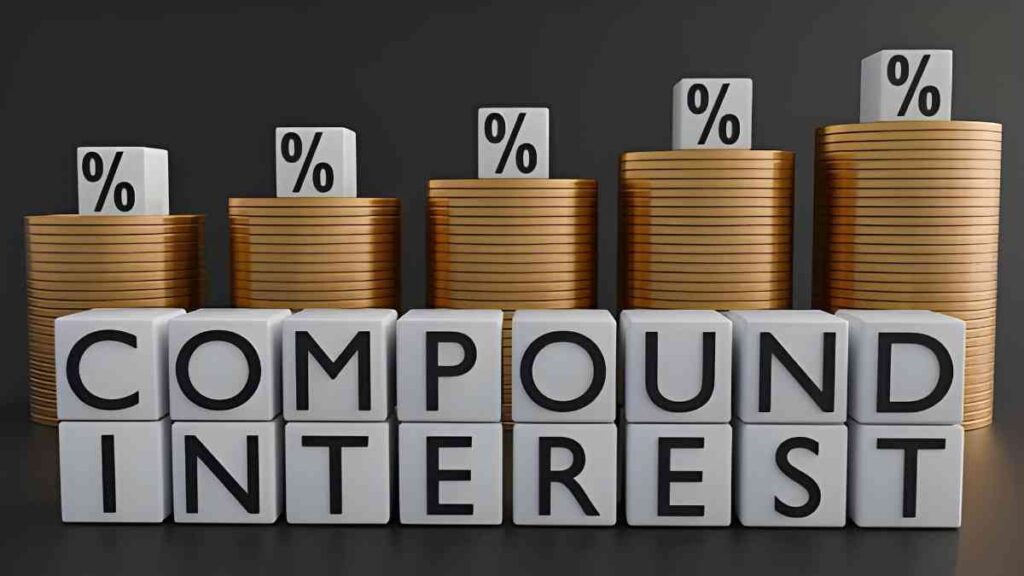
Understanding Simple vs. Compound Interest
Interest is the cost of borrowing money or the reward for saving it. Two primary methods exist for calculating interest: simple interest and compound interest. The key difference lies in whether interest is earned on just the principal or on both the principal and accumulated interest.
Simple Interest
Simple interest is calculated only on the initial principal over the investment period. The formula is:
SI = P \times r \times t
Where:
- SI = simple interest earned
- P = principal amount
- r = annual interest rate (decimal)
- t = time in years
The future value using simple interest is:
FV_{SI} = P + SI = P(1 + r \cdot t)Example: Investing $10,000 at 5% simple interest for 10 years:
FV_{SI} = 10,000(1 + 0.05 \cdot 10) = 10,000(1 + 0.5) = 15,000Compound Interest
Compound interest calculates interest on both the principal and any accumulated interest. This reinvestment effect accelerates growth over time. The formula is:
FV_{CI} = P(1 + r/n)^{nt}
Where:
- FV_{CI} = future value with compounding
- n = number of compounding periods per year
Example: The same $10,000 invested at 5% compounded annually for 10 years:
FV_{CI} = 10,000(1 + 0.05/1)^{1 \times 10} = 10,000(1.05)^{10} \approx 16,288Even at the same interest rate, compound interest produces a higher future value than simple interest due to interest on accumulated interest.
Why Compound Interest Outperforms Simple Interest
1. Reinvestment of Earnings
Compound interest reinvests all earnings, creating a snowball effect. Each period’s interest generates its own interest in subsequent periods, while simple interest ignores previously earned interest.
2. Longer Investment Horizons Amplify Growth
The longer the investment period, the greater the divergence between simple and compound interest. Time magnifies the compounding effect exponentially.
Example: $5,000 at 6% for 30 years:
| Method | Future Value |
|---|---|
| Simple Interest | FV = 5,000(1 + 0.06 \cdot 30) = 14,000 |
| Compound Interest | FV = 5,000(1.06)^{30} \approx 28,720 |
Over 30 years, compounding more than doubles the investment value compared to simple interest.
3. Frequency of Compounding
Increasing the number of compounding periods per year further accelerates growth. Quarterly, monthly, or daily compounding adds incremental interest on interest throughout the year.
Example: $10,000 at 6% for 10 years:
| Compounding Frequency | Future Value |
|---|---|
| Simple Interest | 10,000(1 + 0.06 \cdot 10) = 16,000 |
| Annual | 10,000(1.06)^{10} \approx 17,908 |
| Quarterly | 10,000(1 + 0.06/4)^{4*10} \approx 18,061 |
| Monthly | 10,000(1 + 0.06/12)^{12*10} \approx 18,196 |
More frequent compounding increases the final investment value, while simple interest remains constant regardless of compounding frequency.
Real-World Applications
- Savings Accounts: High-yield savings accounts use compound interest to grow balances faster than simple interest accounts.
- Retirement Plans: 401(k)s and IRAs benefit from reinvested dividends and compounded investment returns, creating substantial retirement wealth.
- Bonds and Fixed Income: Reinvesting coupon payments amplifies long-term returns.
- Education Savings Accounts: Compound interest allows relatively small, consistent contributions to grow into significant college funds.
Comparison Table
| Investment | Principal | Rate | Time | Simple Interest FV | Compound Interest FV |
|---|---|---|---|---|---|
| Savings Account | $10,000 | 5% | 10 years | $15,000 | $16,288 |
| Retirement Plan | $5,000 | 6% | 30 years | $14,000 | $28,720 |
| Bond Investment | $20,000 | 4% | 20 years | $36,000 | $44,000 (approx) |
This table clearly illustrates that compound interest consistently produces higher investment values over time compared to simple interest.
Key Takeaways
- Compound interest grows faster: Reinvested interest produces interest, creating exponential growth.
- Time is critical: The longer the investment horizon, the greater the difference between simple and compound interest.
- Frequency matters: More frequent compounding further increases future value.
- Planning advantage: Using compound interest effectively can accelerate wealth accumulation for retirement, education, or long-term goals.
Compound interest is a powerful mechanism that ensures investments grow more rapidly than simple interest, especially over extended periods. Investors who leverage compounding early and consistently will experience significantly higher wealth accumulation, demonstrating why compound interest is the preferred strategy for long-term financial planning.



