
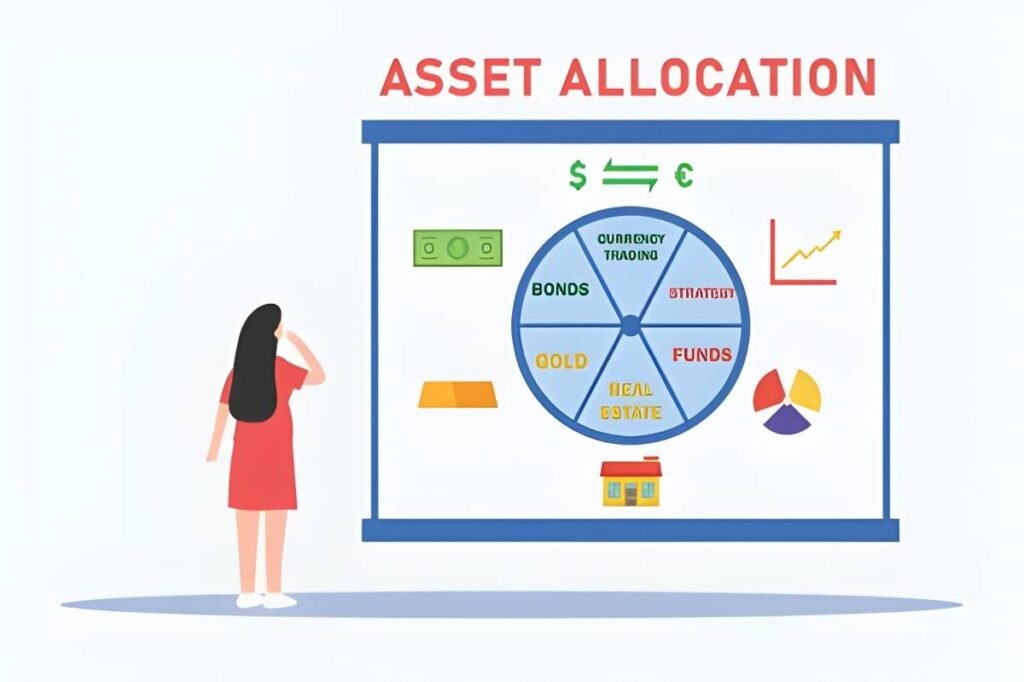
In my years of guiding clients, I have seen every conceivable investment mistake. The most common and damaging among them is not picking the wrong stock or bond; it is the failure to begin with a coherent plan. Investors often focus on the individual bricks—the specific ETFs, the hot stocks, the trending sectors—while giving little thought to the architectural blueprint that holds them all together. That blueprint is a broad asset allocation plan. It is the single most important decision an investor will make, as it determines over 90% of a portfolio’s long-term risk and return characteristics. It is not a prediction of the future; it is a preparation for any future. Today, I want to walk you through the process of constructing this blueprint, moving from abstract theory to a practical, resilient plan you can implement and stick with through any market environment.
The Foundation: Understanding What Asset Allocation Is and Is Not
Asset allocation is the strategy of dividing your investment portfolio among different major asset categories. The goal is not to maximize returns in any given year—that is speculation. The goal is to structure a portfolio that has the highest probability of meeting your specific long-term financial objectives while exposing you to a level of risk you can actually tolerate, both financially and emotionally.
It is a deliberate system for managing uncertainty. By owning assets that respond differently to economic and geopolitical events, you smooth out the journey. When one asset class zigs, another zags. This diversification is the only free lunch in finance, and asset allocation is the menu.
Step 1: Define the Objective – The “Why” Behind the Money
Every enduring structure is built for a purpose. Your asset allocation must be no different. You cannot select an appropriate mix of stocks and bonds until you know what the portfolio is meant to achieve.
I ask my clients to define their goal with precision:
- Is it capital appreciation? (e.g., building a retirement nest egg over 25 years)
- Is it capital preservation with income? (e.g., generating cash flow in retirement without eroding the principal)
- Is it wealth transfer? (e.g., building assets to pass on to heirs)
The goal dictates the time horizon, and the time horizon is the primary driver of risk capacity. A 30-year-old saving for retirement has a high capacity for risk because they have time to recover from market declines. A 70-year-old relying on their portfolio for income has a low capacity for risk; a major downturn could permanently impact their standard of living.
Step 2: Assess Risk Tolerance – The Psychology of Investing
This is the most overlooked and personal step. Risk capacity is a mathematical calculation. Risk tolerance is emotional. It is your ability to sleep soundly at night when your portfolio value is fluctuating.
I have seen investors choose an “aggressive” 90% stock allocation based on a questionnaire, only to panic and sell everything during the first 20% market correction. That is a catastrophic failure of planning.
Be brutally honest with yourself. How did you feel in March 2020? If you were checking prices hourly and considering selling, your true risk tolerance is lower than you think. Your asset allocation must respect your gut reaction, not just your financial calculator. A plan you can stick with is infinitely better than a theoretically “optimal” plan that you will abandon at the worst possible moment.
Step 3: Selecting the Asset Classes – The Building Blocks
A broad asset allocation plan starts with major categories before ever considering individual securities. The core building blocks are:
- Domestic Equity (U.S. Stocks): The primary engine for long-term growth. Sub-asset classes include Large-Cap, Mid-Cap, Small-Cap, and Growth vs. Value stocks.
- International Equity (Foreign Stocks): Provides diversification away from the U.S. economy and access to growth in other developed and emerging markets. This includes Developed Markets (e.g., Europe, Japan) and Emerging Markets (e.g., China, India, Brazil).
- Fixed Income (Bonds): The primary source of stability and income. Acts as a ballast for the portfolio. Sub-asset classes include Government Bonds, Corporate Bonds, Municipal Bonds (for tax-sensitive investors), and bonds of varying durations (Short, Intermediate, Long-Term).
- Real Assets: This category helps hedge against inflation. It includes Real Estate Investment Trusts (REITs) and commodities.
- Cash and Cash Equivalents: Provides liquidity and safety for near-term expenses and opportunities.
Step 4: Constructing the Blueprint – Model Allocations
There is no one-size-fits-all allocation, but model portfolios provide a starting point for discussion. The following table outlines how a target allocation might shift based on the objective and risk profile from Step 1 and 2.
| Profile | Objective | Time Horizon | Sample Allocation | Rationale & Mechanics |
|---|---|---|---|---|
| Conservative | Capital Preservation & Income | < 5 years | 30% Equity / 60% Bonds / 10% Cash | Focus: Prioritizes stability and income. The 60% bond allocation provides regular coupon payments. The 30% equity provides a modest growth hedge against inflation. High cash allocation for safety and opportunities. |
| Moderate | Balanced Growth & Income | 10-20 years | 60% Equity / 35% Bonds / 5% Cash | Focus: A classic balanced approach. The 60% equity allocation (e.g., 40% U.S., 20% Int’l) seeks long-term growth. The 35% bonds dampen volatility. This is a common default for many investors. |
| Aggressive | Capital Appreciation | 20+ years | 90% Equity / 7% Bonds / 3% Cash | Focus: Maximum long-term growth. The high equity allocation (e.g., 55% U.S., 35% Int’l) is vulnerable to large short-term swings but has the highest expected return over decades. Minimal bonds. |
These are starting points. A more sophisticated plan might further diversify the equity portion into small-cap or emerging market funds for a potential return premium, or use Treasury Inflation-Protected Securities (TIPS) in the bond portion for inflation protection.
Step 5: The Implementation – Keeping It Simple and Low-Cost
The simplest and most effective way to implement this blueprint is through low-cost, broad-market index funds or ETFs. You do not need to pick individual stocks.
- For your U.S. Equity allocation, a fund like VTI (Vanguard Total Stock Market ETF) or IVV (iShares Core S&P 500 ETF) provides instant diversification across hundreds of companies.
- For your International Equity allocation, a fund like VXUS (Vanguard Total International Stock ETF) gives you exposure to developed and emerging markets.
- For your Bond allocation, a fund like BND (Vanguard Total Bond Market ETF) covers the entire U.S. investment-grade bond market.
This approach ensures your portfolio’s performance will mirror the returns of the asset classes themselves, minus a minuscule fee. You eliminate manager risk and stock-picking risk, leaving only your asset allocation risk—which is exactly where you want your risk to be.
Step 6: The Maintenance – Rebalancing and Reviewing
An asset allocation plan is not a museum piece; it is a living document. Over time, market movements will cause your portfolio to drift from its target. A strong equity bull market might turn your 60% equity target into a 70% actual allocation, unknowingly increasing your risk.
Rebalancing is the process of selling assets that have outperformed and buying assets that have underperformed to return to your target allocation. It is a disciplined mechanism that forces you to “buy low and sell high.”
I recommend reviewing your portfolio annually or when any asset class deviates by more than 5% from its target. This systematic approach removes emotion from the equation.
Your plan should also be reviewed during major life events: a marriage, the birth of a child, a career change, or the approach of retirement. These events may necessitate a shift in your objective and risk tolerance, and thus, your allocation.
The Final Word: Your Plan is Your Anchor
A broad asset allocation plan provides the one thing every investor needs most: discipline. It is your anchor in the storm of market hype, fear, and greed. It gives you a logical framework to fall back on when your emotions are telling you to do the wrong thing.
By defining your goal, honestly assessing your risk tolerance, selecting appropriate asset classes, implementing with low-cost tools, and maintaining through rebalancing, you are not just buying investments—you are building a system designed for lifelong financial resilience. You are moving from being a speculator, betting on the next hot thing, to being an architect, constructing a durable future.



